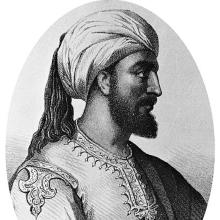
also known asAbd al-Rahman ibn Mu'awiya ibn Hisham ibn Abd al-Malik; al-Dakhil; Saqr Quraish; Falcon of Andalus; Abd ar-Rahman I; Abdul Rahman I; Abdar Rahman I; Abderraman I
Abd al-Rahman I was an Umayyad prince who survived the Abbasid overthrow of his family, reached al-Andalus, and founded the independent Emirate of Córdoba in 756. He ruled until 788, consolidating Umayyad power, resisting internal revolts and external intervention, and beginning the Great Mosque of Córdoba.
Background
Ethnicity:
He was an Arab prince of the Umayyad dynasty. His mother, Ra'ha, was associated with the Nafza Berber tribe.
Abd al-Rahman I was born near Damascus in 731 to the Umayyad prince Mu'awiya ibn Hisham and Ra'ha, a woman associated with the Nafza Berber tribe. He was the grandson of Hisham ibn Abd al-Malik, who had been caliph of the Umayyad Caliphate from 724 to 743.
In 750, the Abbasid Revolution overthrew the Umayyad caliphate in Damascus and brought a widespread purge of the Umayyad family. Abd al-Rahman escaped, traveled through North Africa, and found support among Berber connections before seeking a base in al-Andalus. His survival made him one of the few Umayyad princes able to re-establish dynastic rule outside the Abbasid-controlled eastern Islamic world.
Career
Abd al-Rahman I became the first independent emir of Córdoba and ruled al-Andalus from 756 until his death in 788. After landing at Almuñécar in 755, he gathered support among Syrian military settlers and other groups opposed to Yusuf ibn Abd al-Rahman al-Fihri, the governor of al-Andalus. He defeated Yusuf at the Battle of al-Musara and entered Córdoba in May 756, where he was proclaimed emir.
His rule created an independent Umayyad government in the Iberian Peninsula while he continued to recognize the religious authority of the wider Islamic world rather than claim the title of caliph. Córdoba became the political center of his emirate, and Umayyad administrators, Syrian military supporters, and local forces were incorporated into the new order.
Abd al-Rahman faced repeated revolts by Arab factions, Berber leaders, and regional opponents. The revolt led by the Berber chief Shakya lasted from 768 to 776, while other rebellions received support from Abbasid interests. In 778, a coalition of dissatisfied Arab leaders appealed to Charlemagne, whose army besieged Zaragoza before withdrawing; part of the Frankish force was defeated at Roncesvalles.
During the last years of his reign, Abd al-Rahman sponsored the original Great Mosque of Córdoba. Construction began around 785 or 786 on the site of the former Church of Saint Vincent, creating a major congregational mosque and a visible monument to the independent Cordoban emirate. He died in Córdoba on September 30, 788, and was succeeded by his son Hisham I.
Achievements
Abd al-Rahman I survived the Abbasid destruction of the Umayyad ruling house and established an independent Umayyad emirate in al-Andalus, creating the political foundation for the Umayyad dynasty of Córdoba.
He consolidated authority in al-Andalus through military victories, negotiated alliances, the incorporation of Syrian supporters, and forceful suppression of repeated Arab, Berber, and regional revolts.
He began the construction of the Great Mosque of Córdoba around 785 or 786, establishing one of the principal monuments of the later Islamic civilization of al-Andalus.
Religion
Abd al-Rahman I was a Muslim ruler who established an independent Umayyad emirate in al-Andalus. His reign belonged to the early Islamic political and religious order of medieval Iberia, where Muslim institutions developed alongside established Christian communities and Jewish communities.
His government permitted Christians and Jews to retain their religious communities while requiring the tribute traditionally imposed on non-Muslim subjects. The policy reflected the protected but subordinate status assigned to non-Muslim monotheists under Islamic rule. His foundation of the Great Mosque of Córdoba in the final years of his reign also joined religious patronage with the public representation of Umayyad authority.
Personality
He was described in historical accounts as skilled in oratory and poetry as well as in military affairs. Physical descriptions associated with him portray him as blond and blind in one eye.
Physical Characteristics:
Historical descriptions portray him as blond, habitually dressed in white, and blind in one eye.
Connections
Abd al-Rahman was the son of the Umayyad prince Mu'awiya ibn Hisham and Ra'ha, a woman associated with the Nafza Berber tribe. He was the grandson of the Umayyad caliph Hisham ibn Abd al-Malik.
He was married to Hulal and had several sons, including Hisham I, who succeeded him as emir of Córdoba, as well as Omar, Sulayman, and Abdallah.
Father:
Mu'awiya ibn Hisham
Umayyad prince and the father of Abd al-Rahman I.
Mother:
Ra'ha
She was associated with the Nafza Berber tribe.
Grandfather:
Hisham ibn Abd al-Malik
Umayyad caliph who ruled from 724 to 743.
Son:
Hisham I
Second Umayyad emir of Córdoba, who ruled from 788 to 796 and succeeded Abd al-Rahman I.
Son:
Omar
He died before 758.
Son:
Sulayman
He lived from approximately 745 to 800.
Son:
Abdallah
Wife:
Hulal
She is traditionally identified as the mother of Hisham I.
Abd al-Rahman I
A biographical reference covering Abd al-Rahman I's escape from the Abbasid revolution, arrival in al-Andalus, establishment of Córdoba as his capital, and rule from 756 to 788.
The History of the Mosque-Cathedral of Córdoba
The official history of the Córdoba monument documents Abd al-Rahman I as the first emir of al-Andalus and identifies the original mosque founded during his reign in 786–788.
Great Mosque of Córdoba
An institutional reference on the Great Mosque of Córdoba that identifies Abd al-Rahman I as its principal early patron and places its foundation in the period of the Umayyad emirate.