Background
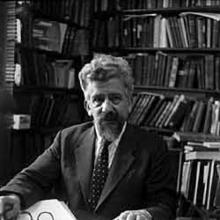
Abraham Joshua Heschel was born in 1907 in Warsaw, Poland to a distinguished Hasidic family.


http://www.amazon.com/gp/product/0374529752/?tag=2022091-20

http://www.amazon.com/gp/product/0374513317/?tag=2022091-20

http://www.amazon.com/gp/product/0824505425/?tag=2022091-20

http://www.amazon.com/gp/product/0374513287/?tag=2022091-20

http://www.amazon.com/gp/product/0060936991/?tag=2022091-20

http://www.amazon.com/gp/product/0943358485/?tag=2022091-20

http://www.amazon.com/gp/product/1879045419/?tag=2022091-20
Abraham Joshua Heschel was born in 1907 in Warsaw, Poland to a distinguished Hasidic family.
He moved to Berlin for a modern education, attending the Institute (Hochschule) for Jewish Studies and studying philosophy at the university. He taught Talmud at the institute and in 1937, succeeded Marlin Buber in the Central Organization for Jewish Adult Education.
1932-1933, Instructor, Hochschule für die Wissenschaft des Judentums: 1937, Director, Jewish Adult Education. Frankfurt; 1938-1939, Lecturer. Philosophical Institution for Judaistic Studies, Warsaw.
1940, Founder, Institute for Jewish Learning, London. 1940-1944, Instructor and Associate Professor in Rabbinics, Hebrew Union College. Cincinnati; 1943-1972, Associate Professor, and then Professor, of Jewish Ethics and Mysticism.
Jewish Theological Seminary of America. 1961-1965, Visiting Professor of Theology. Universities of Iowa, Minnesota and Union Theological Seminary.
Fellow or member of various learned bodies.
He was deeply influenced by western thought, especially Neo-Kantianism, but insisted that Jewish thought cannot be simply fitted into philosophical categories and that God is more than a postulate of reason. Judaism, he believed, teaches a living relationship between man and God and true Jewish observance is expressed when God’s concern for His creatures evokes, in man, a response of love and devotion. The experience of wonder is crucial to true religious expression, leading to an awareness of the grandeur of God.
In the last decades of his life, he was deeply involved in various public issues which gave him a high profile and evoked great admiration, especially among the younger generation. Active in interfaith understanding, he visited Rome during the Second Vatican Council for meetings with Cardinal Agostino Bea, in connection with the formulation of the document of Catholic relations with the Jews. His social-ethical teachings found practical expression in his involvement with the civil rights movement. He marched with Martin Luther King, Jr., and participated in protest marches and demonstrations to secure equal rights for U.S. blacks and to end the U.S. military intervention in Vietnam.
Heschel stressed the holiness of time in Jewish thought and practice. Judaism, he noted, has not created holy places, and unlike modern technological civilizations does not emphasize space, but hallows times, notably the Sabbath and festivals.
His writings are aphoristic, poetic, and sensitive. His theological works include "Man Is Not Alone" and "Who Is Man?" (a defense of human dignity). "The Prophets" (based on his doctoral thesis) seeks to analyze the prophetic consciousness. "The Sabbath" is a paean to the Sabbath day, while "The Earth Is the Lord’s" is a poignant evocation of the lost world of east European Jewry. The broadness of his interests is illustrated by his two books on great Jewish thinkers: the rationalist Maimonidesand his last work on the Hasidic teacher, Menahem Mendel of Kotsk.
Member American Philos.
Married Sylvia Straus.