Background
Legendre was born on September 18, 1752, in Paris, to a wealthy family.

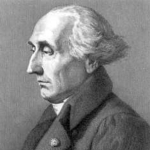
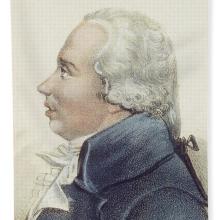
Side view sketching of French politician Louis Legendre (1752-1797), whose portrait has been mistakenly used, for nearly 200 years, to represent French mathematician Adrien-Marie Legendre, i.e. up until 2005 when the mistake was discovered

Legendre studied in Paris at the collége Mazarin (also called Collége des Quarte-Nations). He received an education in science, especially mathematics, that was unusually advanced for Paris schools in the eighteenth century. His mathematics teacher was the Abbé Joseph-Francois Marie, a mathematician of some renown and well-regarded at court. In 1770, at the age of eighteen, Legendre defended his theses in mathematics and physics at the Collége Mazarin. In 1774 he utilized several of his essays in a treatise on mechanics.
Legendre studied in Paris at the collége Mazarin (also called Collége des Quarte-Nations). He received an education in science, especially mathematics, that was unusually advanced for Paris schools in the eighteenth century. His mathematics teacher was the Abbé Joseph-Francois Marie, a mathematician of some renown and well-regarded at court. In 1770, at the age of eighteen, Legendre defended his theses in mathematics and physics at the Collége Mazarin. In 1774 he utilized several of his essays in a treatise on mechanics.

https://www.amazon.com/Elements-geometry-Adrien-Marie-Legendre-ebook/dp/B07NP7GVMR/ref=sr_1_2?keywords=Adrien-Marie+Legendre&qid=1582457304&sr=8-2
1794

(French Edition)
French Edition
https://www.amazon.com/Th%C3%A9orie-Nombres-Cambridge-Library-Collection/dp/1108001734/ref=sr_1_6?keywords=Adrien-Marie+Legendre&qid=1582457304&sr=8-6
1798
Legendre was born on September 18, 1752, in Paris, to a wealthy family.
Legendre studied in Paris at the collége Mazarin (also called Collége des Quarte-Nations). He received an education in science, especially mathematics, that was unusually advanced for Paris schools in the eighteenth century. His mathematics teacher was the Abbé Joseph-Francois Marie, a mathematician of some renown and well-regarded at court. In 1770, at the age of eighteen, Legendre defended his theses in mathematics and physics at the Collége Mazarin. In 1774 he utilized several of his essays in a treatise on mechanics.
Legendre’s modest fortune was sufficient to allow him to devote himself entirely to research. Nevertheless he taught mathematics at the École Militaire in Paris from 1775 to 1780.
In 1782 Legendre won the prize of the Berlin Academy. The subject of its competition that year concerned exterior ballistics; “Determine the curve described by cannonballs and bombs, taking into consideration the resistance of the air; give rules for obtaining the ranges corresponding to different initial velocities and to different angles of projection.” His essay, which was published in Berlin, attracted the attention of Lagrange, who asked Laplace for information about the young author. A few years later the Abbé Marie and Legendre arranged for Lagrange’s Mécanique analytique (Paris, 1788) to be published and saw it through the press.
Meanwhile, Legendre sought to make himself better known in French scientific circles, particularly at the Académie des Sciences. He conducted research on the mutual attractions of planetary spheroids and on their equilibrium forms. In January 1783 he read a memoir on this problem before the Academy; it was published in the Recueil des savants étrangers (1785). He also submitted to Laplace essays on second-degree indeterminate equations, on the properties of continued fractions, on probabilities, and on the rotation of bodies subject to no accelerating force. As a result, on 30 March 1783 he was elected to the Academy as an adjoint mécanicien, replacing Laplace, who had been promoted to associé.
Legendre’s scientific output continued to grow. In July 1784 he read before the Academy his “Recherches sur la figure des planétes” Upon the publication of this memoir, he recalled that Laplace had utilized his works in a study published in the Mémories de l’Académie des sciences for 1782 (published in 1784) but written after his own.
In 1786 Legendre presented a study on the manner of distinguishing maxima from minima in the calculus of variations. The “Legendre conditions” set forth in this paper later gave rise to an extensive literature. Legendre next published, in the Mémoires de l’académie for 1786, two important works on integrations by elliptic arcs and on the comparison of these arcs; here can be found the rudiments of his theory of elliptic functions.
In the works cited above, Legendre had marked off his favorite areas of research: celestial mechanics, number theory, and the theory of elliptic functions. Although he did take up other problems in the course of his life, he always returned to these subjects.
Legendre’s career at the Academy proceeded without any setbacks. On the reorganization of the mechanics section he was promoted to associé (1785). In 1787, along with Cassini IV and Méchain, he was assigned by the Academy to the geodetic operations undertaken jointly by the Paris and Greenwich observatories. On this occasion he became a fellow of the Royal Society. His work on this project found expression in the “Mámore sur les opérations trigonométriques dont les résultats dépendent de la figure de la terre.”
In 1789 and 1790 Legendre presented his “Mémoire sur les intégrales doubles,” in which he completed his analysis of the attraction of spheroids ; a study of the case of heterogeneous spheroids; and some investigations of the particular integrals of differential equations.
In April 1792 Legendre read before the Academy an important study on elliptic transcendentals, a more systematic account of material presented in his first works on the question, dating from 1786. The academies were suppressed in August 1793; consequently he published this study himself, toward the end of the same year, in a quarto volume of more than a hundred pages.
On 13 April 1791 Legendre had been named one of the Academy’s three commissioners for the astronomical operations and triangulations necessary for determining the standard meter. His colleagues were Méchain and Cassini IV, who four years earlier had participated with him in the geodetic linking of the Paris and Greenwich meridians. During 1794 he was head of the first office of the National Executive Commission of Public Instruction (the second section, Sciences and Letters). He had eight employees under him and was expected to concern himself with weights and measures, inventions and discoveries, and the encouragement of science.
A tireless worker, during this same period Legendre published his Éléments de géométrie. This textbook was to dominate elementary instruction in the subject for almost a century. On 20 October 1793 the Committee of Public Instruction, of which Legendre soon became senior clerk, commissioned him and Lagrange to write a book entitled Éléments de calcul et de géométric.
Legendre succeed Laplace, in 1799, as examiner in mathematics of the graduating students assigned to the artillery. He held this position until 1815, when he voluntarily resigned and was replaced by Prony. He was granted a pension of 3,000 francs, equal to half his salary. He lost it in 1824 following his refusal to vote for the official candidate in an election for a seat in the Institute.
Legendre was not one of the forty-eight scholars selected in August 1795 to form the nucleus of the Institut National, but on 13 December he was elected a resident member in the mathematics section. In 1808, upon the creation of the University, he was named a conseiller titulaire. A member of the Legion of Honor, he also obtained the title of Chevalier de l’Empire - a minor honor compared with the title of count bestowed on his colleagues Lagrange, Laplace, and Monge. When Lagrange died in 1813, Legendre replaced him at the Bureau des Longitudes, where he remained for the rest of his life.
Legendre died on 9 January 1833, following a painful illness. His health had been failing for several years. His wife, who died in December 1856, made a cult of his memory and until her death displayed a naïve, religious respect for everything that had belonged to him. She left to the village of Auteuil (now part of Paris) the last country house in which they had lived. They had no children.
Legendre remains a marvelous calculator, a skillful analyst, and, in sum, a good mathematician. In both the theory of elliptic functions and number theory he raised questions that were fruitful subjects of investigation for mathematicians of the nineteenth century. Well-known and important concepts such as the Legendre polynomials and Legendre transformation are named after him.
(French Edition)
1798Legendre did an impressive amount of work on elliptic functions, including the classification of elliptic integrals, but it took Abel's stroke of genius to study the inverses of Jacobi's functions and solve the problem completely.
He is known for the Legendre transformation, which is used to go from the Lagrangian to the Hamiltonian formulation of classical mechanics. In thermodynamics it is also used to obtain the enthalpy and the Helmholtz and Gibbs (free) energies from the internal energy. He is also the namesake of the Legendre polynomials, solutions to Legendre's differential equation, which occur frequently in physics and engineering applications, e.g. electrostatics.
In 1793 Legendre married Marguerite-Claudine Couhin, who helped him put his affairs in order.