

Background
Dundes, Alan was born on September 8, 1934 in New York City. Son of Maurice and Helen (Rothschild) Dundes.

http://www.amazon.com/gp/product/B011SIZR3W/?tag=2022091-20

(CLOTH WITH DUSTWRAPPER)
CLOTH WITH DUSTWRAPPER
http://www.amazon.com/gp/product/B000UDX5F4/?tag=2022091-20

(An interpretation of the Palio of Siena. This study is "n...)
An interpretation of the Palio of Siena. This study is "nothing less than an expression of the soul of the city, endlessly rich in symbolism, metaphor, and life..."
http://www.amazon.com/gp/product/0520047710/?tag=2022091-20
http://www.amazon.com/gp/product/B007SLUPIG/?tag=2022091-20

(With great reverence for the Bible, Dundes offers a new a...)
With great reverence for the Bible, Dundes offers a new and exciting way to resolve some of the mysteries and contradictions that evolved during the Bible's prewritten legacy and that persists today. Using his expert knowledge of folklore, Dundes unearths and contracts multiple versions of nearly every major biblical event, including the creation of women, the flood, the ten commandments, the Sermon on the Mount, the Lord's Prayer, and the inscription on the Cross.
http://www.amazon.com/gp/product/0847691985/?tag=2022091-20

(Dundes offers a new and exciting way to resolve some of t...)
Dundes offers a new and exciting way to resolve some of the mysteries and contradictions that evolved during the Bible's prewritten legacy and that persist today. He unearths and contrasts multiple versions of nearly every major biblical event, including the creation of woman, the flood, the ten commandments, the Sermon on the Mount, the Lord's Prayer, and the inscription on the Cross.
http://www.amazon.com/gp/product/B00FGW2X16/?tag=2022091-20

( Bloody Mary in the Mirror mixes Sigmund Freud with vam...)
Bloody Mary in the Mirror mixes Sigmund Freud with vampires and The Little Mermaid to see what new light psychoanalysis can bring to folklore techniques and forms. Ever since Freud published his analysis of Jewish jokes in 1905 and his disciple Otto Rank followed with his groundbreaking The Myth of the Birth of the Hero in 1909, the psychoanalytic study of folklore has been an acknowledged part of applied psychoanalysis. However, psychoanalysts, handicapped by their limited knowledge of folklore techniques, have tended to confine their efforts to the Bible, to classical mythology, and to the Grimm fairy tales. Most folklorists have been slow to consider psychoanalysis as a method of interpreting folklore. One notable exception is folklorist Alan Dundes. In the seven fascinating essays of Bloody Mary in the Mirror, psychoanalytic theory illuminates such folklore genres as legend (in the vampire tale), folktale (in the ancient Egyptian tale of two brothers), custom (in fraternity hazing and ritual fasting), and games (in the modern Greek game of "Long Donkey"). One of two essays Dundes co-authored with his daughter Lauren Dundes, professor of sociology at Western Maryland College, successfully probes the content of Disney's The Little Mermaid, yielding new insights into this popular reworking of a Hans Christian Andersen favorite. Among folk rituals investigated is the girl's game of "Bloody Mary." Elementary or middle school-age girls huddle in a darkened bathroom awaiting the appearance in the mirror of a frightening apparition. The plausible analysis of this well-known--if somewhat puzzling--American rite is one of many surprising and enlightening finds in this book. All of the essays in this remarkable volume create new takes on old traditions. Bloody Mary in the Mirror is an expedition into psychoanalytic folklore techniques and constitutes a giant step towards realizing the potential Freud's work promises for folklore studies. Alan Dundes is professor of anthropology and folklore at the University of California, Berkeley. Among many others, his books include Interpreting Folklore (1980) and From Game to War and Other Psychoanalytic Essays on Folklore (1997). He edited Mother Wit from the Laughing Barrel: Readings in the Interpretation of Afro-American Folklore (1991), which was published by University Press of Mississippi.
http://www.amazon.com/gp/product/1578064619/?tag=2022091-20
( The evil eye—the power to inflict illness, damage to pr...)
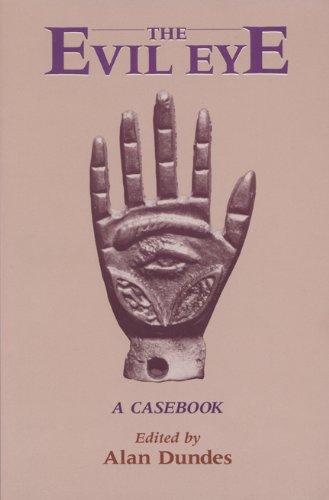
The evil eye—the power to inflict illness, damage to property, or even death simply by gazing at or praising someone—is among the most pervasive and powerful folk beliefs in the Indo-European and Semitic world. It is also one of the oldest, judging from its appearance in the Bible and in Sumerian texts five thousand years old. Remnants of the superstition persist today when we drink toasts, tip waiters, and bless sneezers. To avert the evil eye, Muslim women wear veils, baseball players avoid mentioning a no-hitter in progress, and traditional Jews say their business or health is "not bad" (rather than "good"). Though by no means universal, the evil eye continues to be a major factor in the behavior of millions of people living in the Mediterranean and Arab countries, as well as among immigrants to the Americas. This widespread superstition has attracted the attention of many scholars, and the twenty-one essays gathered in this book represent research from diverse perspectives: anthropology, classics, folklore studies, ophthalmology, psychiatry, psychoanalysis, sociology, and religious studies. Some essays are fascinating reports of beliefs about the evil eye, from India and Iran to Scotland and Slovak-American communities; others analyze the origin, function, and cultural significance of this folk belief from ancient times to the present day. Editor Alan Dundes concludes the volume by proffering a comprehensive theoretical explanation of the evil eye. Anyone who has ever knocked on wood to ward off misfortune will enjoy this generous sampling of evil eye scholarship, and may never see the world through the same eyes again.
http://www.amazon.com/gp/product/0299133346/?tag=2022091-20

http://www.amazon.com/gp/product/902793231X/?tag=2022091-20

(Office copier folklore-those tattered sheets of cartoons,...)
Office copier folklore-those tattered sheets of cartoons, mottoes, zany poems, defiant sayings, parodies, and crude jokes that regularly circulate in office buildings everywhere-is the subject of this innovative study. this type of folklore represents a major form of tradition in modern America, and the authors have compiled this raw data for scholarship-and entertainment. These creations of the Paperwork Empire comment on topics and problems that concern all urban Americans. No one and nothing escapes their raunchy wit and sarcasm. Bosses, ethnic groups, minorities, the sexes, alternative lifestyles, politics, welfare, government workers, the law, bureaucracy, and even "The Night Before Christmas" all come under fire to form a biting, and hilarious, commentary on modern American society.
http://www.amazon.com/gp/product/0814318673/?tag=2022091-20

(First Published in 1982. Routledge is an imprint of Taylo...)
First Published in 1982. Routledge is an imprint of Taylor & Francis, an informa company.
http://www.amazon.com/gp/product/0824092953/?tag=2022091-20

(This book focuses on the topic of 'circumventing custom' ...)
This book focuses on the topic of 'circumventing custom' with special emphasis on the ingenious ways Orthodox (and other) Jews have devised to avoid breaking the extensive list of activities forbidden on the Sabbath. After examining the sources of Sabbath observance as set forth in the Old Testament, the New Testament, and rabbinical writings, some of the most salient forms of circumvention are described. Then drawing on Freud's insights as to the obsessive nature of religious ritual and his persuasive delineation of anal erotic character, an attempt is made to analyze such facets of Jewish character (in addition to circumvention) as an undue concern with purity, and a long-established tradition of indulging in nit-picking and argumentation.
http://www.amazon.com/gp/product/0742516717/?tag=2022091-20

http://www.amazon.com/gp/product/B00JHWNBXK/?tag=2022091-20

http://www.amazon.com/gp/product/B011SIW57I/?tag=2022091-20

http://www.amazon.com/gp/product/B010EUZNZW/?tag=2022091-20
http://www.amazon.com/gp/product/0231054947/?tag=2022091-20

(A dozen essays reprinted in this volume from various prof...)
A dozen essays reprinted in this volume from various professional periodicals and books, the author is a leading folklorist, he shows some theories and methods that might be applied. After redefining the narrow definition of folk as illiterate peasants, he tries to show the importance of collecting folklore and of the folks own interpretation of their folklore and the rules of folklore usage.
http://www.amazon.com/gp/product/B001JQAIH4/?tag=2022091-20

( Alan Dundes continues his exploration of well-loved fai...)
Alan Dundes continues his exploration of well-loved fairy tales with this casebook on one of the best-known of them all: Little Red Riding Hood. Following versions of the tale by Perrault and the Brothers Grimm, the essays by an international group of scholars provide an impressive cross-section of theoretical approaches.
http://www.amazon.com/gp/product/0299120341/?tag=2022091-20

(Life Is Like a Chicken Coop Ladder was first published in...)
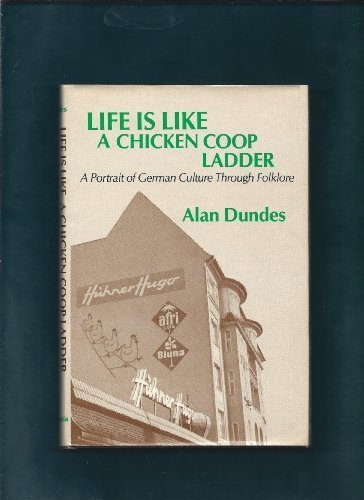
Life Is Like a Chicken Coop Ladder was first published in 1984 and from the outset inspired a wide variety of reactions ranging from high praise to utter disgust. Alan Dundes' theses identifies a strong anal erotic element in German national character, citing numerous examples of scatological data from authentic compilations of German folklore. The examination of this single trait of German character is used to demonstrate that national character exists and that its existence is unambiguously documented by the folklore of a nation. Dundes is of the opinion that the use of folkloristic data minimizes subjective bias in the study of national character, since unedited or uncensored, it constitutes a unique way of looking at a culture from the inside-out rather than from the outside-in, the more typical situation of an outside observer trying to understand a foreign culture.
http://www.amazon.com/gp/product/0814320384/?tag=2022091-20

http://www.amazon.com/gp/product/B010EWENFQ/?tag=2022091-20
(Vampires are the most fearsome and fascinating of all cre...)
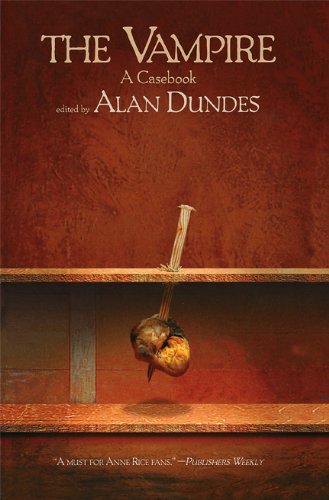
Vampires are the most fearsome and fascinating of all creatures of folklore. For the first time, detailed accounts of the vampire and how its tradition developed in different cultures are gathered in one volume by eminent folklorist Alan Dundes. Eleven leading scholars from the fields of Slavic studies, history, anthropology, and psychiatry unearth the true nature of the vampire from its birth in graveyard lore to the modern-day psychiatric patient with a penchant for drinking blood. The Vampire: A Casebook takes this legend out of the realm of literature and film and back to its dark beginnings in folk traditions. The essays examine the history of the word 'vampire' Romanian vampires; Greek vampires; Serbian vampires; the physical attributes of vampires; the killing of vampires; and the possible psychoanalytic underpinnings of vampires. Much more than simply a scary creature of the human imagination, the vampire has been and continues to haunt the lives of all those who encounter it-in reality or in fiction.
http://www.amazon.com/gp/product/0299159248/?tag=2022091-20

http://www.amazon.com/gp/product/B00XTAYTC8/?tag=2022091-20

(Anyone who has ever filled in a form in triplicate, taken...)
Anyone who has ever filled in a form in triplicate, taken an aptitude test, or been rebuffed by a form letter will appreciate the urban folklore found in this collection. Urban people as a folk are bound together by their unhappy experiences in battling "the system," whether that system is the machinery of government or the office where one works. The wonderfully expressive materials in this book-chain letters, memoranda, notices, and cartoons-touch upon every major controversy of urban America: racism, sex, politics, automation, alienation, welfare, the women's movement, military mentality, and office bureaucracy. The humor of the materials pinpoints the ills and frustrations of modern society and becomes, in turn, an escape from them.
http://www.amazon.com/gp/product/0814324320/?tag=2022091-20
http://www.amazon.com/gp/product/0138589445/?tag=2022091-20

(Will be shipped from US. Used books may not include compa...)
Will be shipped from US. Used books may not include companion materials, may have some shelf wear, may contain highlighting/notes, may not include CDs or access codes. 100% money back guarantee.
http://www.amazon.com/gp/product/B011MDLGPQ/?tag=2022091-20
http://www.amazon.com/gp/product/B00A9Z3UP8/?tag=2022091-20

http://www.amazon.com/gp/product/B013J96GKQ/?tag=2022091-20

http://www.amazon.com/gp/product/0132928051/?tag=2022091-20
http://www.amazon.com/gp/product/B0086HUIVU/?tag=2022091-20

http://www.amazon.com/gp/product/B00JHWMYLK/?tag=2022091-20
http://www.amazon.com/gp/product/B011824N1A/?tag=2022091-20

(new edition with a further illustrative plates by Gini Lu...)
new edition with a further illustrative plates by Gini Lusini
http://www.amazon.com/gp/product/8871450671/?tag=2022091-20

(new edition)
new edition
http://www.amazon.com/gp/product/B00ZVP3FAQ/?tag=2022091-20
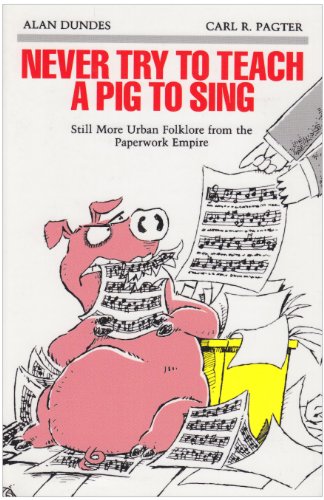
( Never Try to Teach a Pig to Sing documents the thriving...)
Never Try to Teach a Pig to Sing documents the thriving folklore tradition that circulates in the workplace. Alan Dundes and Carl Pagter have collected more than two hundred and fifty "signs of the times"-the office memoranda, parodies, cartoons, and poems that daily make their way through copy machines, interoffice mail systems, and fax machines and are affixed to bulletin boards and water coolers. The rich vein of urban folklore tapped by this imaginative volume constitutes a great testament to one of the world's most prolific authors-anonymous. The popularity of the items featured in this timely book is apparent by their reproduction in mass or popular cultural form-as greeting cards, plaques, and bumper stickers-reminding us of the inevitable interplay between folklore and mass culture. Dundes and Pagter clearly demonstrate the existence of folklore in the modern urban technological world and refute the notion that folklore reflects only the past.
http://www.amazon.com/gp/product/0814323588/?tag=2022091-20

(Siena, 1994; br., pp. 256, ill., cm 16,5x24.)
Siena, 1994; br., pp. 256, ill., cm 16,5x24.
http://www.amazon.com/gp/product/8871450485/?tag=2022091-20
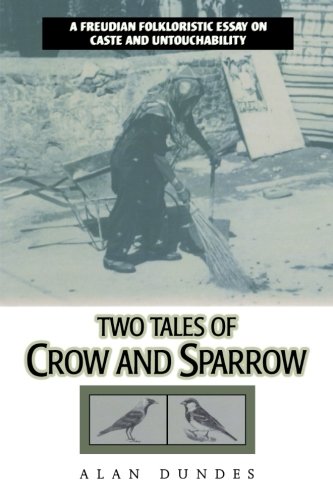
(This provocative book by a leading folklorist offers a ne...)
This provocative book by a leading folklorist offers a new analysis of caste in India, focusing on the rationale underlying the customs surrounding untouchability. Drawing on clues contained in two fascinating folktales, Alan Dundes goes beyond Dumont's classic Homo Hierarchicus in deconstructing the pervasive pollution complex that prevents millions of individuals from entering temples or drawing water from community wells. His graceful and erudite explanation of caste also illuminates the mysterious worship of the sacred cow as well as sati/suttee, or widow burning. The author concludes by relating caste to the theory of marginal survival, drawing on Gypsy concepts of pollution. This controversial book offers a fresh perspective for anyone interested in India, folklore, and psychoanlytic anthropology_a detailed case study documenting how folklore, as a source of native categories and symbols, can yield unique insights into the unconscious functioning of a culture through time. In this comprehensive textbook, renowned philosopher J. N. Mohanty examines the range of Indian philosophy from the Sutra period through the 17th century Navya Nyaya. Classical Indian Philosophy is divided into three parts that cover epistemology, metaphysics, and the attempt to transcend the distinction between subject and object. Mohanty focuses on the major concepts and problems dealt with in Indian philosophy, including ethics, social philosophy, law, and aesthetics. Students of Indian philosophy at every level will find this a rich and rewarding text.
http://www.amazon.com/gp/product/0847684571/?tag=2022091-20

(A casebook of interpretations of the ballad The Walled-Up...)
A casebook of interpretations of the ballad The Walled-Up Wife. Some contributors offer competing nationalistic claims concerning the ballad's origins, Ruth Mandel examines gender and power issues in the ballad, and Lyubomira Parpulova-Gribble presents a structuralist interpretation.
http://www.amazon.com/gp/product/0299150747/?tag=2022091-20
( "... Dundes has produced a work which will be useful to...)
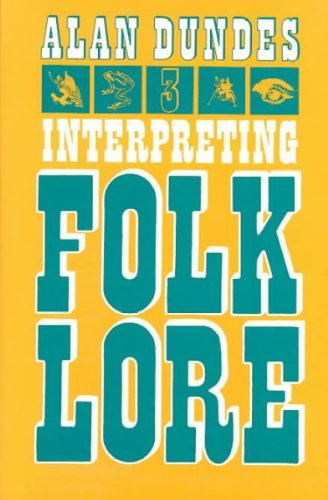
"... Dundes has produced a work which will be useful to both students and teachers who wish to broaden their understanding of modern folklore." ―Center for Southern Folklore Magazine "It is impossible ever to remain unimpressed with Dundes’ excursuses, however much one may be in disagreement (or not) with his conclusions." ―Forum for Modern Language Studies Often controversial, Alan Dundes’s scholarship is always provocative, perceptive, and intelligent. His concern here is to assess the material folklorists have so painstakingly amassed and classified, to interpret folklore, and to use folklore to increase our understanding of human nature and culture.
http://www.amazon.com/gp/product/025320240X/?tag=2022091-20

(This is a collection of Xerox lore and humour circulating...)
This is a collection of Xerox lore and humour circulating widely in today's workplace. Have you seen anytime recently the "High School Math Test", or "Varying Interpretations of a Basic Philosophical Principle", or "Why God Never Received Tenure". Well, it's all here and much more. The book features humorous commentaries - cartoons, mottoes, zany poems, defiant sayings, parodies, funny faxes, ethnic slurs, and crude jokes - on all of the issues and problems facing the modern world. No one and nothing escapes their raunchy wit and sarcasm. The creation and dissemination of the "photocopylore" in this volume have been greatly stimulated and facilitated by the advent of E-Mail and the FAX machine. Increased use of home computers, scanners, clip art, and CD-ROMs have provided individuals with the ability to generate graphic materials often beyond their normal technical capacity and skills. The collected materials in "Sometimes the Dragon Wins" emphatically prove that the rise of science and technology, rather than precipitating the demise of folklore in the modern world, has actually spawned a new generation of folklore - FAX, copier and computer humour.
http://www.amazon.com/gp/product/0815603711/?tag=2022091-20
( In these stimulating essays, Alan Dundes presents a his...)
In these stimulating essays, Alan Dundes presents a history of psychoanalytic studies of folklore while also showing how folklore methodology can be used to clarify and validate psychoanalytic theory. Dundes’ work is unique in its symbolic analysis of the ordinary imagination. His data are children’s games, folktales, everyday speech, cultural metaphors for power and prestige, and rituals associated with childbirth.
http://www.amazon.com/gp/product/0299112640/?tag=2022091-20
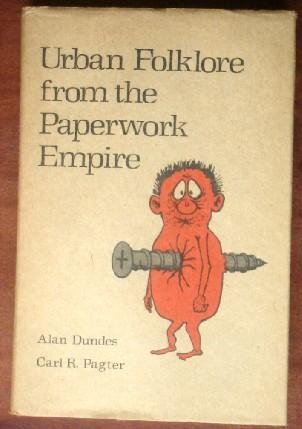
(Anyone who has ever been rebuffed by a form letter will a...)
Anyone who has ever been rebuffed by a form letter will appreciate the urban folklore--chain letters, memoranda, notices and cartoons,--found in this collection.
http://www.amazon.com/gp/product/B000RO6B3E/?tag=2022091-20
Dundes, Alan was born on September 8, 1934 in New York City. Son of Maurice and Helen (Rothschild) Dundes.
Bachelor, Yale University, 1955. Master of Arts in Teaching., Yale University, 1958. Doctor of Philosophy, Indiana University, 1962.
Instructor English, U. Kansas, 1962-1963; assistant professor anthropology, University of California, Berkeley, 1963-1965; associate professor, University of California, Berkeley, 1965-1968; professor anthropology and folklore, University of California, Berkeley, since 1968.
(Office copier folklore-those tattered sheets of cartoons,...)
(This book focuses on the topic of 'circumventing custom' ...)
( The evil eye—the power to inflict illness, damage to pr...)
( In these stimulating essays, Alan Dundes presents a his...)
( In these stimulating essays, Alan Dundes presents a his...)
(With great reverence for the Bible, Dundes offers a new a...)
(A dozen essays reprinted in this volume from various prof...)
(Anyone who has ever filled in a form in triplicate, taken...)
(Anyone who has ever filled in a form in triplicate, taken...)
(Although folklore has been collected for centuries, its p...)
( Bloody Mary in the Mirror mixes Sigmund Freud with vam...)
(This provocative book by a leading folklorist offers a ne...)
(Dundes offers a new and exciting way to resolve some of t...)
(Life Is Like a Chicken Coop Ladder was first published in...)
(Anyone who has ever been rebuffed by a form letter will a...)
( The 30th Anniversary Edition is a candid academic treat...)
( Alan Dundes continues his exploration of well-loved fai...)
( Alan Dundes, in this casebook of an anti-Semitic legend...)
( Never Try to Teach a Pig to Sing documents the thriving...)
(This is a collection of Xerox lore and humour circulating...)
(Vampires are the most fearsome and fascinating of all cre...)
(A casebook of interpretations of the ballad The Walled-Up...)
(new edition with a further illustrative plates by Gini Lu...)
(Seven ways in which psychoanalysis illuminates folklore)
(An interpretation of the Palio of Siena. This study is "n...)
(First Published in 1982. Routledge is an imprint of Taylo...)
(Will be shipped from US. Used books may not include compa...)
(Will be shipped from US. Used books may not include compa...)
(CLOTH WITH DUSTWRAPPER)
(Book by Dundes, Alan)
(Siena, 1994; br., pp. 256, ill., cm 16,5x24.)
(new edition)
( "... Dundes has produced a work which will be useful to...)
With United States Naval Reserve, 1955-1957. Member American Association for the Advancement of Science, American Folklore Society (president 1980), Fellows of the American Folklore Society (president) California Folklore Society, International Society Folk Narrative Research.
Son of Maurice and Helen (Rothschild) D. M. Carolyn M. Browne, September 8, 1958. Children: Alison, Lauren, David.
