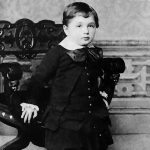
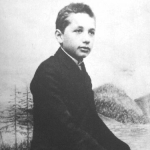
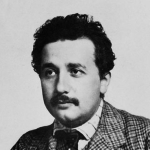
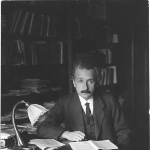
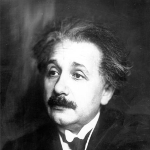
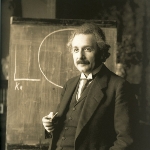
From 1887 to 1895 Albert Einstein studied at Albert Einstein Gymnasium.
Gallery of Albert Einstein
Lautererstraße 2, 81545 München, Germany
At the age of 8, Albert Einstein was transferred to the Luitpold Gymnasium (now known as the Albert Einstein Gymnasium), where he received advanced primary and secondary school education.
College/University
Gallery of Albert Einstein
Albert Einstein
Gallery of Albert Einstein
Albert Einstein
Career
Gallery of Albert Einstein
1920
Berlin, Germany
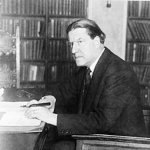
Einstein at his office, University of Berlin.
Gallery of Albert Einstein
1921
Vienna, Budapest
Albert Einstein during a lecture
Gallery of Albert Einstein
Albert Einstein
Gallery of Albert Einstein
Bern, Switzerland
From 1902 to 1909 Albert was a clerk at the Swiss Federal Office for Intellectual Property.
Gallery of Albert Einstein
1904
Albert Einstein
Gallery of Albert Einstein
Zurich, Switzerland
From 1912 to 1914 Albert was a professor of theoretical physics, ETH Zurich.
Gallery of Albert Einstein
1921
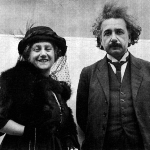
Einstein with his second wife Elsa.
Gallery of Albert Einstein
1921
New York City, New York, United States
Albert Einstein with his wife Elsa Einstein and Zionist leaders, including future President of Israel Chaim Weizmann, his wife Vera Weizmann, Menahem Ussishkin, and Ben-Zion Mossinson.
Gallery of Albert Einstein
Leiden, Zuid-Holland, Netherlands
In 1920 Albert was a professor at Leiden University.
Gallery of Albert Einstein
California City, California, United States
From 1931 to 1933 Albert was a professor at California Institute of Technology.
Gallery of Albert Einstein
California City, California, United States
From 1931 to 1933 Albert was a professor at California Institute of Technology.
Gallery of Albert Einstein
1931
California, United State
This heavily retouched photograph shows German-Swiss-American mathematical physicist Albert Einstein as he plays the violin in the music room of the S.S. Belgenland.
Gallery of Albert Einstein
1931
Albert Einstein
Gallery of Albert Einstein
1932
Portrait of physicist Albert Einstein sitting in an armchair and smoking a pipe.
Gallery of Albert Einstein
1933
German-Swiss-American mathematical physicist Albert Einstein
Gallery of Albert Einstein
Oxford, Oxfordshire, United Kingdom
1From 1931 to 1933 Albert was a professor at the University of Oxford.
Gallery of Albert Einstein
1935
Princeton, United States
Portrait of Einstein
Gallery of Albert Einstein
1944
Princeton, New Jersey, United State
Professor Albert Einstein in his home.
Gallery of Albert Einstein
1951
Princeton, New Jersey, United States
Albert Einstein ponders a problem in his paper-filled study.
Gallery of Albert Einstein
Einstein accepting U.S. citizenship certificate from judge Phillip Forman.
Gallery of Albert Einstein
Albert Einstein
Achievements
USSR postage stamp
Membership
Awards
Gold Medal of the Royal Astronomical Society
United States
In 1926 Albert received the Gold Medal of the Royal Astronomical Society.
Nobel Prize in Physics
Sweden
In 1921 Albert received the Nobel Prize in Physics
Albert Einstein with his wife Elsa Einstein and Zionist leaders, including future President of Israel Chaim Weizmann, his wife Vera Weizmann, Menahem Ussishkin, and Ben-Zion Mossinson.
This heavily retouched photograph shows German-Swiss-American mathematical physicist Albert Einstein as he plays the violin in the music room of the S.S. Belgenland.
In 1895, at the age of 16, Einstein took the entrance examinations for the Swiss Federal Polytechnic in Zürich (later the Eidgenössische Technische Hochschule, ETH). He failed to reach the required standard in the general part of the examination. On the advice of the principal, he thereupon first obtained his diploma at the Cantonal School in Aarau, and in 1896, he was automatically admitted into the FIT.
Albert Einstein, at 26, completed the requirements for his doctoral degree at the University of Zurich and wrote the first of his revolutionary scientific papers, "A New Determination of Molecular Dimensions".
Albert Einstein at a session of the International Committee on Intellectual Cooperation (League of Nations) of which he was a member from 1922 to 1932.
At the age of 8, Albert Einstein was transferred to the Luitpold Gymnasium (now known as the Albert Einstein Gymnasium), where he received advanced primary and secondary school education.
Professor Albert Einstein, now exiled from Germany, calmly smokes his pipe. He is in the United States to give a series of lectures to advanced students at Princeton University.
Southern California said good-bye to its most distinguished visitor of the year, when Dr.Albert Einstein, father of the relativity theory departed from Pasadena. With his wife and party the famous scientist will travel to New York in a private car placed at their disposal. Dr. and Mrs.Einstein are here shown waving their farewells to the crowd at the Pasadena Railway Station.
Albert Einstein, also known as the Father of Modern Physics, was a German-born theoretical physicist, who developed the special and general theories of relativity. For its influence on the philosophy of science, Albert Einstein is considered one of the most influential physicists of the 20th century. Einstein's intellectual achievements and originality have made the word "Einstein" synonymous with "genius."
Background
Albert Einstein was born at Ulm, in Württemberg, Germany, on March 14, 1879, to middle-class Jewish parents, Hermann Einstein, a salesman and engineer, and Pauline Koch. Six weeks later the family moved to Munich, where Einstein's father and his uncle Jakob founded a company that manufactured electrical equipment based on direct current.
Einstein always excelled at math and physics from a young age, reaching a mathematical level years ahead of his peers. His passion for geometry and algebra led the twelve-year-old to become convinced that nature could be understood as a "mathematical structure."
Education
Albert attended a Catholic elementary school in Munich from the age of 5, for three years. At the age of 8, he was transferred to the Luitpold Gymnasium (now known as the Albert Einstein Gymnasium), where he received advanced primary and secondary school education.
In 1895, at the age of 16, Einstein took the entrance examinations for the Swiss Federal Polytechnic in Zürich (later the Eidgenössische Technische Hochschule, ETH). He failed to reach the required standard in the general part of the examination. On the advice of the principal, he thereupon first obtained his diploma at the Cantonal School in Aarau.
In 1900, Einstein passed the exams in Maths and Physics and was awarded the Federal Polytechnic teaching diploma. It was in Bern, too, that Einstein, at 26, completed the requirements for his doctoral degree at the University of Zurich and wrote the first of his revolutionary scientific papers, "A New Determination of Molecular Dimensions."
During his career as a scientist, Albert Einstein received a number of honorary degrees from different universities. In 1946, Albert Einstein visited Lincoln University in Pennsylvania, a historically black college, where he was awarded an honorary degree.
In February 1902, Einstein moved to Bern and applied for a job with the Swiss Patent Office. He was given a probationary appointment to begin in June of that year and was promoted to the position of technical expert, third class, a few months later. The seven years Einstein spent at the Patent Office were the most productive years of his life. The demands of his work were relatively modest and he was able to devote a great deal of time to his own research.
In 1905, Einstein published a series of papers, any one of which would have assured his fame in history. One, "On the Movement of Small Particles Suspended in a Stationary Liquid Demanded by the Molecular-Kinetic Theory of Heat," dealt with a phenomenon first observed by the Scottish botanist Robert Brown in 1827. Brown had reported that tiny particles, such as dust particles, move about with a rapid and random zigzag motion when suspended in a liquid.
Einstein hypothesized that the visible motion of particles was caused by the random movement of molecules that make up the liquid. He derived a mathematical formula that predicted the distance travelled by particles and their relative speed. This formula was confirmed experimentally by the French physicist Jean Baptiste Perrin in 1908. Einstein's work on the Brownian movement is generally regarded as the first direct experimental evidence of the existence of molecules.
A second paper, "On a Heuristic Viewpoint Concerning the Production and Transformation of Light," dealt with another puzzle in physics, the photoelectric effect. First observed by Heinrich Hertz in 1888, the photoelectric effect involves the release of electrons from a metal that occurs when light is shined on the metal. The puzzling aspect of the photo-electric effect was that the number of electrons released is not a function of the light's intensity, but of the colour (that is, the wavelength) of the light.
A third 1905 paper by Einstein, almost certainly the one for which he became best known, details his special theory of relativity. In essence, "On the Electrodynamics of Moving Bodies" discusses the relationship between measurements made by observers in two separate systems moving at constant velocity with respect to each other.
Using only these two assumptions, Einstein proceeded to uncover an unexpectedly extensive description of the properties of bodies that are in uniform motion. For example, he showed that the length and mass of an object are dependent upon their movement relative to an observer. He derived a mathematical relationship between the length of an object and its velocity that had previously been suggested by both FitzGerald and Lorentz. Einstein's theory was revolutionary, for previously scientists had believed that basic quantities of measurement such as time, mass, and length were absolute and unchanging. Einstein's work established the opposite - that these measurements could change, depending on the relative motion of the observer.
In addition to his masterpieces on the photoelectric effect, Brownian movement, and relativity, Einstein wrote two more papers in 1905. One, "Does the Inertia of a Body Depend on Its Energy Content?" dealt with an extension of his earlier work on relativity. He came to the conclusion in this paper that the energy and mass of a body are closely interrelated. Two years later he specifically stated that relationship in a formula, E=mc2 (energy equals mass times the speed of light squared), that is now familiar to both scientists and non-scientists alike. His final paper, the most modest of the five, was "A New Determination of Molecular Dimensions." It was this paper that Einstein submitted as his doctoral dissertation, for which the University of Zurich awarded him a Ph.D. in 1905.
Fame did not come to Einstein immediately as a result of his five 1905 papers. Indeed, he submitted his paper on relativity to the University of Bern in support of his application to become a privatdozent or unsalaried instructor, but the paper and application were rejected. His work was too important to be long ignored, however, and a second application three years later was accepted. Einstein spent only a year at Bern, however, before taking a job as a professor of physics at the University of Zurich in 1909. He then went on to the German University of Prague for a year and a half before returning to Zurich and a position at ETH in 1912. A year later Einstein was made the director of scientific research at the Kaiser Wilhelm Institute for Physics in Berlin, a post he held from 1914 to 1933.
The war years marked the culmination of Einstein's attempt to extend his 1905 theory of relativity to a broader context, specifically to systems with non-zero acceleration. Under the general theory of relativity, motions no longer had to be uniform and relative velocities no longer constant. Einstein was able to write mathematical expressions that describe the relationships between measurements made in any two systems in motion relative to each other, even if the motion is accelerated in one or both.
The growing fascism and anti-Semitism of Hitler's regime, however, convinced him in 1939 to sign his name to a letter written by American physicists warning President Franklin D. Roosevelt that the Germans were nearing the possibility of an atomic bomb and that Americans must develop the technology first. This letter led to the formation of the Manhattan Project for the construction of the world's first nuclear weapons. Although Einstein's work on relativity, particularly his formulation of the equation E=mc2, was essential to the development of the atomic bomb, Einstein himself did not participate in the project. He was considered a security risk, although he had renounced his German citizenship and become a United States citizen in 1940 while retaining his Swiss citizenship.
In 1944, he contributed to the war effort by handwriting his 1905 paper on special relativity and putting it up for auction. The manuscript, which raised $6 million, is today the property of the U.S. Library of Congress.
A week before he died, Einstein agreed to include his name on a manifesto urging all nations to give up nuclear weapons. Einstein died in his sleep at his home in Princeton at the age of 76, after suffering an aortic aneurysm. At the time of his death, he was the world's most widely admired scientist and his name was synonymous with genius.
Albert Einstein ranks as one of the most remarkable theoreticians in the history of science for his contributions to statistical physics, and for his role as a philosopher of science and a humanitarian. He was also a heartfelt pacifist dedicated to world peace. During a single year, 1905, he produced three papers that are among the most important in twentieth-century physics, and perhaps in all of the recorded histories of science, for they revolutionized the way scientists looked at the nature of space, time, and matter. These papers dealt with the nature of particle movement known as Brownian motion, the quantum nature of electromagnetic radiation as demonstrated by the photoelectric effect, and the special theory of relativity. Although Einstein is probably best known for the last of these works, it was for his quantum explanation of the photoelectric effect that he was awarded the 1921 Nobel Prize in physics. In 1915, Einstein extended his special theory of relativity to include certain cases of accelerated motion, resulting in the more general theory of relativity.
Four months after his death, the chemical element 99 (einsteinium) was named for him.
In 1999, Time magazine named him the Person of the Century, ahead of Mahatma Gandhi and Franklin Roosevelt, among others. In the words of a biographer, "to the scientifically literate and the public at large, Einstein is synonymous with genius." Also in 1999, an opinion poll of 100 leading physicists ranked Einstein the "greatest physicist ever."
Nowadays, the Albert Einstein Science Park is located on the hill Telegrafenberg in Potsdam, Germany. The park has a tower by the name, Einstein Tower which is an astrophysical, built to perform checks of Einstein's theory of General Relativity.
Washington D.C. also houses the Albert Einstein Memorial. In it is a monumental bronze statue depicting Einstein seated with manuscript papers in hand.
It's also must be mentioned, that Albert Einstein has been the character of or inspiration for many novels, films, plays, and works of music. He is a favorite model for depictions of mad scientists and absent-minded professors; his expressive face and distinctive hairstyle have been widely copied and exaggerated. Time magazine's Frederic Golden wrote that Einstein was "a cartoonist's dream come true."
In 2008, Albert Einstein was inducted into the New Jersey Hall of Fame.
Einstein spoke of his religious outlook in a wide array of original writings and interviews. Einstein stated that he believed in the pantheistic God of Baruch Spinoza. He did not believe in a personal God who concerns himself with fates and actions of human beings, a view which he described as naïve. He clarified however that, "I am not an atheist," preferring to call himself an agnostic, or a "deeply religious nonbeliever." When asked if he believed in an afterlife, Einstein replied, "No. And one life is enough for me."
Politics
Einstein's political view was in favor of socialism and critical of capitalism, which he detailed in his essays such as "Why Socialism?". He strongly advocated the idea of a democratic global government that would check the power of nation-states in the framework of a world federation.
A lifelong pacifist, he was only one of four intellectuals in Germany to sign a manifesto opposing Germany’s entry into war. Disgusted, he called nationalism “the measles of mankind.” He would write, “At such a time as this, one realizes what a sorry species of animal one belongs to.”
Views
Einstein was passionate, committed antiracist and joined the National Association for the Advancement of Colored People (NAACP) in Princeton, where he campaigned for the civil rights of African Americans. He considered racism America's "worst disease." He was also a prominent supporter of both Labor Zionism and efforts to encourage Jewish-Arab cooperation. He supported the creation of a Jewish national homeland in the British mandate of Palestine but was opposed to the idea of a Jewish state "with borders, an army, and a measure of temporal power."
In 1927, Albert Einstein participated in the Congress of the League against Imperialism in Brussels. Einstein also met with many humanists and humanitarian luminaries including Rabindranath Tagore with whom he had extensive conversations in 1930 prior to leaving Germany.
It also must be mentioned, that Einstein was one of the thousands of signatories of Magnus Hirschfeld's petition against Paragraph 175 of the German penal code, which condemned homosexuality.
Einstein was opposed to violence against animals, so he thought that one should "embrace all living creatures." Also, he sympathized with the idea of Vegetarianism.
Quotations:
"Unthinking respect for authority is the greatest enemy of truth."
"The state of mind which enables a man to do work of this kind is akin to that of the religious worshiper or the lover; the daily effort comes from no deliberate intention or program, but straight from the heart."
"The supreme task of the physicist is to arrive at those universal elementary laws from which the cosmos can be built up by pure deduction. There is no logical path to these laws; only intuition, resting on sympathetic understanding of experience, can reach them."
"Whether you can observe a thing or not depends on the theory which you use. It is the theory which decides what can be observed."
"God doesn't play dice with the universe."
"Imagination is more important than knowledge."
"Life is like riding a bicycle. To keep your balance you must keep moving."
"Insanity: doing the same thing over and over again and expecting different results."
"If you can't explain it simply, you don't understand it well enough."
"The important thing is not to stop questioning. Curiosity has its own reason for existing."
"No problem can be solved from the same level of consciousness that created it."
"Two things are infinite: the universe and human stupidity; and I'm not sure about the universe."
"Try not to become a man of success, but rather try to become a man of value."
"There are only two ways to live your life. One is as though nothing is a miracle. The other is as though everything is a miracle."
"In the middle of difficulty lies opportunity."
Membership
In 1916, Einstein was elected president of the German Physical Society (1916–1918) and in 1920, he became a Foreign Member of the Royal Netherlands Academy of Arts and Sciences. The next year, he was elected a Foreign Member of the Royal Society (ForMemRS).
From 1922 to 1932, Einstein was a member of the International Committee on Intellectual Cooperation of the League of Nations in Geneva.
In 1942, after having been naturalized in the United States, Einstein was elected to full National Academy of Sciences membership and affiliated with the Academy's Physics Section.
During his life, Einstein was also a member of the American Philosophical Society, Bavarian Academy of Sciences, and an honorary member of the USSR Academy of Sciences. He had also expressed his interest in the plumbing profession and was made an honorary member of the Plumbers and Steamfitters Union.
Personality
Many people know Einstein for his intelligence, yet many do not know that he was a man with many different facets to his character. Albert Einstein had a restless personality, although he may appear to be very calm and wise on some images that have become popular over the years. He was a mischievous person and that was primarily because of his curiosity.
He was also a playful man indeed and some of his mischief may have been intended or intentional. His playfulness is displayed when one studies that Albert Einstein loved playing the violin but instead of practising he preferred to perform.
Albert Einstein had a very pleasant personality. He was a wonderful friend to his friends, a witty, charming, and prolific letter writer, a humanitarian, and a pacifist. He valued truth and simplicity and abhorred the trappings of convention. He was also a very humble man with a robust sense of humour.
Einstein enjoyed reading and is quoted as saying that "Traktat" by David Humes had a big influence on him. He enjoyed classics, such as Don Quijote by Cervantes Saavedra and books with a scientific bent, including "Energy and Matter" by Ludwig Büchners and Aaron Bernstein's "Natural-Scientific Popular Books." He also read books by the philosophers Spinoza and Schopenhauer.
Einstein also loved to smoke. A life member of the Montreal Pipe Smokers Club, Einstein was quoted as saying: "Pipe smoking contributes to a somewhat calm and objective judgment of human affairs". He once fell into the water during a boating expedition but managed heroically to hold on to his pipe.
Physical Characteristics:
As a child, the famous scientist was not a child prodigy. Many people doubted that he was a healthy child. His mother even suspected congenital malformation of her child (Einstein had a big head).
As an adult, Albert Einstein's height was 5 ft 7,5 in (172 cm). In his Swiss passport, however, his height was written as 175cm, but on his Declaration of Intention form in 1936 (to become an American citizen) his height was listed as 5ft 7 in. Einstein's weight was 90 kg.
Part of Einstein's charm was his dishevelled look. In addition to his uncombed hair and big dark brown eyes, one of Einstein's peculiar habits was to never wear socks.
Quotes from others about the person
"I was particularly won over by his sweet disposition, by his general kindness, by his simplicity, and by his friendliness." - Louis de Broglie
"Like many other great scientists, he does not fit the boxes in which popular polemicists like to pigeonhole him." - John Brooke
"Einstein was a giant. His head was in the clouds, but his feet were on the ground. Those of us who are not so tall have to choose!" - Richard Feynman
"He used to say the left-hand side of his equation is beautiful and the right-hand side is ugly. Much of what he was doing in the latter part of his career was trying to move the right-hand side to the left... and understand matter as a geometrical structure." - David Gross
"Einstein was confused, not the quantum theory." - Stephen Hawking
"The man who was best known for his legendary struggle with the most inaccessible and recondite theories... was—and to this day remains—one of the most readable and widely read scientists." - Gerald Holton
"The mathematical genius can only carry on from the point which mathematical knowledge within his culture has already reached. Thus if Einstein had been born into a primitive tribe which was unable to count beyond three, life-long application to mathematics probably would not have carried him beyond the development of a decimal system based on fingers and toes." - Ralph Linton
"Men like Einstein proclaim obvious truths about war but are not listened to. So long as Einstein is unintelligible, he is thought wise, but as soon as he says anything that people can understand, it is thought that his wisdom has departed from him." - Bertrand Russell
"Whenever he felt that he had come to the end of the road or faced a difficult challenge in his work, he would take refuge in music and that would solve all his difficulties." - Hans Einstein
"In building a theory, his approach had something in common with that of an artist. He would aim for simplicity and beauty, and beauty for him was, after all, essentially simplicity." - Nathan Rosen
"He could be downright brutal, but he could show deep compassion for the poor, weak, and persecuted. He alternated between kind sage and incorrigible mule, an egocentric loner with a sense of responsibility for all of mankind." - Jurgen Neffe
"The point is that the arts are important enough to have influenced the greatest minds and talents we know. Albert Einstein said that if he were not a physicist, he would probably be a musician." - Mickey Hart
"His cocky contempt for authority led him to question received wisdom in ways that well-trained acolytes in the academy never contemplated." - Walter Isaacson
Interests
Playing violin, piano, reading
Philosophers & Thinkers
Baruch Spinoza, Nietzsche, Schopenhauer, Kant
Politicians
Chaim Weizmann
Writers
Ernst Mach, Miguel de Cervantes, Johann von Goethe, David Hume, Cervantes Saavedra, B. Kovner, F. M. Dostoevsky
Artists
Josef Scharl, Paul Rand, Saul Bass, Charles Eames
Sport & Clubs
Sailing, chess
Music & Bands
Beethoven, Bach, Mozart, Schumann, Heine
Connections
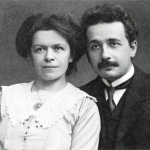
On January 6, 1903, Albert Einstein married the twenty-seven-year-old Mileva Marich. She had been his fellow student in physics at ETH. However, his parents were strongly against the relationship due to her ethnic background, so only after Einstein’s father passed away in 1902, the couple got married. The couple gave birth to three children, Lieserl, who was either given up for adoption or died of scarlet fever in infancy; Hans Albert, who became a Swiss-American engineer and educator; and Eduard, who had a breakdown at about age 20 and was diagnosed with schizophrenia (his mother cared for him and he was also committed to asylums for several periods, finally being committed permanently after her death).
The marriage would not be a happy one, with the two divorcing in 1919. Einstein, as part of a settlement, agreed to give Marich any funds he might receive from possibly winning the Nobel Prize in the future.
During his marriage to Marich, Einstein had also begun an affair with a cousin, Elsa Löwenthal. The couple wed in 1919, the same year of Einstein’s divorce. He would continue to see other women throughout his second marriage. The marriage ended with Löwenthal's death in 1936.