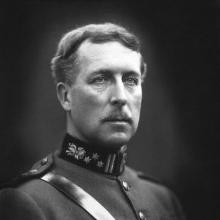
Albert I was King of the Belgians from 1909 until 1934. He became internationally known for commanding Belgium's army during the First World War, defending the Yser position while preserving Belgian independence, and later supporting political, linguistic, scientific, and social reforms during the country's reconstruction.
Background
Albert was born on April 8, 1875, in Brussels, the fifth child of Prince Philippe, Count of Flanders, and Princess Marie of Hohenzollern-Sigmaringen. His father was the brother of King Leopold II, while his mother belonged to the Catholic branch of the German Hohenzollern family. The Belgian monarchy was a constitutional institution established after the country's independence in 1830, and Albert was raised within the royal house of Saxe-Coburg-Gotha.
The early death of Albert's older brother, Prince Baudouin, and the absence of a surviving son of Leopold II eventually placed Albert in the line of succession. He developed cultural and scientific interests alongside the military preparation expected of a European prince. His 1909 journey through the Congo, undertaken before he became king, produced notes later published from his travel journal and contributed to his interest in colonial administration and public affairs.
Education
Albert received the military education expected of a future Belgian monarch and entered the Royal Military Academy in Brussels in 1891. The academy, founded to provide professional training for Belgian officers, represented the modernization of the country's armed forces and the development of a technically educated officer corps.
He entered the Belgian Army as a lieutenant in 1892 and continued his military formation through active service and promotion. His education combined military preparation with broad cultural and scientific interests that remained visible during his princely and royal years.
Career
Albert entered the Belgian Army as a lieutenant in 1892, became a colonel in 1901, and reached the rank of lieutenant general in 1907. His military career prepared him for the constitutional responsibility of commanding the armed forces while also giving him direct knowledge of Belgium's defense needs. He served as a senator by right from 1893 until his accession, using that position to speak on improvements to Belgium's naval, railway, and road infrastructure.
In 1906, Albert founded the Ibis institution, a home and school for the orphaned children of fishermen. The initiative reflected the period's expanding concern with organized social welfare and vocational education. He also undertook a major journey through the Congo in 1909, traveling by rail, boat, bicycle, on foot, and by other means and recording observations later published from his journal.
Albert became King of the Belgians on December 23, 1909, after the death of Leopold II. The Belgian monarchy was a parliamentary constitutional institution, but the king retained important responsibilities in national defense, government formation, and the representation of the state. Albert's reign coincided with debates over military preparedness, universal suffrage, language rights, industrial development, and the social consequences of rapid economic change.
When Germany demanded passage through Belgium in August 1914, Albert rejected the ultimatum and assumed effective command of the Belgian Army. He directed the defense of Liège and Antwerp and then led the army toward the Yser, where Belgian forces held the last substantial area of unoccupied Belgium behind the flooded river positions. Albert remained with the army at De Panne while the Belgian government operated from Sainte-Adresse near Le Havre.
Throughout most of the war, Albert resisted placing the Belgian Army under Allied command for offensives whose immediate objectives extended beyond the liberation of Belgian territory. He favored a defensive strategy intended to preserve the army and protect Belgium's independence, while also considering negotiated ways to end the conflict. In September 1918, after the strategic situation changed, he authorized Belgian participation in the Allied Group of Armies of Flanders and commanded forces involved in the final liberation of the country.
Albert and the royal family entered Brussels on November 22, 1918. His speech from the throne called for universal male suffrage, equality of Belgium's two national languages, the Dutchification of the University of Ghent, recognition of trade-union freedoms, and expanded social legislation. During the interwar years he participated in government formation, addressed linguistic tensions, and supported reconstruction during the economic and social difficulties that followed the war.
In 1920, Albert helped establish the Royal Academy of French Language and Literature of Belgium. In 1928, on his initiative, Belgium created the National Fund for Scientific Research to encourage scientific work and industrial development. He died on February 17, 1934, after a fatal fall while climbing at Marche-les-Dames near Namur; he was succeeded by his elder son, Leopold III.
Achievements
Albert commanded the Belgian Army during the First World War and maintained a Belgian defensive position behind the Yser River, preserving the army's independent command and the country's remaining unoccupied territory.
He founded the Ibis institution in 1906, a home and school for orphaned children of fishermen.
He supported the postwar reforms announced in 1918, including universal male suffrage, equality of Belgium's two national languages, trade-union freedoms, and expanded social legislation.
On his initiative, Belgium established the National Fund for Scientific Research in 1928 to support scientific work and industrial development.
(An edited publication of Albert's wartime notebooks and c...)
1991
Religion
Albert I was a Roman Catholic, the faith of the Belgian royal family and the dominant religious tradition in Belgium during his lifetime. Catholic institutions played a major role in Belgian education, charity, political organization, and social life, although the constitutional monarchy also governed a society divided among Catholic, liberal, and socialist currents.
His public life included support for charitable and educational initiatives, including the Ibis institution for orphaned fishermen's children. During the First World War, religious language and Catholic moral ideas formed part of the wider culture in which Belgian leaders discussed national duty, sacrifice, neutrality, and the protection of civilians.
Politics
Albert I was a nonpartisan constitutional monarch rather than a member of a political party. Belgium's monarchy operated within a parliamentary system in which the king appointed ministers, mediated among political forces, and exercised formal powers subject to constitutional responsibility.
During his reign, Belgian politics was shaped by Catholic, liberal, and socialist parties, disputes over universal suffrage, and tensions between French-speaking and Dutch-speaking communities. Albert supported the transition toward broader political participation after the First World War, including universal male suffrage, recognition of the country's two national languages, and expanded social legislation. His political role centered on national unity, defense, and mediation rather than party leadership.
Views
Albert's public outlook emphasized the independence, territorial integrity, and unity of Belgium. During the First World War, he regarded the Belgian Army's central obligation as the liberation of Belgian territory rather than participation in unlimited Allied war aims. His resistance to offensives that he considered strategically unsound reflected a moral concern about avoidable military casualties.
His postwar positions combined constitutional monarchy with support for broader political participation, linguistic equality, social legislation, scientific research, and national reconstruction. His wartime diaries and correspondence also show an interest in negotiated peace and in the moral and political consequences of prolonged warfare.
Membership
Albert was associated with Belgian scientific, literary, and colonial institutions during his reign. He helped establish the Royal Academy of French Language and Literature of Belgium in 1920 and became an associate member of the Academy of Colonial Sciences in 1924. These organizations supported scholarly, linguistic, and colonial studies in the institutional culture of interwar Belgium.
Founding member
Royal Academy of French Language and Literature of Belgium
,
Belgium
1920
Associate member
Academy of Colonial Sciences
,
Belgium
February 20, 1924
Personality
Albert was described as shy and as having broad cultural and scientific interests in addition to his military responsibilities. His wartime conduct showed a strong concern for preserving the Belgian Army and limiting unnecessary losses, while his political decisions reflected caution, independence of judgment, and concern for Belgium's territorial integrity.
Interests
Scientific research, travel, colonial affairs, infrastructure, and mountaineering
Sport & Clubs
Mountaineering and climbing
Connections
Albert married Elisabeth, Duchess in Bavaria, in 1900. They had three children: Leopold, who became King Leopold III; Charles, Count of Flanders and later regent; and Marie-José, who became Queen of Italy as the wife of King Umberto II.
His father was Prince Philippe, Count of Flanders, and his mother was Princess Marie of Hohenzollern-Sigmaringen. Albert succeeded his uncle Leopold II as king in 1909 and was succeeded by his son Leopold III in 1934.
Father:
Prince Philippe, Count of Flanders
Albert's father and the brother of King Leopold II.
Mother:
Princess Marie of Hohenzollern-Sigmaringen
Albert's mother, from the Catholic branch of the Hohenzollern dynasty.
Wife:
Elisabeth, Duchess in Bavaria
Albert married Elisabeth in 1900; she became Queen of the Belgians.
Son:
Leopold III
Albert's elder son and successor as King of the Belgians.
Son:
Charles, Count of Flanders
Albert's son, who later served as regent of Belgium.
Daughter:
Marie-José, Queen of Italy
Albert's daughter, who became queen consort of Italy through her marriage to King Umberto II.
References
Albert Of Belgium: Defender Of Right
A biography of Albert I by Emile Cammaerts, presenting his public life, constitutional role, and leadership during the First World War.