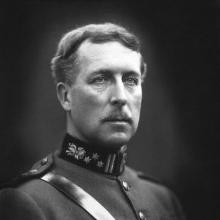
Albert I was King of the Belgians from 1909 to 1934. He led Belgium's army through the First World War, maintaining its independent command and defending the Yser front, then supported postwar suffrage, language, social, and scientific reforms. A soldier, constitutional monarch, and keen alpinist, he died in a climbing accident at Marche-les-Dames.
Background
Albert was born in Brussels on April 8, 1875, the fifth child and second son of Prince Philippe, Count of Flanders, and Princess Marie of Hohenzollern-Sigmaringen. His father was a younger brother of King Leopold II and a son of Leopold I, Belgium's first king; his mother belonged to the Catholic branch of the Hohenzollern family and was related to Kaiser Wilhelm II of Germany. Albert grew up at the Palace of the Count of Flanders within the royal house of Saxe-Coburg-Gotha.
The death of his elder brother, Prince Baudouin, altered Albert's place in the succession. After Baudouin, who had been prepared for the throne, died young, Albert became second in line to the Belgian crown after his father. His uncle Leopold II had no surviving son.
Education
Albert entered the Royal Military Academy in Brussels in 1891 for military education. The academy trained officers for Belgium's armed forces, which were undergoing professional and technical modernization. He received military preparation suited to a future constitutional monarch and officer, and continued his formation through service in the Belgian Army.
Career
Albert entered the Belgian Army as a lieutenant in 1892. He became a colonel in 1901 and lieutenant general in 1907. From 1893 until his accession to the throne, he was a senator by right and spoke in support of improvements to Belgium's naval, railway, and road infrastructure.
In 1906, he founded the Ibis institution, a home and school for orphaned children of fishermen. In 1909, before becoming king, he traveled through the Congo. The nearly three-month journey took him by rail, boat, bicycle, and on foot through the region; he kept notes that were later used in a published travel journal. His observations included criticism of the colonial exploitation under his uncle Leopold II and concern about British expansionist ambitions.
Albert became King of the Belgians on December 23, 1909, after Leopold II's death. His reign took place in a parliamentary constitutional monarchy in which the king retained responsibilities connected with national defense and government formation. The period was marked by disputes over military preparedness, suffrage, language rights, industrial development, and social legislation.
On August 2, 1914, as Germany demanded passage across Belgium, Albert assumed effective command of the Belgian Army and rejected the ultimatum. He directed the defense of Liège and Antwerp before the Belgian forces withdrew to the Yser. There, behind flooded river positions, the army held the remaining substantial area of unoccupied Belgium. Albert remained with the army at De Panne while the Belgian government operated from Sainte-Adresse near Le Havre.
For most of the war, Albert resisted placing Belgian forces under Allied command for offensives whose immediate aims went beyond liberating Belgian territory. He favored a defensive strategy to preserve the army and Belgium's independence, and considered negotiated ways to end the conflict. In September 1918, after the strategic situation changed, he authorized Belgian participation in the Allied Group of Armies of Flanders and commanded forces in the final liberation of the country.
Albert and the royal family entered Brussels on November 22, 1918. In his speech from the throne, he called for universal male suffrage, equality between Belgium's two national languages, the Dutchification of the University of Ghent, trade-union freedoms, and expanded social legislation. During the postwar reconstruction he participated in government formation and addressed linguistic tensions, unemployment, and social conflict. Belgium's economy was hit hard by the global economic crisis after 1929, and his final years included efforts to address rising unemployment and sociopolitical strain.
In 1920, Albert helped establish the Royal Academy of French Language and Literature of Belgium. On his initiative, Belgium established the National Fund for Scientific Research in 1928 to encourage scientific research and industrial development. He died on February 17, 1934, after falling while climbing at Marche-les-Dames near Namur. He was succeeded by his elder son, Leopold III, and was buried in the Royal Crypt at the Church of Our Lady of Laeken in Brussels.
Achievements
As commander of the Belgian Army during the First World War, Albert maintained the army's independent command and defended the Yser position, preserving the country's remaining unoccupied territory.
He founded the Ibis institution in 1906 as a home and school for orphaned children of fishermen.
He supported the postwar reform program announced in his 1918 speech from the throne, including universal male suffrage, equality of Belgium's two national languages, trade-union freedoms, and expanded social legislation.
On his initiative, Belgium established the National Fund for Scientific Research in 1928 to support scientific research and industrial development.
Albert was a devout Roman Catholic. His letters expressed faith in God's power and goodness, and he told his children that the soul, like the body, needed nourishment. In a wartime address on the Battle of the Yser, he argued that Christian ideals of humility, fraternity, and peace were essential to social well-being.
Roman Catholicism was the faith of Belgium's royal family and a major presence in Belgian social and political life. Catholic institutions were active in education and charity, while the country's parliamentary politics also included influential liberal and socialist movements.
Politics
Albert was a nonpartisan constitutional monarch, not a member of a political party. Belgium's parliamentary system included Catholic, liberal, and socialist parties, whose rivalries shaped debates over suffrage, social policy, and the relationship between the monarchy and Parliament.
Before the First World War, the Catholic Party held a majority in the Chamber of Deputies. The central political dispute included the restricted plural-vote system: although universal male suffrage had been introduced in 1893, voters could receive additional votes according to marital status, education, and occupation. The Belgian Labor Party organized demonstrations and strikes for the principle of one man, one vote. In 1919, the plural-vote arrangement was replaced by universal male suffrage.
During Albert's reign, the constitutional convention that the prime minister and cabinet must retain the confidence of the Chamber of Deputies became firmly established. After returning to Brussels in 1918, he called publicly for broader political participation, equality for Belgium's two national languages, trade-union freedoms, and expanded social legislation. His public role focused on national unity, defense, and mediation among political forces rather than party leadership.
Views
Albert's political and moral outlook emphasized Belgium's independence, territorial integrity, and national unity. His wartime writings and correspondence reveal concern about the consequences of prolonged conflict and an interest in negotiated peace. He regarded the army's central purpose as liberating Belgian territory, and resisted offensives he considered strategically unsound and needlessly costly in lives.
His public positions after the war combined constitutional monarchy with broader political participation, linguistic equality, social legislation, scientific research, and national reconstruction. In religious reflection, he associated Christian ideals of humility, fraternity, and peace with the well-being of society.
Membership
Albert was a founding member of the Royal Academy of French Language and Literature of Belgium, which promotes the study and development of French-language literature. He was also an associate member of the Academy of Colonial Sciences, a scholarly body concerned with colonial subjects, and an honorary member of the New York Society of the Cincinnati, an organization of descendants of officers who served in the American Revolutionary War.
Founding member
Royal Academy of French Language and Literature of Belgium
,
Belgium
1920
Associate member
Academy of Colonial Sciences
,
Belgium
February 20, 1924
Honorary member
New York Society of the Cincinnati
,
United States
1919
Personality
Albert was described as shy and had wide cultural and scientific interests alongside his military responsibilities. His wartime decisions reflected caution and independence of judgment, particularly in his concern for Belgium's territorial integrity and the preservation of the army.
Interests
Albert was a passionate and experienced alpinist. He climbed regularly in Belgium and the Alps, including with members of the Belgian Alpine Club and, later, his son Leopold. The mountains offered him an activity distinct from the pressures of court and government life.
Connections
Albert married Elisabeth, Duchess in Bavaria, in Munich on October 2, 1900. She was the daughter of Karl-Theodor, Duke in Bavaria, and Infanta Maria Josepha of Portugal. The couple had three children: Leopold, later King Leopold III; Charles, Count of Flanders, who later served as regent of Belgium; and Marie-José, who became Queen of Italy through her marriage to King Umberto II. Albert and Elisabeth shared a commitment to their family and public roles and cultivated relationships with scientists, artists, mathematicians, musicians, and philosophers at Laeken.
His father was Prince Philippe, Count of Flanders, and his mother was Princess Marie of Hohenzollern-Sigmaringen. Albert succeeded his uncle Leopold II as king in 1909, and his son Leopold III succeeded him in 1934.
Father:
Prince Philippe, Count of Flanders
Brother of King Leopold II and son of Leopold I, the first King of the Belgians.
Mother:
Princess Marie of Hohenzollern-Sigmaringen
Belonged to the Catholic branch of the Hohenzollern family and was related to Kaiser Wilhelm II.
Wife:
Elisabeth, Duchess in Bavaria
A Wittelsbach princess and daughter of Karl-Theodor, Duke in Bavaria, and Infanta Maria Josepha of Portugal; she became Queen of the Belgians.
Son:
Leopold III
Albert's elder son and successor as King of the Belgians.
Son:
Charles, Count of Flanders
Later served as regent of Belgium.
Daughter:
Marie-José, Queen of Italy
Became Queen of Italy through her marriage to King Umberto II.
References
Albert Of Belgium: Defender Of Right
Emile Cammaerts's biography of Albert I, covering his public life, constitutional role, and leadership during the First World War.