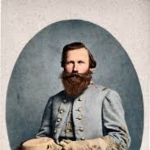
Alexander Boteler was an American politician. He served as a congressman and Confederate soldier and remains in history as a member of he first Confederate Congress who played the most influential part in the selection of the design for the Great Seal of the Confederacy.
Background
Alexander Robinson Boteler was born on May 16, 1815, in Shepherdstown, Virginia. He was the son of Dr. Henry Boteler, a graduate of Dr. Rush's medical school, Philadelphia, and of Priscilla Robinson Boteler, whose father was a successful Baltimore shipowner and merchant and whose mother was a daughter of the artist Charles William Peale. Boteler's mother having died when he was four years old, he lived with his grandmother in Baltimore.
Education
At the age of eighteen, Boteler entered Princeton University and roomed with the poet-novelist Philip Pendleton Cooke. He graduated in 1835.
In 1859, Alexander Robinson Boteler was elected to the United States House of Representatives, succeeding Charles J. Faulkner who was appointed a minister to France. During the sectional struggle in Congress, in 1860, Boteler sought to avoid disunion and secured the passage of a resolution creating a committee of one from each state to consider the "perilous condition of the country."
He made an appeal for the Union so effectively that a fellow member, S. S. Cox, considered it "the most eloquent speech, next to that of Sergeant S. S. Prentiss in his own case, ever delivered in Congress." With Virginia's passage of the secession resolution, Boteler left Congress and was elected to the General Assembly of Virginia; but in the meantime, his district elected him as its delegate to the Confederate Provisional Congress, which he entered on November 27, 1861.
In 1861, Boteler was elected to the Confederate Congress where he played a significant part in the design and adoption of the Great Seal of the Confederacy, he was defeated for re-election in 1863.
In the summer of 1862, Boteler was serving as a volunteer aide on the staff of his friend, Stonewall Jackson, who upon more than one occasion appealed, through Boteler, to the Congress. After Jackson's death, he became an aide to J. E. B. Stuart. Later, he was the aide to Governors Smith and Letcher.
He was West Virginia's commissioner at the Philadelphia Exposition 1871-76; he was appointed by Arthur as a member of the Tariff Commission in 1881; he was an assistant attorney in the United States Department of Justice in 1882 and 1883; he was clerk of pardons in the same department, 1884-1889.
In 1887, the Military Historical Society of Massachusetts purchased "The Boteler Collection" composed of oil sketches of Robert E. Lee, Longstreet, Jefferson Davis, Wade Hampton, Pickett, and John H. Morgan and a pencil sketch of John Brown.
Achievements
Alexander Boteler's greatest achievement was in his participation in 1861 in the first Confederate Congress as a member, presenting a design for the flag and being influential in the selection of the Great Seal of the Confederacy. He was the author of a number of pamphlets and articles. His description of John Brown's Raid appeared in Century Magazine, July 1883. He wrote "My Ride to a Barbecue," and presented in writing the claims of James Rumsey as the inventor of the steamboat. He probably had much to do with the placing of the memorial to Rumsey on the Potomac near Shepherdstown.