

Background
Bogue, Allan George was born on May 12, 1921 in London, Ontario, Canada.

http://www.amazon.com/gp/product/B010EW82I0/?tag=2022091-20
http://www.amazon.com/gp/product/B0108E0DZE/?tag=2022091-20
(Bound in publisher's original brown quarter cloth and whi...)
Bound in publisher's original brown quarter cloth and white boards, spine stamped in gilt. Illustrated throughout. Notes, bibliography, index.
http://www.amazon.com/gp/product/0806130393/?tag=2022091-20

( Beginning in 1820, settlers broke the tall grass prairi...)
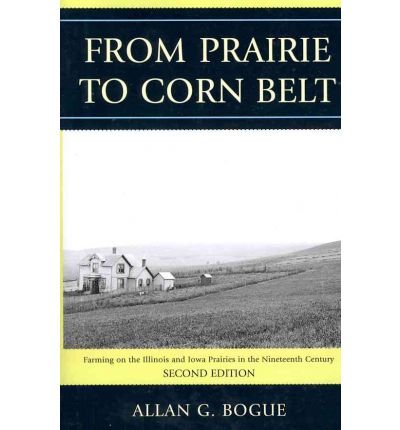
Beginning in 1820, settlers broke the tall grass prairies of mid-America. By the 1870s they had begun to use the term "Corn Belt" to describe much of the region. In From Prairie to Corn Belt , Allan G. Bogue chronicles this remarkable transformation and challenges the view that the post–Civil War period constituted thirty years of unrelieved agricultural depression. His book remains the only study of Midwestern agricultural development that focuses on the farmers themselves, the entire range of production problems they had to solve on their land, and the diversity of their responses.
http://www.amazon.com/gp/product/1566638798/?tag=2022091-20
(Book by Bogue, Allan G.)
Book by Bogue, Allan G.
http://www.amazon.com/gp/product/080392089X/?tag=2022091-20
( Taking a quantitative approach, Allan G. Bogue assesses...)
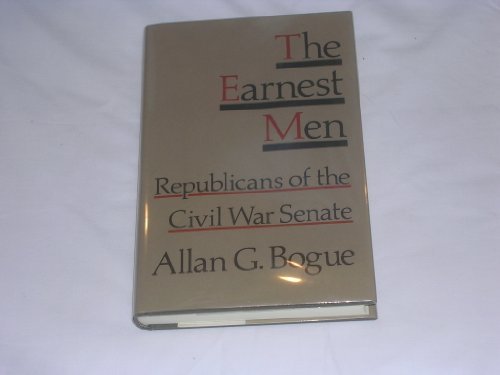
Taking a quantitative approach, Allan G. Bogue assesses the nature of radical and conservative Republicanism in the Civil War Senate, documents the distinctions among the senators, and clarifies the factors that encouraged or discouraged factionalism. The Earnest Men is divided into two parts: "Men, Context, and Patterns" and "The Substance of Disagreement." In Part One, Bogue investigates the backgrounds of the senators and the institutional structure of the Senate, and he examines the character of leadership exercised in the Senate chamber. He then uses roll-call analysis as a means of establishing distinctions between radical and moderate senators. To account for their voting patterns, he considers living arrangements, seating, regionalism, and election results. In Part Two, Bogue looks closely at the debates in the Senate in order to ascertain the nature of disagreements between radical and moderate Republicans in such policy-making areas as slavery, taxation, human rights, punishment and rehabilitation, and legislation affecting the border states. Taking issue with the idea that the Republicans were essentially unified on the issues of the day, he finds that their differences were widespread and important. A major study of the Senate in one of its most productive periods, The Earnest Men is a remarkable combination of systematic analysis and narrative history.
http://www.amazon.com/gp/product/0801413575/?tag=2022091-20

http://www.amazon.com/gp/product/B001UAQVKW/?tag=2022091-20

( As the family farm of yesterday steadily loses ground t...)
As the family farm of yesterday steadily loses ground to the corporate farm of tomorrow, pundits and plain folks alike bemoan the loss of the homely, down-to-earth rural life that few actually know or remember anymore. Allan G. Bogue is a notable exception. A legendary agricultural, political, and economic historian, and one of only three historians ever elected to the National Academy of Sciences, Bogue has for the last fifty years written about the political and economic forces shaping agriculture. And he himself has roots in the family farm—roots he traces in this memoir that is both a thoughtful tribute to the tradition that nurtured him and North America and an authentic, unsentimental portrait of the hard life that most have abandoned. Through descriptions of neighborly good will, adverse climate, charismatic family relations, and the seasonal tasks demanded by dairy farming, Bogue imparts the rhythms of growing up in rural Ontario in the early years of the twentieth century. Tracing the family's fortunes through the ups and downs of the economy in the 1920s and 1930s, he draws an absorbing picture of how they and their neighbors farmed, the crops they raised, the livestock they kept, the technology they used, and the stresses, strains, frustrations, sadness, joy, and triumphs they experienced. Firsthand history of a rare and moving sort, his book is at once an elegy for a disappearing way of life and a deftly realized, meticulously reconstructed chapter of North American history.
http://www.amazon.com/gp/product/0803261896/?tag=2022091-20
(Between 1820 and the 1990s settlers broke the tallgrass p...)
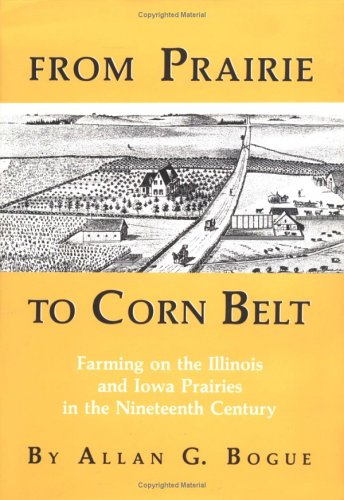
Between 1820 and the 1990s settlers broke the tallgrass prairies of mid-America and, by the 1870s, had begun to use the term "Corn Belt" in relation to much of the region. In From Prairie to Corn Belt Allan G. Bogue describes this remarkable transformation and challenges the view that the post- Civil War period constituted thirty years of unrelieved agricultural depression. From Prairie to Corn Belt is still the only study of Midwestern agricultural development that focuses on the farmers themselves, the whole range of problems relating to production that they had to solve on their holdings, and the diversity of their responses. Opening with a picture of the prairie environment of Illinois and Iowa during the early nineteenth century, Bogue describes the pioneer farmers, their reasons for coming and the impressions that the new land made on them. How farmers acquired land on the prairies, the prices that they paid, and the development of tenancy covered. Bogue also discusses in considerable detail how the pioneers improved their farms, livestock, and crops and how they used agricultural machinery and the process of innovation. He also notes the relative costs of credit, labor, and taxes. A series of personal sketches of farmers based on diaries, journals, and letters will be of particular interest to historians and students of agriculture as well as to general readers with an interest Midwestern history. This printing of From Prairie to Corn Belt includes a new preface by the author in which he describes the background of the book, its initial reception and its relation to the research in Midwestern rural history since its original publication in the mid-1960s.
http://www.amazon.com/gp/product/0813822181/?tag=2022091-20
Bogue, Allan George was born on May 12, 1921 in London, Ontario, Canada.
Bachelor of Arts, University Western Ontario, 1943; Master of Arts, University Western Ontario, 1946; Doctor of Philosophy, Cornell Univercity, 1951; Doctor of Laws, University Western Ontario, 1973; D.Fil (honorary), University Uppsala, 1977.
Lecturer economics and history, assistant librarian University Western Ontario, 1949-1952. From assistant professor to professor history University Iowa, 1952-1964, chairman department, 1959-1963. Professor history University Wisconsin-Madison, 1964-1968, chairman department, 1972-1973, Frederick Jackson Turner professor history, 1968-1991.
Member history advisory committee Mathematics Science Society Board, 1965-1971. Scandinavian-American Foundation Thord-Gray lecturer, 1968. Member Council Inter-University Consortium Political 2nd Sec121 Research, 1971-1973, 89-91.
Visiting professor history Harvard University, 1972. Director Social Science Research Council, 1973-1976. Lieutenant Canada Army, 1943-1945, captain Canada Reserve Army, 1951-1952.
( As the family farm of yesterday steadily loses ground t...)
(Between 1820 and the 1990s settlers broke the tallgrass p...)
(Between 1820 and the 1990s settlers broke the tallgrass p...)
(Bound in publisher's original brown quarter cloth and whi...)
( Beginning in 1820, settlers broke the tall grass prairi...)
( Taking a quantitative approach, Allan G. Bogue assesses...)
( Taking a quantitative approach, Allan G. Bogue assesses...)
(his tardiness delayed the reports)
(Book by Bogue, Allan G.)
Fellow Agriculture History Society (president 1963-1964). Member Organization American Historians (president 1982-1983), American History Association (counsel 1977-1979), Economic History Association (president 1981-1982), Social Science History Association (president 1977-1978), Western History Association (honorary life).
Married; 3 children.
