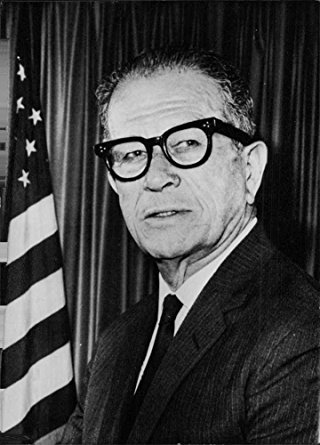
Allen Joseph Ellender was a U. S. senator. He was a lifelong Democrat opposing the Vietnam War.
Background
Allen Joseph Ellender was born on September 24, 1890 on a sugar cane plantation near Montegut, Louisiana.
He was the son of French-speaking parents. His father, Wallace Ellender, was a farmer; his mother was Victoria Jarveaux.
Education
Educated initially in plantation schools, Ellender attended St. Aloysius (1905 - 1909), a Catholic school in New Orleans, before attending Tulane University (1909 - 1913), from which he graduated with a law degree in 1913.
Career
Ellender began his law practice in Houma, Louisiana, becoming city attorney in 1913, and district attorney in 1915.
In 1924, he was elected to the state legislature and re-elected in 1928 as an anti-Huey Long member. Converting to Longism in 1928, Ellender defended Long against impeachment charges. The next year, he directed Long's election campaign to the Senate.
After Long's assassination in 1935, Ellender was elected to fill the Senate seat in 1936. Ellender took office in January 1937. By the late 1940's, Ellender had become a world traveler and a critic of foreign aid.
Ellender became an architect of farm policy in the 1960's.
As a member of the Senate Appropriations Committee, Ellender's worldwide inspection tours of foreign installations became more intensive.
Instructing agents abroad to deceive, Ellender, whenever possible Federal Bureau of Investigation Director J. Edgar Hoover and Central Intelligence Agency Director Allen Dulles, concealed from him the extent of intelligence operations abroad.
Ellender suspected the two agencies of deliberately sabotaging exchange programs with the USSR, which Ellender visited five times. When Ellender claimed in 1962, that African nations were incapable of self-government without the help of Europeans, his credibility among foreign policy observers evaporated.
In 1971, Ellender became president pro tempore of the Senate and chairman of the Appropriations Committee.
After campaigning in north Louisiana, he returned to Washington, D. C. , on July 27, 1972, to vote on an agricultural appropriations bill. Several hours later he died of a coronary occlusion at Bethesda Naval Hospital.
President Nixon, Vice-President Spiro Agnew, and a large Senate delegation attended his funeral in Houma on July 31.
Achievements
Allen Joseph Ellender is known as a delegate to the constitutional convention of Louisiana. He was a member of the Louisiana State House of Representatives, and was elected as a Democrat to the United States Senate, serving until his death.
Ellender Memorial High School in Houma and Allen Ellender Middle School in Marrero are named in his honor.
In 1994, Ellender was inducted posthumously into the Louisiana Political Museum and Hall of Fame in Winnfield.
The Allen J. Ellender Memorial Library on the campus of Nicholls State University in Thibodaux is named after him.
Politics
Ellender was a lifelong Democrat. Although Long had been hostile to Roosevelt and the New Deal, Ellender became a loyal New Dealer, supporting President Roosevelt on welfare, agriculture, housing, public works, and his 1937 court-packing scheme.
A segregationist all his life, Ellender voted against antilynching and anti-poll tax measures and educational programs calling for racial integration. He voted for the Social Security Act and for the Fair Labor Standards (minimum-wage) Act, but only after agriculture was exempted from the latter's provisions. During World War II he endorsed Roosevelt's war measures but opposed the Fair Employment Practices Commission, which called for ending racial discrimination in war plants. Ellender favored the Marshall Plan and other postwar recovery programs, but he worried about their costs. He also wanted to limit the number of displaced persons allowed to enter the United States.
A conservative on issues of labor, he voted for the Taft-Hartley Act of 1947 and against increasing the minimum wage, Ellender was surprisingly liberal in his views on datente and exchange programs with the Soviet Union and other Communist-bloc nations.
Ellender also favored wheat sales to the USSR. Believing that anticommunist forces fomented Cold War incidents in order to increase military spending and foreign aid, he opposed McCarthyism and was one of the first legislators to criticize the Wisconsin senator for his scare tactics.
Ellender joinedSenators Robert Taft of Ohio and Robert Wagner of New York in passing significant housing and education legislation during the Truman administration. Ellender became chairman of the Senate Committee on Agriculture in 1951.
As a member of the agricultural establishment he supported farmers and farm programs, but he criticized waste and high costs. He blamed Eisenhower's Soil Bank and flexible commodity price supports for a $10 billion farm deficit by 1960.
Supporting sugar, rice, and cotton constituents, he opposed placing a limit on benefit payments to wealthy landowners. An expert in the game of broker politics, he assiduously sheltered the sugar program.
An admirer of Lyndon Johnson, Ellender opposed Johnson's civil rights legislation. President Johnson catered to Ellender and bestowed countless political favors on him in exchange for support for his Vietnam policy.
Although Ellender criticized the Vietnam War and claimed frequently he had warned Presidents Eisenhower and Kennedy about becoming involved in that situation, he refused to vote for McGovern-Hatfield, Cooper-Church, or other end-the-war measures.
An early supporter of the food-stamp concept, Ellender later advocated spreading the idea to impoverished peoples abroad through Public Law 480, an agricultural export subsidy. Author of the Food Stamp Act of 1964, he voted against the domestic poverty program and granting loans to slum dwellers.
Personality
Short and gregarious, Ellender was never shy about expressing his opinion on a variety of subjects. Health conscious long before being physically fit became a national obsession, he appeared younger than he was.
He also furthered an image that he was frugal and down to earth. Sometimes verbose, he rose to his toes when making a point, gesturing with his hands and speaking rapidly in a clipped Acadian accent.
Noted for his Acadian cooking, he courted presidents and won countless projects for Louisiana.
Frequently re-elected without serious opposition, Ellender in 1972, faced a strong challenger in J. Bennett Johnston. Some voters viewed Ellender, who was eighty-one, as too old for office.
Connections
In 1917, Allen Ellender married Helen Calhoun Donnelly of New Orleans, whom he met at Tulane. His only child, Allen Jr. , was born in 1921, the year Ellender was elected to serve as a delegate to write a new Louisiana state constitution.