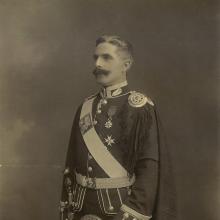
Background
GORDON, Archibald Alexander was born in 1867 in Bridge of Allan. 2nd son of late William Eagleson Gordon, Doctor of Medicine, Bridge of Allan, Stirlingshire.

GORDON, Archibald Alexander was born in 1867 in Bridge of Allan. 2nd son of late William Eagleson Gordon, Doctor of Medicine, Bridge of Allan, Stirlingshire.
Studied at Stanley House School, Bridge of Allan.
Studied at Edinburgh Collegiate and University. Abroad. Been Honourable.
Honorary Secretary to several national and international movements (incl.Franco-Scottish Society)
Justice of the Peace for Edinburgh.
Private Secretary to The Duke of Wellington.
Organisor of the Belgian Relief Fund
Belgian King's Messenger to King Albert I of Belgium
Fundraiser for the chapel of the Church of the Multiplication in Isreal
Author of several publications
Participated in the establishment of the Queen Victoria School in Dunblane
Organised the Belgian Relief Fund for the Belgian refugees in 1914
Evacuated the hospitals during the Siege of Antwerp (1914) and evacuated the British troops to Bruges and Ostend.
Received the position of Belgian Kings Messenger for King Albert I of Belgium
Funded the chapel of the Church of the Multiplication in Isreal and edited the book: "Church of the Multiplying of the Loaves and Fishes at Tabgha, Lake of Galilee, and its Mosaics".
Author of the book: Culled from a Diary
Club: Constitutional.
Spouse 1892, Maude, twindaughter of Major-General East. Davidson Smith.
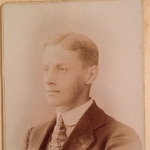
Twin of Archibald George Ramsay Gordon. He studied at Haileybury College and Sidney Sussex College, Cambridge and enlisted in the army with the Gordon Highlanders in 1914 as a Temporary-Lieutenant. He landed in France on 5 May 1915 and served as a lieutenant in the 8th Battalion, Gordon Highlanders. On 27 September 1915, William became mortally wounded during the Battle of Loos and suffered from a head wound. He succumbed to his wounds on September 30, 1915, in Etaples Military Hospital at the age of 22. He is buried in the Etaples Military Cemetery in Pas-de-Calais, grave I.B.17. Lieutenant William Hyde E. Gordon is mentioned on the Sidney Sussex College – Ante Chapel Memorial and the Haileybury College memorial.
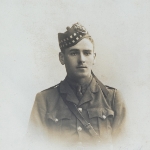
He enlisted in the 7th Seaforth Highlanders, served as a temporary Lieutenant, and arrived simultaneously with his older brother in France. He survived the Battle of Loos but was later diagnosed with jaundice and neurasthenia. Major Gordon, who had planned to visit him on the front, learned his son was at the infirmary. He visited five field ambulances before he found out that his son had already been evacuated to a railhead and placed in a Red Cross train bound for England. Edmund recovered from his illness and later returned to the front. On 25 August 1917, Major Gordon was informed that Edmund was wounded and suffered from a leg wound and a severe hand wound. He was hospitalised in the General Hospital N°8 at Rouen and later taken to a hospital in Brighton, where Major Gordon visited him. Over time, Edmund's condition worsened, and he had to undergo several operations, resulting in the amputation of some of his fingers and a part of his hand. Edmund returned afterwards to the front and survived the war but struggled with severe health issues for the remainder of his life. In 1926 he married his wife Vivienne Roberts in Kensington, and the couple got their firstborn, Peter. Peter Gordon tragically died in his infancy. Edmund's condition worsened, and he was now diagnosed with Tuberculosis. He died of this disease on 5 October 1932 and was burried next to his son at North Sheen Cemetery in Kew, London. He is mentioned on the Haileybury College memorial.
Died in his infancy.