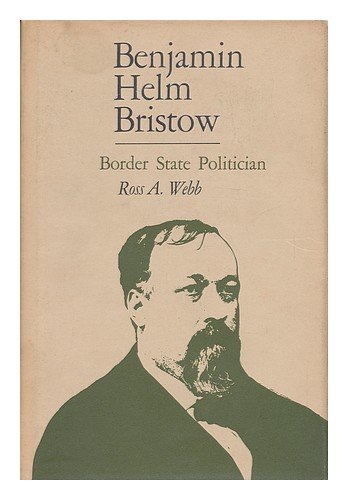
Benjamin Helm Bristow was an American lawyer, Kentucky unionist, and Federal official. As United States attorney in Kentucky, he fought the Ku Klux Klan, and as United States secretary of the Treasury, he crushed the Whiskey Ring.
Background
Benjamin Helm Bristow was born on June 20, 1832 in Elkton, Kentucky, the son of Francis M. and Emily E. (Helm) Bristow. His father, a leading lawyer and politician of the district, sat in Congress in 1854-55 and 1859-61, and was first a Whig and later an anti-slavery Unionist. These facts shaped Bristow's early life.
Education
After graduating from Jefferson College in Pennsylvania in 1851, Benjamin Bristow studied law in his father's office.
Career
After studying law in his father's office, Bristow was admitted to the Kentucky State Bar Association in 1853 and practiced law with his father.
In 1858 he removed to Hopkinsville, Kentucky, to practise law, and was there when the Civil War began. Being an ardent Unionist, Bristow aided in recruiting the 25th Kentucky Infantry, and on September 20, 1861, was mustered into service as its lieutenant-colonel. After fighting at Fort Donelson and elsewhere, he was seriously wounded by the explosion of a shell at Shiloh, where his regiment was so badly cut up that it was merged with another.
Upon recovering, he helped raise the 8th Kentucky Cavalry, became its lieutenant-colonel, and on April 1, 1863, was commissioned its colonel. He fought in many skirmishes, and was present when Morgan's raiders were captured at Wellsville, Ohio, in the summer of 1863. Offered a brevet as a major-general, he modestly refused it. Bristow's war service was cut short by the need for strong Union men in Kentucky politics, where ex-Governor John A. Wickliffe was leading an organized opposition to Lincoln's emancipation proclamation and other measures.
In August 1863, without his knowledge, he was elected to the state Senate from Christian County. Realizing the emergency, Bristow somewhat reluctantly accepted and took his seat in December. He supported all Union enactments, labored for ratification of the Thirteenth Amendment, and was an active worker for Lincoln's reëlection.
Resigning from the Senate in 1865, he removed to Louisville, and there was immediately appointed assistant United States attorney; the next spring (May 4, 1866) he was made United States attorney for the Kentucky district. This time he had to play a greater role in a more pressing emergency.
Kentucky was in a state of lamentable disorder. Ku Klux Klan violence, spontaneous racial clashes, and conflicts between Unionists and former secessionists were everyday occurrences; while gross frauds were practised upon the internal revenue service. Bristow acted with characteristic energy and determination.
He obtained twenty-nine convictions for various crimes under the first Federal Enforcement Act, one capital sentence for murder being especially effective in shaking the nerve of the Klan. The lives and property of colored people were rapidly made safe.
Attacking the distillers of illicit whiskey, he obtained more than a hundred forfeitures of stocks of liquor. The skill and courage which Bristow displayed attracted national attention, and led at once to higher federal office.
President Grant promptly appointed Bristow the first incumbent. He wrote many opinions, made arguments in several important constitutional cases before the Supreme Court, and won a reputation for mastery of federal jurisprudence.
He quit office on November 12, 1872, to accept a highly paid place as counsel of the Texas & Pacific Railroad, but found this step a mistake, for the labor required was administrative while his tastes were for legal work. Returning to Kentucky, he was practising law again when on July 3, 1874, President Grant appointed him secretary of the treasury. This appointment, his predecessor W. A. Richardson having been seriously compromised by contract scandals, was hailed by the press as promising a much-needed reform of the department. With gratifying rapidity this promise was fulfilled.
A drastic reorganization was carried through. The office of supervising architect, made notorious by Mullett, was abolished; the second comptroller and his leading subordinates were dismissed for inefficiency; the detective force was shaken up; and the new Secretary consolidated a number of collection districts in both the customs and internal revenue services. At the same time he argued vigorously for a resumption of specie payments. But his greatest service was in breaking up the notorious Whiskey Ring.
This was a powerful and corrupt machine which had been devised by western distillers and their allies in the internal revenue service for the evasion of the whiskey tax, and despite general knowledge of its activities, it seemed impregnable.
George W. Fishback, owner of the St. Louis Democrat, advised Bristow upon the best means of attacking the Ring in that city. The work of detection was assigned to men wholly outside the Treasury department; instructions were given them in a cipher different from the department code; and by maintaining complete secrecy, a mass of evidence upon the frauds was accumulated. Similar work was done in Chicago and Milwaukee.
On May 10, 1875, all the suspected distilleries and rectifying houses in these three cities were seized, and the Ring was shattered at one blow. Books and papers were found proving individual guilt. Nearly 250 civil and criminal suits were instituted forthwith. Within a year Bristow had taken action to recover $3, 150, 000, had indicted 176 men, and had obtained sentences for 110. The Ring, fighting back desperately, sought with some success to poison the mind of President Grant against Bristow. Through the attorney-general's office they were able to impede the Secretary's efforts to complete the destruction of the Ring; and by adroit manipulation they induced Grant to believe that Bristow was using his office to scheme for the Republican nomination.
His resignation was virtually forced by the President, and was handed in on June 17, 1876. Since the beginning of the year he had been prominently mentioned for the presidency. The conference of moderate Republicans held at the Fifth Avenue Hotel in May regarded him as the best Republican candidate but refrained from an open indorsement.
Nominated at the Cincinnati convention in June by John M. Harlan, he received 113 votes on the first ballot, and on the fourth ballot, with 126 votes, stood second only to Blaine. Bristow's resignation from the Treasury closed his official career, which had covered but fifteen years, two of them spent in military commands. In 1895 Cleveland offered him membership on the Venezuela Boundary Commission, but for personal reasons he declined. Removing from Louisville to New York in 1878, and on October 16 of that year forming the partnership of Bristow, Peet, Burnett, & Opdyke, he remained for the rest of his life one of the leaders of the Eastern bar.
In 1896, while in apparently robust health, he was stricken with appendicitis, and died at his home, 27 West Fiftieth St. , within four days.
Achievements
Benjamin Bristow argued many cases before the Supreme Court, and was noted among lawyers for his personal charm, the thoroughness and closeness of his argument, and the skill with which he confined himself to vital points.
One of his career achievements was in the election as the second president of the American Bar Association in 1879, and another one in serving for many years was a vice-president of the Civil Service Reform Association.
He remained for the rest of his life one of the leaders of the Eastern bar, after forming the partnership of Bristow, Peet, Burnett, & Opdyke on the year of 1878.
His father's political anti-slavery and Whig views strongly influenced Bristow's own political outlook. Later in his political life he was a prominent candidate for the Republican presidential nomination in 1876. At the 1876 Republican convention in Cincinnati, Bristow was a strong contender for the presidential nomination but chose finally to bow out of a deadlock by throwing his support behind Rutherford B. Hayes.
Views
Although a lawyer by trade and having no financial training, he was able to rid the Internal Revenue Department of corruption. Bristow demonstrated his ability and in striking down the Whiskey Ring that was supported by powerful political forces. His prosecutions offended the social and political Republican Party stalwarts who supported patronage, forcing him out of office. As the first Solicitor General Bristow aided in prosecuting the Ku Klux Klan that enabled African Americans in the South to vote freely without fear of violent retaliation. He was born a Southerner in Kentucky, but he lived the remaining years of his life in New York.
Membership
Benjamin Bristow was a member of the American Bar Association, and for many years was a member of the Civil Service Reform Association. He was also a member of the Metropolitan, Union, and Union League clubs.
Personality
Bristow had a charming personality, which was regarded by his fellow colleagues.
Connections
On November 21, 1854, Bristow married Abbie S. Briscoe. Benjamin and Abbie had two children one son, William A. Bristow, and one daughter Nannie Bristow. William was an attorney who worked in Bristow's New York law firm Bristow, Opdyke, & Willcox. In June 1896 William was in London recovering from typhoid fever.
Father:
Francis Marion Bristow
Congressman
1804–1864
Sister :
Martha Marie Bristow Gill
1838–1911
Sister :
Mary Margaret Bristow Petrie
1834–1916
Daughter:
Nancy Bristow Draper
1858–1913
wife :
Abbie Slaughter Briscoe Bristow
1835–1915
mother :
Emily Edwards Helm Bristow
1808–1882
Partner:
John M. Harlan
He was practising law in Louisville with John M. Harlan as partner when Congress created the post of solicitor-general.