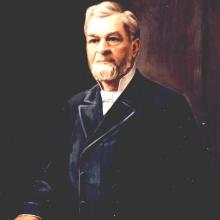
The Life and Letters of James Henley Thornwell: Ex-president of the South Carolina College, Late Professor of Theology in the Theological Seminary at Columbia, South Carolina
Benjamin Morgan Palmer was an American Presbyterian clergyman and educator. He served the First Presbyterian Church of New Orleans and was the first moderator of the Presbyterian Church in the Confederate States of America.
Background
Benjamin Morgan Palmer was born on January 25, 1818 in Charleston, South Carolina, United States. He was the second of the four children of Reverend Edward and Sarah Bunce Palmer. Both parents were of New England stock, his father being a descendant of William Palmer who emigrated to America in 1621
Education
Benjamin was prepared for college by his parents and at a private academy. He entered Amherst College when he was little more than fourteen years old. He led his class at Amherst but was expelled in his second year for refusing to divulge the secrets of an undergraduate society. Returning to South Carolina, he taught school until, in January 1837, he entered the University of Georgia, from which he graduated eighteen months later. In 1841 he graduated, also, from the Columbia Theological Seminary, and in April of that year was licensed to preach.
He also received the Doctor of Divinity degree from Oglethorpe University in Atlanta in 1852. In 1870 he received the Doctor of Law degree from Westminster College in Fulton, Missouri.
In 1841 Benjamin Palmer was invited to become pastor of the First Presbyterian Church of Savannah, Georgia and on March 6, 1842, he was ordained. He served the church at Savannah only until January 1843, when he went to the Presbyterian Church at Columbia, South Carolina. In Columbia he was part of a circle of Presbyterian intellectuals that included James Henley Thornwell, Joseph LeConte, and Louisa Cheves McCord. With George Howe and Thornwell, he in 1847 established the Southern Presbyterian Review, perhaps the most influential and certainly the most scholarly religious journal published in the South at the time.
He lectured at Columbia Theological Seminary, and in 1854 resigned his pulpit to accept a professorship there. Two years later he relinquished it and became pastor of the First Presbyterian Church of New Orleans, which he served until his death. He participated in establishing Southwestern Presbyterian University and a weekly paper, the Southwestern Presbyterian.
In 1861 Palmer became the first moderator of the Presbyterian Church in the Confederate States of America.
During the war he traveled throughout the South preaching and speaking and providing important ideological support to the Confederate cause. When New Orleans fell to Union forces, Palmer returned to Columbia and filled his old pulpit and briefly, after Thornwell's death, a professorship at the seminary. The fire following Sherman's entrance into Columbia destroyed much of Palmer's library and many of his personal papers.
After the war, Palmer returned to New Orleans, where he was a highly regarded pastor who ministered with great compassion to the victims of yellow fever epidemics. He was a founder of the weekly Southwestern Presbyterian and was influential in establishing Southwestern Presbyterian University, now Rhodes College, in Memphis.
Palmer's "The Life and Letters of James Henley Thornwell," first published in 1875, was reprinted by the Trust in 1974. He is also known for his books, "The Family in its Civil and Churchly Aspects" (1876), "The Theology of Prayer" (1894), and "The Three-Fold Fellowship and the Three-Fold Assurance" (1902).
Achievements
Benjamin Morgan Palmer was a distinguished Presbyterian clergyman. He was active in founding the Presbyterian Church in the Confederate States and was the first moderator of its General Assembly.
He delivered his most famous defense of slavery and call for Southern secession in a Thanksgiving sermon preached to his New Orleans congregation, First Presbyterian Church, in the wake of Abraham Lincoln's election to the United States presidency.
He was also the co-founder of the Southern Presbyterian Review and Southwestern Presbyterian and Rhodes College.
All Benjamin's life he was a devoted member of the Presbyterian church.
Politics
Palmer was a staunch secessionist with a wide and respected reputation. In 1860, he was perhaps the most influential person in New Orleans in urging his state to join the Confederate cause. He was a Confederate commissioner to ten general assemblies in 1861 and served as chaplain of the Army of Tennessee throughout the war.
Membership
Palmer became a member of the Anti-Lottery League in 1891.
Connections
On October 7, 1841, Benjamin married Mary Augusta Howe, by whom he had six children, only two of whom lived to maturity.