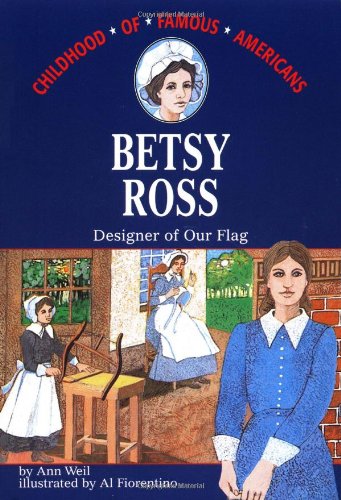
Betsy Ross: Designer of Our Flag (Childhood of Famous Americans)
(Recreates the childhood of the woman traditionally rememb...)
Recreates the childhood of the woman traditionally remembered as the maker of the first American flag, which was secretly presented to General George Washington in Philadelphia in 1776.
(
A richly woven biography of the beloved patriot Betsy R...)
A richly woven biography of the beloved patriot Betsy Ross, and an enthralling portrait of everyday life in Revolutionary War-era Philadelphia
Betsy Ross and the Making of America is the first comprehensively researched and elegantly written biography of one of America's most captivating figures of the Revolutionary War. Drawing on new sources and bringing a fresh, keen eye to the fabled creation of "the first flag," Marla R. Miller thoroughly reconstructs the life behind the legend. This authoritative work provides a close look at the famous seamstress while shedding new light on the lives of the artisan families who peopled the young nation and crafted its tools, ships, and homes.
Betsy Ross occupies a sacred place in the American consciousness, and Miller's winning narrative finally does her justice. This history of the ordinary craftspeople of the Revolutionary War and their most famous representative will be the definitive volume for years to come.
Elizabeth Griscom "Betsy" Ross, née Griscom, also known by her second and third married names, Ashburn and Claypoole, was an American seamstress and upholsterer.
Background
Betsy Ross was born on January 1, 1752, to Samuel Griscom (1717–93) and Rebecca James Griscom (1721–93) in Philadelphia, Pennsylvania. Betsy was the eighth of seventeen children, of whom only nine survived childhood.
Her father operated a building business, which had been established by her great-grandfather Andrew Griscom, who had emigrated from England in 1680.
Education
She attended a Quaker-run state school.
Career
Her father apprenticed her to an upholsterer named William Webster.
After marriage Ross and her husband returned to Philadelphia, where they opened an upholstery and sewing shop on Arch Street, which also served as their home. John, a member of the state militia, was killed three years later in an explosion while on guard duty. After the death of her husband, Betsy continued the day-to-day operations of the shop.
Ross and John Claypoole (third husband) continued to run the upholstery shop. Returning to her Quaker roots, Betsy and her husband joined the Society of Free Quakers. After her third husband's death, Ross lived the remainder of her life with one of her daughters and continued to work in the shop until 1827, when she turned it over to her daughter.
The house where she purportedly made the flag was marked as a historical landmark in 1887. There is very little evidence to support the story that Ross was the creator of the original flag. The story of her contribution to the design and creation of the first flag of the United States was first put forth by her grandson, William Canby, in March of 1870 before a meeting of the Historical Society of Pennsylvania. He claims that as an 11-year-old boy, his grandmother told him of her involvement with the stars and stripes while on her deathbed.
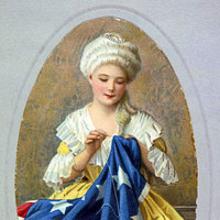
According to Who Was Who in the American Revolution, the legend stated: "(George) Washington, (George) Ross, and Robert Morris came to Mrs. Ross's house in June 1776 and asked her to make a flag for the new country that was on the verge of declaring its independence. She suggested a design to Washington, he made a rough pencil sketch on the basis of it, and she there upon made the famous flag in her back parlor. She is supposed also to have suggested the use of the five- rather than the six-pointed star chosen by Washington. " Although there is no written record to support this story, there is ample evidence, in the form of receipts, that she made numerous flags for the Pennsylvania State Navy, and many efforts to refute the legend have failed. The millions of members of the Betsy Ross Memorial Association would have one accept the story as fact, but until further evidence is revealed, it cannot be either proved or disproved.
Achievements
Most historians point to upholsterer Betsy Ross as the woman who sewed the first U. S. flag.
So widely accepted is the story of this legendary flagmaker, the United States government issued a commemorative postage stamp in 1952 in celebration of the two hundredth anniversary of her birth. Despite the accuracy or not of the historical legend, the Betsy Ross Bridge, connecting Philadelphia with Pennsauken Township, New Jersey, across the Delaware River is named in her honor.
(Recreates the childhood of the woman traditionally rememb...)
Religion
She was disowned by the Quaker church, the Society of Friends, in 1773 when she eloped to Gloucester, New Jersey, to marry John Ross, an Episcopalian.
Connections
She married John Ross, an Episcopalian. Betsy and John Ross had no children.
On June 15, 1777, Ross married Captain Joseph Ashburn, at Old Swedes' Church. Together they had two daughters. As with Ross's previous husband, her second husband's military career once again made her a widow. The first mate of the brigantine Patty, he was captured at sea by the British Navy. He died on March 3, 1782, in the Old Mill Prison, Plymouth, England.
The news of her second husband's death was brought to Ross by John Claypoole, a lifelong friend of both Ross and Ashburn. This friendship quickly grew into more, and the two were married May 8, 1783. Before he died in 1817, he and Ross had five daughters.