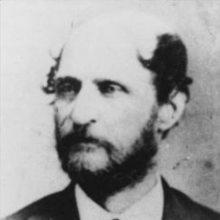
Birkett Davenport Fry was an American lawyer, Confederate soldier and cotton manufacturer. He was a brigadier general in the filibustering army, brigadier-general of Archer’s and Walker’s brigades which he led in the second battle of Cold Harbor.
Background
Birkett Davenport Fry was born on June 24, 1822, in Kanawha County, Virginia. He was the son of Thornton and Eliza Rootes Thompson Fry and a great-grandson of Colonel Joshua Fry.
His maternal grandfather was Philip Rootes Thompson who had been a member of Congress from Virginia from 1801 to 1807.
Education
Fry received his education at Virginia Military Institute and at Washington College (now Washington & Jefferson College), Pennsylvania. In 1842, he was admitted to West Point but withdrew after two years because of a deficiency in mathematics. He then studied law and was admitted to the bar in 1846.
Birkett Fry's military training secured him an appointment as the first lieutenant of infantry in the regular army at the opening of the Mexican War. He was appointed on February 24, 1847, and two months later was transferred to Voltigeurs. At the battle of Chapultepec, he was mentioned in the report of the colonel for unusual courage.
He received his discharge on August 31, 1848, and was presented with a sword by the state of Virginia "for gallant and meritorious service." The following year, he made the journey across the plains to California and opened a law office in Sacramento. While there, he took part in Walker’s expedition to Nicaragua (1855) and rose to the rank of brigadier-general in the filibustering army.
When the movement collapsed he was in California where he had been sent to secure recruits for Walker’s army. He, therefore, escaped the fate which overtook most of the members of the expedition.
In 1859, he left the West and settled in Tallassee, Alabama, where he became the manager of a cotton-mill in which the family of his wife was interested. At the outbreak of the Civil War, he offered his services to the state of Alabama and was commissioned colonel of the 13th Regiment, Alabama Infantry.
Fry accompanied this regiment to Virginia where it was assigned to the 5th Brigade in the Army of Virginia. Here he rendered heroic service. At Seven Pines, he was wounded but refused to leave the field. At Sharpsburg, where Birkett was officially commended by General Hill, his arm was shattered and he was warned by the physicians that he could not hope to live unless he permitted it to be amputated.
Fry refused, nevertheless, and did recover in time to participate in the battle of Chancellorsville where he was again wounded. At Gettysburg, he led Archer’s brigade in the attack upon Cemetery Ridge. In this attack, he was wounded and taken prisoner. Nine months later, he was exchanged and returned to the Army of Virginia.
He received his commission as brigadier-general May 24, 1864, and was given command of Archer's and Walker's brigades which he led in the second battle of Cold Harbor. Shortly after this battle, he was sent to Augusta, Georgia, to command a military district, and remained there until the close of the war.
The three years following the war he spent in Cuba, returning to Tallassee in 1868 to manage the cotton-mill once more. In 1881, he settled in Richmond, Virginia, and engaged in cotton-buying.
In 1886, Birkett Fry became president of the Marshall Manufacturing Company and held this position until his death in 1891.
Achievements
Birkett Davenport Fry participated in numerous battles during the American Civil War, was wounded not once and stayed loyal to his ideas. For his military actions, he was promoted to Brigadier General on May 24, 1864.
General Bragg described Fry as "a man of gunpowder reputation" and his career proves that he merited the tribute, though he was slight in build and quiet in manner. He was devoted to children and was very fond of flowers and animals.
Connections
In 1853, Fry had married Martha Micou Baker, the daughter of William and Ann Micou of Augusta.