Background
Colden was born on February 7, 1688, in Ireland, of Scottish parents. He was raised in Berwick shire, Scotland, where his father, the Reverend Alexander Colden of the Church of Scotland, had the church in Duns.


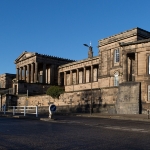
E Barnton Ave, Edinburgh EH4 6AQ, UK
Colden studied at Royal High School in Edinburgh.

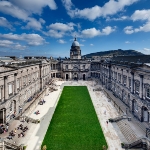
Old College, South Bridge, Edinburgh EH8 9YL, UK
Colden was sent to the Royal High School and Edinburgh University to become a minister, graduating in 1705.
1772
1000 5th Ave, New York, NY 10028, USA
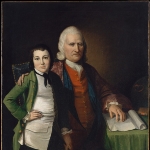
Cadwallader Colden and His Grandson Warren De Lancey by Matthew Pratt, at the Metropolitan Museum of Art, ca. 1772
E Barnton Ave, Edinburgh EH4 6AQ, UK
Colden studied at Royal High School in Edinburgh.
Old College, South Bridge, Edinburgh EH8 9YL, UK
Colden was sent to the Royal High School and Edinburgh University to become a minister, graduating in 1705.
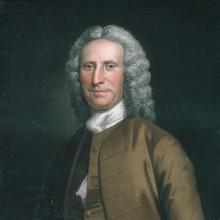
Colden by Matthew Pratt


(The author discusses the religion, manners, customs, laws...)
The author discusses the religion, manners, customs, laws and forms of government of the confederacy of tribes composed of the Mohawks, Oneidas, Onondagas, Cayugas, and Senecas, and gives accounts of battles, treaties, and trade with these Indians up to 1689.
http://www.amazon.com/gp/product/0801490863/?tag=2022091-20
1727

http://www.amazon.com/gp/product/1437332722/?tag=2022091-20
1877

http://www.amazon.com/gp/product/1573928356/?tag=2022091-20
lieutenant governor military physician scientist
Colden was born on February 7, 1688, in Ireland, of Scottish parents. He was raised in Berwick shire, Scotland, where his father, the Reverend Alexander Colden of the Church of Scotland, had the church in Duns.
Colden's father, Rev. Alexander Colden A.B. of Duns, Berwickshire, sent him to the Royal High School and Edinburgh University to become a minister. Colden graduated in 1705.
Feeling that he lacked funds to pursue a career in England, Colden removed to Philadelphia in 1710. There he practiced medicine and engaged in business for a time; but, with the encouragement of Governor Robert Hunter, a fellow Scot, he moved to New York in 1718 and speedily rose to prominence in its politics and government. He was appointed surveyor general in 1720 and a member of the governor’s council in 1721. In 1761 he became lieutenant governor and several times thereafter served as acting governor. About 1727 he began to develop Coldengham, a country seat west of Newburgh; after 1739 he spent most of his time there until 1762, when he acquired the Spring Hill estate in Flushing. He remained a major force in government, aroused patriot wrath at the time of the Stamp Act, and died loyal to the crown.
Colden consistently aspired to scientific achievement. In Philadelphia he enjoyed the acquaintance of James Logan; and before removing to New York, he began a correspondence with British members of an international circle engaged in the study of natural history. He soon became a correspondent of Peter Collinson in England, J. F. Gronovius in Holland, and Carl Linnaeus in Sweden. With a group of American naturalists he participated in making known to the European members of the circle new species and genera of plants.
Having studied some botany under Charles Preston at Edinburgh, Colden pursued the improvement of his knowledge in America. His work was carefully done and was admired by taxonomists of his own day and later.
Colden interested himself in a great variety of sciences. A significant portion of his correspondence related to medicine; and he wrote several medical essays, some of which were published after his death. Probably his most influential publication was An Abstract From Dr. Berkley’s Treatise on Tar-water (1745), to which he added important reflections of his own. Among other contemporary publications were articles on the medical virtues of pokeweed and the New York diphtheria epidemic, which were published in London journals. Other of his ideas appeared as newspaper articles. Because Colden early gave up medical practice, he was sometimes speculative and incorrect in his observations - as in his manuscript essay on yellow fever.
Colden’s major scientific effort was the most ambitious ever attempted in the colonies. Conscious that Newton had admitted his inability to understand the cause of gravity, Colden sought to supply this deficiency by devising his own explanation. He began publishing on this subject with An Explication of the First Causes of Action in Matter, which appeared in 1746. The same year, a pirated edition was brought out in London; a German translation came out in 1748, and a French translation in 1751. In that year Colden issued a second, expanded edition in London under the title The principles of Action in Matter Several magazines published extracts and synopses; but when he produced a third, corrected and further expanded, edition in 1755, no publisher would touch it. He had to be content with a couple of magazine articles drawn from it and with the permanence anticipated from depositing the manuscript in the library of the University of Edinburgh.
Colden is viewed as one of the representatives of the American Enlightenment with recognition of his work in the fields of botany and public health. On the basis of his constructive achievements in botany and other fields, as well as his wide correspondence and European reputation, Colden was able to play a significant role in the American scientific community.
(The author discusses the religion, manners, customs, laws...)
1727Colden criticized the Linnaean reliance on sexual characteristics and suggested a more natural system. An Explication of the First Causes of Action in Matter (1745) was his attempt to discover the cause of gravity, postulating a division of the material world into matter, light, and ether. Although it is possible to read an equation of energy with matter in the work, it was in general a rationally deduced system in no way based on the observations of scientists in Europe. He sent copies to European scientists, most of whom refused to comment, but the German scientist Leonhard Euler called it absurd. Colden never accepted the verdict and hoped to perfect his theory.
Colden maintained an alertness to astronomical events of importance and corresponded on the application of astronomy to cartography and surveying. He wrote essays on light, on optics, and on waterspouts and published a piece on fluxions. His knowledge of mathematics was good, and he displayed significant insights in several fields. His History of the Five Indian Nations, although much of it was based on French accounts, was considered as reliable on both sides of the Atlantic.
Colden married Alice Christty in 1715, in Scotland; they had eight children who lived to maturity. Of these, Jane followed her father’s tutoring and made botanical contributions of her own, while David sought to extend some of his father’s scientific ideas, publishing most usefully in electricity.
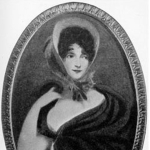
She was the first female botanist working in America, and who married Dr. William Farquhar.