Background
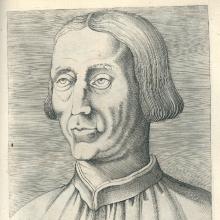
Carlo Ruini was born in 1530, into a wealthy family in Bologna, Italy.

Carlo Ruini (1530–1598) was one of the most noted anatomists of the horse of the 16th century.
1598
An illustration from Dell'anotomia, et dell'infirmita del cavallo by Carlo Ruini.
1618
Carlo Ruini's Anatomia del Cavallo (Venice: F. Prati).
1618
Carlo Ruini, Horse Muscle Figure (Woodblock print), Venice.

https://www.amazon.com/Anatomia-Cavallo-Infermit%C3%A0-Suoi-Rimedii/dp/1397306971/ref=sr_1_10?keywords=Carlo+Ruini&qid=1580306245&sr=8-10
1598

https://www.amazon.com/Dellanotomia-dellinfermita-cavallo-RUINI-Carlo/dp/B00D95L7KU/ref=sr_1_6?keywords=Carlo+Ruini&qid=1580306245&sr=8-6
1618
lawyer scientist statesman Veterinarian anatomists
Carlo Ruini was born in 1530, into a wealthy family in Bologna, Italy.
Ruini did not receive special training as a physician or attend the famous university in Bologna. It is unknown if he received special training in art.
Ruini was not a physician or even a veterinarian, but a Bolognese aristocrat, senator, and high-ranking lawyer. Following the example of Vesalius, Ruini stressed the importance of “artful instruction” about all parts of the horse’s body, the diseases that afflict them, and their cures.
The first part of his work gives an exhaustive treatment of equine anatomy, with especially good accounts of the sense organs; it is illustrated with sixty-four full-page woodcuts, of which the last three, showing a stripped horse in a landscape setting, were clearly inspired by the Vesalian “muscleman” plates.
The second part of the work deals with equine diseases and their cures from a traditional Hippocratic-Galenic standpoint.
Carlo Ruini died before his work was published but his son Ottavio saw it through the press. A total of 15 editions appeared between 1598 and 1769; the original blocks were only used for this first and were then recut for the 1618 and subsequent editions.
Ruini ranks among the founders of both comparative anatomy and veterinary medicine. He is remembered chiefly for his most important work, which is a two-volume Anatorhia del cuvalio, inferinita et sttoi rimedii. The first edition appeared after Ruini’s death (Bologna, 1598) and was followed throughout the seventeenth century by other editions and translations; and in 1706-1707 the first edition was reissued.
Some scholars, basing their arguments on Ruini’s description of the horse’s heart and blood vessels, believe that Ruini was active in the discovery of the greater and lesser circulatory systems. A pioneer in the veterinarian field, Ruini deserves to be ranked among the founders of comparative anatomy, along with Vesalius, Belon, Rondelet, and Coiter.
In the introduction to Carlo Ruini's book I of the first volume he stresses the importance of "artful instruction” concerning the body of the horse, which leads to knowledge of its constitution and of the means of prolonging its life. It was from riding the horse, Ruini points out, that man derived the title cavaliere (knight) to denote his own valor and nobility.
After recounting the horse’s role in both work and recreation. Ruini concludes the introduction by explaining that his aims are to describe each part of the horse’s body, the nature of the ailments that afflict them, and the means of curing this worthy and noble animal.
In the first volume, which deals mainly with anatomy, Ruini includes notes on physiology that reflect his teleological Galenic approach. In the first book, the morphology of the head is described in detail.
The second book deals with the neck and its organs, the lungs, the heart, and the thoracic muscles, blood vessels, and nerves. The third book covers the liver, spleen, kidneys, stomach, intestines, peritoneum, and bladder. The structures of these organs and their positions are described, as are the lumbosacral region and its muscles, blood vessels, and nerves. The fourth book describes the genital system and the fifth deals with the extremities.
Volume II deals specifically with equine diseases and their cures. Explaining that he has followed the methods used by Aristotle. Hippocrates, and Galen to describe the human body, Ruini considers equine pathology, beginning with conditions of a general nature, such as fever, before progressing to descriptions of specific diseases. He considered it necessary to place pathology on a constitutional foundation because he believed that from the knowledge of the horse’s physical disposition one could more easily understand the nature of disease: also, from knowing the age of the horse, one could determine the appropriate treatment at any phase of an illness. At the beginning of the first book, Ruini discusses at length the four Galenic humors (choleric, sanguine, phlegmatic, and melancholic) and ways of telling a horse’s age.
He then offers a detailed analysis of fever, distinguishing three types, giving general causes and a general cure, and discussing fevers of various origins.
The second book considers various types of horse in regard to humoral pathology, using criteria based essentially on the concept of the four qualities (hot. cold, moist, dry). Ruini then examines a series of “affections” of the brain: frenzy, rage or fury, and insanity, leading to convulsions and paralysis. The book concludes with the diseases of the neck. In the third book Ruini describes the diseases of the heart and the lungs: in the fourth, the afflictions of the digestive tract, from diarrhea to jaundice; and in the fifth, hernia, diseases of the testicles and penis, and problems of obstetrics. The sixth book deals with the diseases of the legs.
On the whole, Ruini's treatise was still closely bound to the Scholastic tradition. It does, however, show the effort made by its author, who must certainly have known the work of Vesalius, to produce a work that would manifest the new direction being taken by sixteenth-century anatomy. Because it was so traditional, his treatment of pathology, although minutely detailed, is less valuable than his study of anatomy.
It appears that Ruini had been an avid collector of horses and a rider.