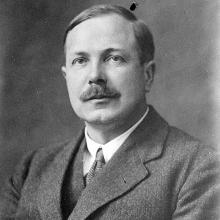
Darwin was educated at Cambridge University, where he held a major scholarship in Trinity College and took an honors degree in the mathematical tripos in 1910.
Darwin was educated at Cambridge University, where he held a major scholarship in Trinity College and took an honors degree in the mathematical tripos in 1910.
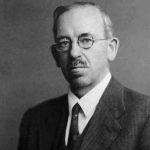
Charles Galton Darwin was a British physicist. He served as director of the National Physical Laboratory during the Second World War.
Background
Darwin was born on December 19, 1887, in Cambridge, England, the son of Sir George Howard Darwin and Lady Darwin, Maud du Puy. Darwin's elder sister was the artist Gwen Raverat, and his younger sister Margaret married Geoffrey Keynes, the brother of the economist John Maynard Keynes. His younger brother William Robert Darwin was a London stockbroker.
Education
Darwin was educated at Cambridge University, where he held a major scholarship in Trinity College and took an honors degree in the mathematical tripos in 1910. His training in applied mathematics was particularly strong, although there was little emphasis on contemporary developments in theoretical physics. After leaving Cambridge, Darwin became a postgraduate student with Ernest Rutherford at Manchester.
Darwin began research on the absorption of alpha rays and for a time showed interest in the dynamics of Rutherford’s nuclear atom model. He soon turned to X-ray diffraction as a subject on which he could exercise his mathematical powers and, after some experimental work with H. G. J. Moseley, produced a series of papers which laid the foundation for all subsequent interpretation of X-ray diffraction by crystals. In these he anticipated by many years the classic work of P. P Ewald. These researches were probably Darwin’s most important contribution to theoretical physics.
After service in World War I, in which he engaged in some early work on acoustic gun ranging, Darwin was appointed fellow and lecturer of Christ’s College, Cambridge, a post he held until 1922, when he spent a year in the United States as visiting professor at the California Institute of Technology. The principal fruit of his Cambridge appointment was the collaboration with Fowler on a new method of developing statistical mechanics. Know since this time as the Darwin-Fowler method, it differs from the Maxwell-Boltzmann and Gibbs approach by calculating directly the averages of physical quantities over assemblies of systems by the method of steepest descents. It served as a particularly effective foundation for the later quantum statistics. For this work and his earlier researches, Darwin was elected a fellow of the Royal Society in 1922.
From 1924 to 1936 Darwin served as Tait professor of natural philosophy at the University of Edinburgh, where his colleagues were E. T. Whittaker in mathematics and J. G. Barkla in physics. Darwin turned his attention to quantum optics and published several papers, particularly in magneto-optics. After a visit to Niels Bohr’s institute in 1927, he became interested in the new quantum mechanics and developed a quantum mechanical theory of the electron that proved to be an approximation to P. A. M. Dirac’s later relativistic electron theory. This was another high point in Darwin’s scientific career. In a sense it marked the termination of his creative investigations in theoretical physics, although during the rest of his life he continued to return to the examination of physical problems that happened to excite his interest.
In 1936 Darwin became master of Christ’s College, Cambridge, and devoted himself primarily to educational administration. Presumably he would have been happy to devote the remainder of his professional life to this form of activity. But the approach of war and the resignation of Sir Lawrence Bragg from the directorship of the National Physical Laboratory put pressure on Darwin to take on this important national post. He served in this capacity throughout the war and did not retire until 1949. Darwin’s administrative talents were demonstrated by his reorganization of the laboratory both before and after the war. The exigencies of wartime interfered to some extent with his program, since he was engaged in scientific liaison work in the United States during 1941-1942.
The last fifteen years of Darwin’s life were devoted largely to the problems of science and society. He paid much attention to genetics and eugenics and to the sociological implications of the population explosion. He became neo-Malthusian and developed a pessimistic attitude toward man’s future on the earth, in spite of obvious technological progress. This view was presented in detail in his well-known book The Next Million Years. Here his theory of man as the last “wild” animal is skillfully although rather grimly worked out and has produced much healthy controversy.
Achievements
Darwin is best known for his contributions to science. His main areas of activity were: theoretical research in optics (particularly X-ray diffraction), atomic structure, and statistical mechanics; educational and scientific administration; and world sociological and technical problems, with special reference to population.