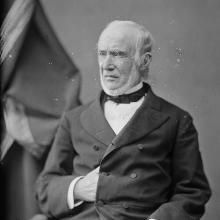
Charles O'Conor was an American lawyer and candidate in the 1872 U. S. presidential election.
Background
Charles O'Conor was born on January 22, 1804, in New York City, the son of Thomas and Margaret O'Connor and the great-grandson of Charles O'Conor who wrote a history of Ireland. In 1839-40, upon visiting Ireland and discovering that his ancestors spelled the name with one "n, " he adopted that form. Thomas O'Connor incurred the disapproval of the British authorities by engaging in the Irish rebellion of 1798 and found it wise to emigrate to New York in 1801. He earned a precarious living by writing editorials for the local press, and after his marriage to the daughter of Hugh O'Connor, and the birth of Charles, was able to give his son scarcely any educational advantages. His mother died in 1816.
Education
After his mother's death in 1816, Charles was apprenticed to a tar and lampblack manufacturer. At the end of a year he began his legal education as errand boy in Henry Stannard's office, from which he graduated to the office of Stephen P. Lemoine and finally into the office of Joseph D. Fay, where he served as clerk and law student.
Later in O'Conor's life, five institutions of learning conferred upon him the doctorate of law.
Career
Charles O'Conor was admitted to the bar in 1824, and at the age of twenty, with a capital of only $25, opened his own law office. This was the inauspicious beginning of a career in which he became nationally famous.
After the Civil War he served as senior counsel for Jefferson Davis when he was under indictment for treason, and along with Horace Greeley went surety for his bail bond. He held only two semi-political offices. In 1846 he was elected a member of the New York state constitutional convention, and in 1853 he was appointed United States district attorney for the southern district of New York, an office in which he served with distinction for fifteen months. He was for ten years treasurer of the New York Law Institute, and in 1869, its president; and he served also as vice-president of the New York Historical Society.
O'Conor's fame is due almost entirely to his phenomenal success as a lawyer. It was literally true that his life was in his cases, so that they constitute his true biography. He was not a law reformer, did not believe in codification, and opposed it, says David Dudley Field, "with might and main. " The papers in his principal cases, bound and bequeathed by him to the New York Law Institute, fill 100 volumes. They cover a period of fifty years.
One of the earliest is the case of Bowen vs. Idley, in which succession to property depended upon establishing the parentage of an illegitimate child. His most famous cases were probably the following: two cases involving the status of slaves temporarily brought into free states - Jack vs. Martin and Lemmon vs. People; four testamentary cases, the Parish and Jumel will cases, the Roosevelt Hospital case, and Manice vs. Manice; the Tilden-Hayes election contest; the Tweed cases; and the Forrest divorce case.
He was a master of the law of uses and trusts, and of the law of wills, and seemed equally at home in commercial and corporation law, a fact evidenced by his conduct of the North American Trust & Banking Company cases; and of the case of Ogden vs. Astor. This latter case involved intricate commercial dealings between Ogden and the two Astors, John Jacob and William B. , running over a period from 1816 to 1850.
The two cases which brought him most fame were the Tweed litigation and the Forrest divorce suit. In the former of these he represented the state of New York, as special deputy attorney-general. The chief counsel opposed to him was David Dudley Field. Although these suits resulted in the dissolution of the "Tweed ring, " they did not, in the judgment of O'Conor, give to the law an interpretation necessary to protect the public from corruption in office. His view of the result is expressed in the title given by him to a collection of documents which he published in 1875: Peculation Triumphant: Being the Record of a Four Years' Campaign against official Malversation in the City of New York. A. D. 1871 to 1875.
Twenty years before the Tweed cases, O'Conor, by his brilliant conduct of the Forrest divorce case, had established himself as the ablest member of the New York bar. In 1837, Edwin Forrest, the tragedian, married Catherine N. Sinclair in England. In 1849, after having made their home in New York for several years, they agreed upon a permanent separation. Subsequently Forrest unsuccessfully sought a legislative divorce in Pennsylvania, and then cross-suits for divorce were brought by both in New York. O'Conor appeared for Mrs. Forrest in a trial which lasted from December 16, 1851, to January 26, 1852, and resulted in a decree of absolute divorce with alimony. Justice Benjamin R. Curtis said at the time that O'Conor's management of the case was "the most remarkable exhibition of professional skill ever witnessed in this country". The validity of the divorce and the award of alimony were bitterly contested by Edwin Forrest through legal proceedings which were finally decided against him on last appeal in 1862.
Twenty-five years after the original suit, it was charged in the New York papers that, far from acting for Mrs. Forrest without compensation, O'Conor had in fact kept most of the awarded arrears of alimony for himself, contrary to an actual understanding with his client, and contrary to a public belief which he had allowed to go uncorrected. The venerable counselor, then seventy-two years old, himself presented these charges to the Association of the Bar of the City of New York and demanded an investigation. A committee was appointed which, after examination of evidence, reported that the charges were without foundation.
Late in life he retired from practice, built a house on the Island of Nantucket, and there, surrounded by his library of 18, 000 volumes, spent his last years.
Achievements
Charles O'Conor is famous due to his numerous successful cases: Bowen vs. Idley, Jack vs. Martin, Lemmon vs. People, the Parish and Jumel will cases, the Roosevelt Hospital case, Manice vs. Manice, the Tilden-Hayes election contest, the Tweed cases, and the Forrest divorce case, etc.
Politics
Politically O'Conor was a Democrat, with an aspiration for public office, to which, however, he never attained. He attributed his failure to win political recognition to the fact that he was a Roman Catholic and the son of an Irish emigrant. He was nominated for the office of lieutenant-governor of New York in 1848 but was not elected; and in 1872, at the Louisville Convention, he was nominated for president of the United States by the "Straight-out" Democrats. His popularity among Southern Democrats was due to his belief in slavery as a "just, benign and beneficent" institution, and to his firm conviction, often expressed, that there was no constitutional warrant for coercing seceding states.
Membership
Charles O'Conor was a member of the New York state constitutional convention, president of the New York Law Institute (1869), vice-president of the New York Historical Society, a member of the New York bar and the Directory of the Friends of Ireland.
Personality
Physically O'Conor was tall and spare, and possessed of a physique which for strength, said Joseph H. Choate, seemed to be made of gutta-percha and steel springs. He was renowned as a pedestrian and in his long walks from Wall Street to Washington Heights, wearing an ill-fitting suit of black broadcloth and a rusty high hat, was the counterpart of the early stage lawyer. He had piercing gray eyes, a finely chiseled Irish face, and a square chin fringed with a white beard.
Connections
O'Conor was married in 1854 to Cornelia (Livingston) McCracken, the daughter of Francis A. Livingston and the widow of L. H. McCracken. Their married life was unhappy and they agreed to live apart.