


Background
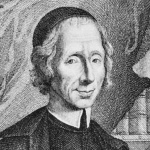
Charles-René Reynaud was born on June 11, 1656, in Brissac, Maine-et-Loire, France.
1739
Analyse demontrée by Reyneau

(Volume 2)
Volume 2
https://www.amazon.co.uk/Usage-lAnalyse-Vol-lAppliquer-Physico-Mathematiques/dp/036509580X/?tag=prabook0b-20
1708

(Volume 1)
Volume 1
https://www.amazon.co.uk/Analyse-Demontree-V1-Problemes-Mathematiques/dp/1169804276/?tag=prabook0b-20
1736

https://www.amazon.co.uk/Science-Calcul-Grandeurs-General-Mathematiques/dp/B005GDF9PM/?tag=prabook0b-20
1739
mathematician philosopher scientist author
Charles-René Reynaud was born on June 11, 1656, in Brissac, Maine-et-Loire, France.
Reyneau's studied at the Oratorian College in Angers. This college was run by the Congregation of the Oratory of Jesus and Mary Immaculate, also called the Bérulliens, which was founded by Pierre de Bérulle in 1611.
In October 1682 Reyneau went to the University of Angers to replace Prestet as a professor of mathematics, a post he held for twenty-three years. Suffering from deafness, he had former students substitute for him for several years but was finally obliged to give up teaching in 1705.
Reyneau spent the rest of his life in Paris, at the Oratorian house on rue Saint-Honore, and published his textbooks there. He was named an associe libre of the Academie Royale des Sciences on 12 February 1716.
Reyneau was only slightly aware of the projects of Malebranche and L’Hospital in 1690-1691 and of the revolution resulting from Johann Bernoulli’s stay in Paris in 1692. As late as 1694 all that Malebranche had for Reyneau to do was edit Prestet’s posthumous Geometrie. But, after abandoning the last shred of Cartesian mathematics, Malebranche chose Reyneau to write the entirely new textbook required by this turnabout (1698).
Reyneau worked with two other Oratorians, Louis Byzance and Claude Jaquemet, who were better mathematicians than he. He had some difficulty in assimilating the differential and integral calculus and was very interested in the debates, beginning in 1700, provoked by Rolle on this subject. Reyneau’s editorial efforts were frustrated in various ways, and the textbook was not published until 1708.
In 1705 Reyneau came into possession of Byzance’s papers, which included a copy of the “Legons” that Bernoulli had prepared for L’Hospital. Unfortunately, Reyneau lent some of the documents to Montmort, who lost them. On the whole, however, he preserved as well as possible the manuscripts of the group around Malebranche; and from them, he drew the inspiration for a second didactic work, published in 1714. This work, which attempted to preserve the central conceptions of the Oratorian mathematics of the end of the preceding century, was less successful than the first.

Reyneau’s most notable contribution to mathematical education was Analyse demontree (1708). It was from the second edition of this work that d’Alembert learned the fundamentals of the subject. Another famous work that Reyneau wrote titled La Science du Calcul des Grandeurs en Général, ou les Éléments des Mathématique, was published in 1714.
(Volume 2)
1708(Volume 1)
1736Initially, Reyneau was ordained for theological career and at some point was sent to the College de Toulon, where he served as a priest in 1681.
In 1716 Reyneau was elected to the Paris Academy of Sciences.
Quotes from others about the person
Jean-Pierre Lubet writes: "Until at least 1698, Reyneau encountered difficulties in assimilating the new calculus. But his experience made him decide to work on elements that can replace the books of Prestet, the work to be implemented must also include an introduction to differential and integral calculus. Reyneau did not work alone. Pierre Costabel shows him belonging to a network whose documentary activity is particularly intense at times. While still living in Angers, he received from the librarian of the Oratory articles of the Acta eruditorum, signed notably by Leibniz and Jacques Bernoulli. The course that Johann Bernoulli gave to de l'Hôpital in 1692 gave rise to one or more copies, it served as a support for the personal works that Malebranche carried out to assimilate the methods of differential and integral calculus, but Reyneau also had this course in his hands. He also benefited from the help of some of his colleagues."

While he was still teaching at the University of Angers, Reyneau visited Paris in 1700 and spent time there learning more mathematics from Pierre Varignon, someone who he would naturally get to know since Varignon was a leading member of the group around Malebranche.
