

Background
Haar, Charles Monroe was born on December 3, 1920. Came to the United States, 1921. Son of Benjamin and Dora (Eisner) Haar.

( In Suburbs under Siege Charles Haar argues passionately...)
In Suburbs under Siege Charles Haar argues passionately that all people--rich or poor, black or white--have a constitutional right to live in the suburbs and that a socially responsible judiciary should vigorously uphold that right. For various reasons, American courts have generally failed to question local zoning regulations that trap the urban poor in the squalor of inner cities, away from decent housing and jobs in the suburbs. No U.S. Supreme Court case, for instance, has confronted exclusionary zoning rules, as Brown v. Board of Education once attacked school segregation. Instead, judges at all levels have most often reinforced the residential segregation that may well destroy American society. In this provocative book on the landmark Mount Laurel cases, Haar shows how the N.J. state judiciary broke out of this pattern of judicial behavior. These courageous, innovative judges attracted nationwide attention by challenging the forces of affluence that ruled the suburbs (and the legislature) of their state. Furthermore, they based their reasoning on the N.J. state constitution in order to protect their rulings from invalidation by the U.S. Supreme Court. In the early 1970s, when the cases began, the plaintiffs, Ethel Lawrence and her daughter Thomasene, were barely making ends meet in the Philadelphia suburb of Mount Laurel, a town where their African-American ancestors had lived for seven generations. The Lawrences' dream was to live in a Mount Laurel garden apartment planned by a grassroots reform group as affordable housing: in their way stood a typical minimum acreage zoning ordinance. The eventual court victory of the Lawrences and their young public interest attorneys inspired other N.J. suits and a process of remediation that continues to this day, as judges, experts (special masters), the state legislature, and other citizens work to carry out the Mount Laurel principles. Haar's book is a bold attack on conventional doctrines of the separation of powers limitations on the judicial branch and a plea that judges across the country assume their proper responsibilities for fair housing before it is too late. Originally published in 1996. The Princeton Legacy Library uses the latest print-on-demand technology to again make available previously out-of-print books from the distinguished backlist of Princeton University Press. These paperback editions preserve the original texts of these important books while presenting them in durable paperback editions. The goal of the Princeton Legacy Library is to vastly increase access to the rich scholarly heritage found in the thousands of books published by Princeton University Press since its founding in 1905.
http://www.amazon.com/gp/product/0691044449/?tag=2022091-20

http://www.amazon.com/gp/product/B0087P51S6/?tag=2022091-20

http://www.amazon.com/gp/product/0884104052/?tag=2022091-20
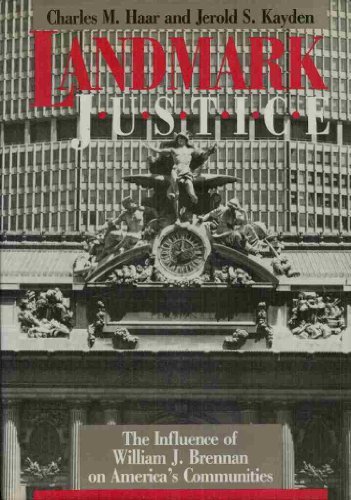
(Book by Charles M. Haar, Jerold S. Kayden)
Book by Charles M. Haar, Jerold S. Kayden
http://www.amazon.com/gp/product/0891331328/?tag=2022091-20

http://www.amazon.com/gp/product/B010BA8E0Q/?tag=2022091-20

( Mastering Boston Harbor chronicles how America's most ...)
Mastering Boston Harbor chronicles how America's most glorious and historically significant harbor was rescued from decades of pollution and neglect by a community of caring citizens who were linked to an environmentally committed judge and his special harbor master. This dynamic public-private team shaped novel legal and political procedures for governing and restoring the harbor. Charles Haar provides a fascinating study of the convergence of judicial supervision with political, environmental, financial, and technological interests. He challenges those who will instantly decry an "activist" judiciary and pulls back the curtain on the serious problems a court faces when it must grapple with an intractable problem affecting public interest. Haar demonstrates that at times only a resolute judiciary can energize and coordinate the branches of government to achieve essential contemporary social goals--goals that are endorsed and supported by a majority whose voice is often ignored in legislative and executive back rooms. Because of his experience as special master in the dispute, Haar provides the reader with an insider's view of a modern brand of judicial decision-making that is not anti-majoritarian, and could be applied to similar crises in which the legislative and executive branches of government are impotent. Citizens concerned about the conflict between unbridled economic liberty and environmental protection will gain important insight from this eyewitness account of how the "harbor of shame" became a vibrant focal point for the renewal of Boston as a world-class city.
http://www.amazon.com/gp/product/0674015282/?tag=2022091-20

(This thoughtful book assesses just how well zoning is mee...)
This thoughtful book assesses just how well zoning is meeting its goals six decades after it was introduced. Zoning and the American Dream finds grounds for both optimism and pessimism. Though susceptible to gross misuse, Haar and Kayden argue that zoning is still the most powerful tool available for shaping the environment in which we live and work. The book starts before the Supreme Court's 1926 landmark decision in Village of Euclid v. Ambler Realty Company with a look at the battles that prompted litigation. It's a story of strong-willed individuals, surprising political coalitions, and debate on some of the major philosophical issues of the Progressive era. This great drama is recounted with flair and detail. The dusty files of Ambler Realty Company's lawyers are exhumed to reveal the thinking behind the case. We're given a lively first hand perspective of the unfolding trail strategy. There's also a look at the personal backgrounds of major and minor players and an appendix with the complete text of the decision. The book also explores the problematic sides of zoning—for example, its use for racial and class discrimination. One chapter uncovers how some communities have even used zoning not only to exclude blacks but to destroy existing viable black neighborhoods by zoning for intrusive commercial and industrial uses. The book casts a skeptical eye on increased judicial intervention in zoning as constitutional battles have involved judges more and more in the planning of American communities. It also examines the pervasive impact of zoning on design and questions the compatibility of zoning and traditional economic theory. Zoning and the American Dream is the first book that looks at zoning from every imaginable perspective: historical, physical design and planning, sociological, legal, economic, and political. It's a useful reference for professionals. And just a good read for anyone interested in the nature of American communities.
http://www.amazon.com/gp/product/0918286573/?tag=2022091-20

(In Land Use Planning and the Environment, the authors hav...)
In Land Use Planning and the Environment, the authors have dramatically revised and updated a classic, seminal casebook, Land-Use Planning. Designed primarily for the classroom, the book takes a comprehensive approach to the teaching of planning and zoning law, regulatory takings, and environmental topics. Throughout the casebook, the authors identify and explore intersections between land use planning law and environmental regulation. They also identify the hidden environmental “agenda” behind exclusionary zoning, the impact of urban sprawl on clean air and critical habitats, and other interconnections. Professors, students, and law and planning practitioners with strong backgrounds and exposure to “traditional” environmental law will find these intersections a wonderful opportunity to examine familiar topics from a fresh perspective. For other users, Land Use Planning and the Environment will serve as a valuable introduction to the environmental realm, a realm that, more than perhaps any other in American law, is subject to swift and dramatic changes that require the most current teaching materials.
http://www.amazon.com/gp/product/1585761281/?tag=2022091-20

http://www.amazon.com/gp/product/B010BA8ARI/?tag=2022091-20

(Book by Haar, Charles Monroe)
Book by Haar, Charles Monroe
http://www.amazon.com/gp/product/0671601873/?tag=2022091-20
Haar, Charles Monroe was born on December 3, 1920. Came to the United States, 1921. Son of Benjamin and Dora (Eisner) Haar.
Came to the United States, 1921. Bachelor of Arts, New York University, 1940. Bachelor of Laws, Harvard, 1948.
Master of Arts, University of Wisconsin, 1941. Doctor of Laws, Lake Erie U., 1968.
Bar: New York 1949, United States District Court (southern district) New York.1950, Supreme Court of the United States Court 1968, Massachusetts 1978. Practice law, New York City, 1949-1952. Assistant professor of law Harvard, 1952-1954, professor, 1954-1966, 69, Louis D. Brandeis professor of law, 1972.
Chairman Joint Center for Urban Studies, Massachusetts Institute Technology and Harvard, 1969, chairman land policy roundtable Lincoln Institute Land Policy. Director Charles River Associates. Assistant secretary metropolitan development Department Housing and Urban Development, Washington, 1966-1969.
Chief reporter American Land Institute project model code land development, 1964-1966. Member Cambridge Redevelopment Authority, Metropolitan Area Planning Council, Massachusetts Governor's Committee on Resource Management, 1974, Finance Advisory Board, 1978, Uniform Commission State Laws, 1979, Jerusalem Committee, 1970. Chairman President's Task Force Preservation Natural Beauty, Task Force on Model Cities, on Suburban Problems.
Chairman of Commission on metropolitan governance RFF, 1970-1972. Cons. White House, Agency for International Development, Housing and Home Finance Agency, United States Senate Subcommittee Governmental Operations, World Bank, OTA, state and city agencies. Member United States delegate to United Nations Conference on Habitat, 1976.
President Regional and Urban Planning Implementation, Inc. Board directors Zelda Zinn Foundation. Trustee Massachusetts General Hospital, since 1979.
Lieutenant (junior grade), United States Naval Reserve, 1942-1946.
( Mastering Boston Harbor chronicles how America's most ...)
( In Suburbs under Siege Charles Haar argues passionately...)
(In Land Use Planning and the Environment, the authors hav...)
(This thoughtful book assesses just how well zoning is mee...)
(Book by Haar, Charles Monroe)
(Book by Charles M. Haar, Jerold S. Kayden)
Chief reporter American Land Institute project model code land development 1964-1966. Member Cambridge Redevelopment Authority, Metropolitan Area Planning Council, Massachusetts Governor's Committee on Resource Management, 1974, Finance Advisory Board, since 1978, Uniform Commission State Laws, since 1979, Jerusalem Committee, since 1970. Chairman President's Task Force Preservation Natural Beauty, Task Force on Model Cities, on Suburban Problems.
Chairman committee on metropolitan governance RFF, 1970-1972. Consultant WHite House Agency for International Development, Housing and Home Finance Agency, United States Senate state and city agencies. Member United States delegate to United Nations Conference on Habitat, 1976.
President Regional and Urban Planning Implementation, Onc., board directors Zelda Zinn Foundation. Trustee Massachusetts General Hospital, since 1979. Lieutenant (junior grade) United States Naval Reserve, 1942-1946.
Fellow Urban Land Institute. Member American Academy Arts and Sciences, American Institute Planners, British Town Planning Institute, American Bar Association, American Law Institute, Phi Beta Kappa.
Children: Jeremy, Susan Eve, Jonathan.
