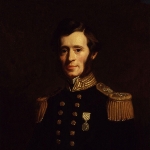
English explorer and geographer Clements Robert Markham around 1890.
Gallery of Clements Markham
1900
Markham at 70. Source: Mill, The Record of the Royal Geographical Society, 1930.
Gallery of Clements Markham
1913
United Kingdom
Markham in old age. Originally painted by George Henry in 1913 and of which a photogravure was made by Emery Walker. It includes a statuette of a polar explorer on the table and a painting of a cinchona plant on the wall.
Gallery of Clements Markham
1913
Kathleen and Robert Falcon Scott aboard Terra Nova, with Clements Markham, of the Royal Geographical Society around 1913.
Gallery of Clements Markham
1914
United Kingdom
Portrait painting of Sir Clements Robert Markham by the unknown artist.
Achievements
Bust of Markham by F. W. Pomeroy.
Membership
Royal Geographical Society
Sir Clements Robert Markham was closely connected with the Royal Geographical Society.
Hakluyt Society
Sir Clements Robert Markham was closely connected with the Hakluyt Society.
Royal Society
Sir Clements Robert Markham was a fellow of the Royal Society.
Markham in old age. Originally painted by George Henry in 1913 and of which a photogravure was made by Emery Walker. It includes a statuette of a polar explorer on the table and a painting of a cinchona plant on the wall.
(This account, published in 1853, was written in response ...)
This account, published in 1853, was written in response to criticism of the expedition. They had found some evidence of Franklin's route - he had set off in May 1845 to find the North-West Passage - but returned to Britain without any of the survivors. Markham gives a brief history of Arctic exploration, but the majority of the book recounts the expedition's efforts to find Franklin. The crew endured a harsh winter and sailed in iceberg-laden waters along the coast of Greenland, looking for clues of Franklin's whereabouts. They also spent some time exploring the Parry Islands (the present-day Queen Elizabeth Islands). Markham's account of the rescue mission provides insight into the little-known and often dangerous world of Arctic explorers.
(Published in 1856, this is Markham's lively account of hi...)
Published in 1856, this is Markham's lively account of his travels. In his description of arriving in Panama we see a picture of the mid-nineteenth-century eagerness to explore (or exploit) Latin America. Markham's stay in Cuzco allowed him ample time to study the ruins and research the lost Inca civilisation, and also gave him his introduction to the properties of the cinchona plant, a source of quinine, which he later returned to collect and introduce to India, as described in his 1862 Travels in Peru and India (also reissued in the Cambridge Library Collection).
(This book, originally published in 1862, is Markham's per...)
This book, originally published in 1862, is Markham's personal account of his travels. His story moves from the misty heights of the Peruvian mountains, where he suffered from altitude sickness, to the Malabar coastline and its complex, remarkable caste system. Markham also includes a detailed history of the use of cinchona bark, both by Europeans and aboriginal Peruvians, and a discussion of Incan culture since the arrival of the Spanish. His work is still a valuable resource for students of scientific and colonial history.
A Memoir of the Lady Ana de Osorio, Countess of Chinchon and Vice-Queen of Peru (A. D. 1629-39) with a Plea for the Correct Spelling of the Chinchona Genus
(Very little is known for certain of one of the most impor...)
Very little is known for certain of one of the most important events in the history of the world, the coming of the Englishmen to England. It took a long time, fully a century, from 450A.D. to 550 A.D., and they came constantly, in small detachments for the most part, landing on the coast, in all directions, from the Forth to the Isle of Wight. They came amidst the ruins of the mighty Roman Empire, a new race of empire - founders, with all the germs of a still mightier future.
(The story of the Islands of Majorca and Minorca has never...)
The story of the Islands of Majorca and Minorca has never been told in our language in a condensed form, although the interest is great from an historical point of view, and the materials sufficient, though not perhaps abundant. It is so closely connected with the history of Aragon and the recovery of the Sicilies from the intruding Angevins that the two cannot be altogether separated. The most that can be done is, as far as practicable, to treat the Aragonese and Sicilian events from a Majorcan point of view. This has been attempted. The stirring events of the conquest of Majorca by Jayme I., the latter part of the reign of his son, and the reigns of Sancho and Jayme III., as well as the adventures and death of Jayme IV., the last of his race, all belong strictly to Majorcan history, as do the chapters on Balearic navigators and the revolt of the 'Comunidades.'
Sir Clements Robert Markham was a British geographer, explorer, and writer. He joined the Royal Geographical Society in 1854 and was its honorary secretary from 1863 to 1888 and its president from 1893 to 1905. He was also a longtime member of the Hakluyt Society, serving as secretary from 1858 to 1886 and president from 1889 to 1909.
Background
Clements Robert Markham was born on July 20, 1830, in Stillingfleet, York, United Kingdom to the family of Reverend David Frederick Markham and the former Catherine Milner, the daughter of Sir William Milner, 4th Baronet, of Nun Appleton Hall, Yorkshire. Markham was the second son to the family. The family were descendants of William Markham, former Archbishop of York and royal tutor; this Court connection led to David Markham's appointment, in 1827, as an honorary canon of Windsor.
Education
Markham attended Westminster School for two years before joining the Royal Navy as a cadet in 1844. By the time he left the service in December 1851, he had acquired various technical, nautical, and geographical skills, which were the extent of his formal education.
Markham entered the Royal Navy in 1844 as an officer cadet. He was posted to the Pacific station, where he spent three years. In 1845 he made his first visit to Peru, landing at Callao, and while in the region he learned Spanish. Following his service in the Pacific, Markham participated in the expedition mounted to look for Sir John Franklin, the Arctic explorer, and so gained firsthand knowledge of the difficulty of movement in the Polar regions. On returning from the Arctic, Markham stopped in Boston, where he met William Prescott, author of History of the Conquest of Mexico (1843) and History of the Conquest of Peru (1847), enormously popular books that Markham had already read and admired and that probably greatly influenced his thoughts about a future career. In 1851, after just seven years, Markham left the navy against the desires of his family but with hopes of becoming an explorer and writer.
After a year in Peru (1852-1853) studying Inca ruins, Markham spent most of the next two decades in the service of the India Office. In 1860 Markham planned and executed a project for the acclimatization of Peruvian cinchona in India, an enterprise which had immense significance for public health and for the Indian economy. During this period he wrote extensively on topics in geography, economic botany, and technology related to the development of the British Empire. Combining these pursuits with a historical interest in the diffusion of Islamic technology, he studied the irrigation systems of southeastern Spain with an eye toward the agricultural development of the Madura district of India.
Markham left the India Office in 1877 and devoted the rest of his life to the promotion of geographical research, exploration, and education. Markham was secretary of the Hakluyt Society (1858-1886) and then president (1889-1909). Under his direction, the society published a series of historical accounts of exploration. Markham edited twenty volumes of the series himself and was responsible for editions of several important treatises in the history of science, including a reedition of Edward Grimston’s translation (1604) of José de Acota’s Natural and Moral History of the Indies; Robert Hue’s Tractatus de globis coelesti et terrestri ac eorem usu conscriptus (1594); and Garcia da Orta’s Colloquies on the Simples and Drugs of India, the latter in Markham’s translation.
Markham’s major work took place in the Royal Geographical Society, which he had joined in 1854. As a secretary from 1863 to 1888 and as president from 1893 to 1905, Markham helped to found a school of geography at Oxford; and it was under his aegis that the Geographical Journal became “the chief repository of geographical information from all parts of the world”. As president of the Geographical Society, he established a research committee for polar exploration designed to ensure the maximum preparation and planning toward the accomplishment of these goals.
The last part of Markham’s career was linked to the fortunes of Commander Robert F. Scott, whose first Antarctic expedition (voyage of the Discovery, 1901-1904) was the crowning achievement of Markham’s exploration program. He continued writing on the subject and played an active role in the planning of Scott’s fatal expedition on the Terra Nova (1910-1912). Described by a navy colleague as a “peripatetic encyclopedia,” Markham’s scholarship suffered from overextended interests and hasty research.
Sir Clements was the recipient of many honours. He was made Knight Commander of the Order of the Bath in 1896, and orders were conferred upon him by the Sovereigns of Portugal, Brazil, Sweden, and Norway. He was elected Fellow of the Royal Society in 1873 and was Honorary Member of various Academies, and of all the Geographical Societies of Europe and the Americas. Cambridge conferred upon him the degree of Doctor of Science. He is commemorated by Mount Markham, 82°51′S 161°21′E, in the Transantarctic range, discovered and named by Scott on his southern march during the Discovery expedition in 1902. The Markham River in Papua New Guinea was named after him; Carsten Borchgrevink discovered and named Markham Island in the Ross Sea during his 1900 expedition, a gesture that was not, however, acknowledged by Markham. The name lives on in Lima, Peru, through Markham College, a private co-educational school.
Despite being from religious family Markham wasn't regularly expressing his views on this topic.
Politics
Markham was a convinced British colonialist.
Views
Markham entered the Royal Navy in 1844 as an officer cadet. He was posted to the Pacific station, where he spent three years. In 1845 he made his first visit to Peru, landing at Callao, and while in the region he learned Spanish. Following his service in the Pacific, Markham participated in the expedition mounted to look for Sir John Franklin, the Arctic explorer, and so gained firsthand knowledge of the difficulty of movement in the Polar regions. On returning from the Arctic, Markham stopped in Boston, where he met William Prescott, author of History of he Conquest of Mexico (1843) and History of the Conquest of Peru (1847), enormously popular books that Markham had already read and admired and that probably greatly influenced his thoughts about a future career. In 1851, after just seven years, Markham left the navy against the desires of his family but with hopes of becoming an explorer and writer.
Markham considered himself a comparative and historical geographer and stressed the value of historical records for the study of physical geography. As president, he enjoined both the Geographical Society and the nation to embark upon what he called an “Antarctic crusade”. He believed that the polar regions, particularly the southern one, comprised the single great geographical problem left for England to solve. Markham’s program for polar exploration was carefully conceived. His chief arctic canons were that progress should always be made along the coastlines and that in order to be successful, an expedition had to remain over at least one winter in order to collect significant meteorological and magnetic data. Polar research should have two principal focuses: work conducted on the shore and that carried out aboard ship along the coasts. Research on shore would include (1) geographical exploration, (2) geology, (3) studies of glaciation, (4) magnetic observations, (5) meteorological observations, (6) pendulum observation, (7) studies of tides, and (8) inshore and land biology. Shipboard tasks would comprise (1) surveying coastlines, (2) magnetic observations, (3) meteorological studies, (4) deep-sea sounding, and (5) marine biology.
Not interested in promoting a mere race to the poles, Markham frequently stressed that the aim of such expeditions was to “secure useful scientific results”. Although he worked closely with the Royal Society in the planning of polar expeditions, Markham always favored navy men over scientists to lead expeditions.
Membership
Royal Geographical Society
,
United Kingdom
Hakluyt Society
,
United Kingdom
Royal Society
,
United Kingdom
Personality
Markham's organizational and promotional talents sufficed to make him the leading figure of Victorian geography. Underneath a somewhat abrupt and detached manner, Sir Clements Robert Markham concealed strong feelings and a warm and sympathetic heart. He was the staunchest of friends and the indomitable champion of any cause he made his own. Naturally conservative, he was specially jealous of any departure from the traditions of the Society, but as facts show he did not hesitate to welcome new departures which contributed to the promotion of its objects. As might have been expected he had his prejudices and dislikes, but even these, strong as they may have been sometimes, were frequently overcome by an appeal to his better judgment and his heart. Without ostentation, he helped many a needy man.
Connections
In April 1857, Markham married Mary Anne Isabella Caroline Chichester who was often called Minna, who accompanied him on the cinchona mission to Peru and India. Their only child, a daughter Mary Louise (known as May), was born in 1859.