

Education
Gray was educated at the University of Manchester and the University of Oxford.

http://www.amazon.com/gp/product/B01N9M6JRY/?tag=2022091-20

(Airpower for Strategic Effect is intended to contribute t...)
Airpower for Strategic Effect is intended to contribute to the understanding of airpower-what it is, what it does, why it does it, and what the consequences are. This is the plot: airpower generates strategic effect. Airpower's product is strategic effect on the course of strategic history. Everything about military airpower is instrumental to the purpose of securing strategic effect.
http://www.amazon.com/gp/product/B00GTOO0SE/?tag=2022091-20

http://www.amazon.com/gp/product/B008VQOO1Q/?tag=2022091-20

http://www.amazon.com/gp/product/B01K05ON70/?tag=2022091-20

http://www.amazon.com/gp/product/B00Y2QEM9I/?tag=2022091-20

http://www.amazon.com/gp/product/B00Y2QF5YE/?tag=2022091-20

http://www.amazon.com/gp/product/B01FEOK39E/?tag=2022091-20

(What is Soviet-American competition all about? Is the Sov...)
What is Soviet-American competition all about? Is the Soviet Union a security problem that the United States must solve? Or is it an insecurity condition with which the U.S. must learn to live―and if so, on what terms? What kind of a player is the United States in the great game of power politics? In The Geopolitics of Super Power, one of our most respected strategic theorists answers these and other questions. In geopolitical terms, Colin Gray sees the Soviet-American antagonism as an enduring contest between a continental empire and a maritime coalition, each with its distinctive character and purposes. Gray explores the roots of the American style in foreign policy and strategy, and how that style relates to defense options. He identifies four broad alternatives for U.S. national security policy: passive and active means of containment, disengagement from foreign security commitments, and the "rollback" of the Soviet empire. Gray argues vigorously for active containment, for the systematic deemphasis of nuclear weapons, and for the intelligent use, for deterrence and defense purposes, of the West's great competitive strengths in the political, economic, and technological spheres.
http://www.amazon.com/gp/product/0813116279/?tag=2022091-20

( Colin S. Gray has advised governments on both sides of ...)
Colin S. Gray has advised governments on both sides of the Atlantic about military affairs, and he looks into the future to provide some intriguing answers about the ways Western armed forces—which have traditionally been trained to fight conventional, not guerrilla, warfare—may have to evolve.
http://www.amazon.com/gp/product/0304367346/?tag=2022091-20

(Taking issue with the complacent belief that a happy mixt...)
Taking issue with the complacent belief that a happy mixture of deterrence, arms control, and luck will enable humanity to cope adequately with weapons of mass destruction (WMD), the author of this study argues that the risk posed by WMD is ever more serious. Policy that ignores the nuclear age, he cautions, is policy that ignores reality. Gray's analysis, which includes a rigorous examination of the major policy and conceptual issues associated with WMD, criticizes traditional approaches to nonproliferation and assaults as fallacious both the aspiration to "abolish" or "marginalize" nuclear weapons and the idea that there is a "nuclear taboo" in universal operation.
http://www.amazon.com/gp/product/1555873316/?tag=2022091-20

http://www.amazon.com/gp/product/B007NBB3FK/?tag=2022091-20

http://www.amazon.com/gp/product/B00GTMN8UC/?tag=2022091-20

(Weaponry does not equal strategy, argues Colin Gray, but ...)
Weaponry does not equal strategy, argues Colin Gray, but the two are often confused, resulting in such linguistic errors as "strategic weapons". There may be an interactive relationship between policy, strategy and weaponry but, he contends, policy and strategy always take the front seat. Gray presents in "Weapons Don't Make War", a statement of the interrelations among policy-making, strategic planning and military technology. He argues that policy shapes strategy and gives meaning to weapons (not vice versa); that without clear policy guidance, the weapons-acquisitions process degenerates into political arm-wrestling; that military technology is only one of the many servants of defence policy (and by no means the most important); that the "arms-race" concept creates more confusion than clarity in studying international security; that the pursuit of arms control is seriously flawed by the belief that international conflict can be reduced to a problem of administration and management; that uncertainty is an essential condition of - not simply a problem for - defence policy; and that nuclear-age history confirms much of the accepted wisdom of modern strategic theory. Gray provides a detailed and multi-angled examination of just how policy and weapons influence - or fail to influence - each other. His arguments in this book are not time-bound; they hold regardless of the evolution of Eastern Europe, or of shifts in US policy and strategy. They aim to offer insight into "the basics" of national security not only in the post-Cold War era, but for all time.
http://www.amazon.com/gp/product/0700605592/?tag=2022091-20

http://www.amazon.com/gp/product/B01FGO0PNG/?tag=2022091-20

(Book by Gray, Colin S.)
Book by Gray, Colin S.
http://www.amazon.com/gp/product/034701125X/?tag=2022091-20
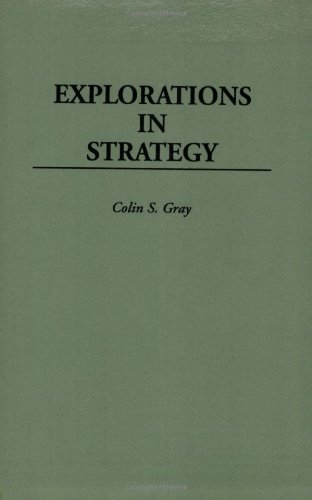
( This study is one of the rare contributions to the very...)
This study is one of the rare contributions to the very small library of genuine strategic studies. (Strategy here covers all military activity.) The broad purpose is to show how strategy works, using air power and special operations as substantial case studies, but also addressing sea power, nuclear deterrence, and information warfare. Although this book has many interesting things to say about the future of air power, the reliability of non-nuclear deterrence, the true character of joint warfare, the utility of special warriors, and the limitations of excellence in information warfare, the primary intention is to deepen the understanding of the nature and working of strategy and strategic effect.
http://www.amazon.com/gp/product/0275962563/?tag=2022091-20

http://www.amazon.com/gp/product/B01FGIK6OA/?tag=2022091-20

(Modern Strategy explains the permanent nature, but ever c...)
Modern Strategy explains the permanent nature, but ever changing character, of strategy in light of the whole strategic experience of the twentieth century. The book is a major contribution to the general theory of strategy; it makes sense of the strategic history of the twentieth century, and provides understanding of what that strategic history implies for the century to come. The book offers a uniquely comprehensive analysis of the different facets of modern strategy. The classic writings of Carl von Clausewitz are reconsidered for their continuing relevance, while possible successors are appraised. In addition to arguing that Clausewitz figured out what strategy was, and how it worked, the book probes deeply into strategy's political, ethical, and cultural dimension. The book explains how strategic behaviour in the twentieth century has expanded from the two-dimensional world of the land and the surface of the sea, to include the ocean depths, the air, space, and most recently the 'cyberspace' environments. It also offers details analyses both of nuclear matters and of the realm of irregular violence. This is the first comprehensive account of all aspects of modern strategy since the Cold War ended and will be essential reading for all students of modern strategy and security studies.
http://www.amazon.com/gp/product/0198782519/?tag=2022091-20

http://www.amazon.com/gp/product/B019NE3TP6/?tag=2022091-20

http://www.amazon.com/gp/product/0030594421/?tag=2022091-20

http://www.amazon.com/gp/product/B008NXLDXY/?tag=2022091-20

(Airpower for Strategic Effect is intended to contribute t...)
Airpower for Strategic Effect is intended to contribute to the understanding of airpower-what it is, what it does, why it does it, and what the consequences are. This is the plot: airpower generates strategic effect. Airpower's product is strategic effect on the course of strategic history. Everything about military airpower is instrumental to the purpose of securing strategic effect.
http://www.amazon.com/gp/product/1780397852/?tag=2022091-20

(Author Colin Gray maintains that there are distinctive U....)
Author Colin Gray maintains that there are distinctive U.S. and Soviet national styles which come into play in each power's nuclear strategic planning. And the U.S.'s lack of understanding of the fundamental historical and anthropological factors that make up the Soviet national style has led to poor U.S. policy. Perhaps no issue is more critical for the U.S. as nuclear strategy planning; this book is a statement to be reckoned with in the surrounding debate. Co-published with Abt Books.
http://www.amazon.com/gp/product/0819153346/?tag=2022091-20
political scientist university professor
Gray was educated at the University of Manchester and the University of Oxford.
In addition, he is a Senior Associate to the National Institute for Public Policy. He worked at the International Institute for Strategic Studies and the Hudson Institute, before founding the National Institute for Public Policy in Washington, District of Columbia He has also served as a defence adviser both to the British and United States. governments. Gray served from 1982 until 1987 in the Reagan Administration"s General Advisory Committee on Arms Control and Disarmament.
Furthermore, he has taught at the University of Hull, the University of Lancaster, York University, Toronto and University of British Columbia.
Gray has published 23 books on military history and strategic studies, as well as numerous articles
(Taking issue with the complacent belief that a happy mixt...)
(What is Soviet-American competition all about? Is the Sov...)
(Airpower for Strategic Effect is intended to contribute t...)
(Airpower for Strategic Effect is intended to contribute t...)
(Modern Strategy explains the permanent nature, but ever c...)
(Weaponry does not equal strategy, argues Colin Gray, but ...)
( This study is one of the rare contributions to the very...)
(Author Colin Gray maintains that there are distinctive U....)
(Book by Gray, Colin S.)
( Colin S. Gray has advised governments on both sides of ...)
