Royal Holloway, University of London. Photo: Rwendland, CC BY-SA 3.0, via Wikimedia Commons (https://commons.wikimedia.org/wiki/File:Founder%27s_Building,_Royal_Holloway,_south_quad.jpg)
Career
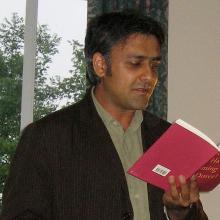
Gallery of Daljit Nagra
Brunel University London. Photo: Basher Eyre, CC BY-SA 2.0, via Wikimedia Commons (https://commons.wikimedia.org/wiki/File:The_Wilfred_Brown_Building_at_Brunel_University_-_geograph.org.uk_-_1518813.jpg)
Royal Holloway, University of London. Photo: Rwendland, CC BY-SA 3.0, via Wikimedia Commons (https://commons.wikimedia.org/wiki/File:Founder%27s_Building,_Royal_Holloway,_south_quad.jpg)
Brunel University London. Photo: Basher Eyre, CC BY-SA 2.0, via Wikimedia Commons (https://commons.wikimedia.org/wiki/File:The_Wilfred_Brown_Building_at_Brunel_University_-_geograph.org.uk_-_1518813.jpg)
Daljit Nagra is a British poet, professor, and broadcaster known for poetry shaped by Punjabi-inflected English, migration, and British Asian experience. His collections include Look We Have Coming to Dover!, Ramayana, British Museum, indiom, and Yiewsley. He has won major poetry prizes and served as Chair of the Royal Society of Literature.
Background
Daljit Nagra was born in Yiewsley, near Heathrow in West London, to Sikh Punjabi parents who had come to Britain from India in the late 1950s. His father worked in a concrete factory and his mother in a hospital laundry before the family moved to Sheffield in 1982, when his parents bought a convenience store in Gleadless Valley.
Nagra encountered poetry seriously at nineteen through William Blake's Songs of Innocence and of Experience. He later studied English literature at evening classes before moving to London for university study. His early experience of a Punjabi-speaking immigrant household and of growing up in London and Sheffield became important contexts for his later poetry about language, migration, class, and cultural belonging.
Education
Nagra studied English at Royal Holloway, University of London, receiving both a Bachelor of Arts and a Master of Arts. Royal Holloway developed from the nineteenth-century tradition of women's higher education and later became part of the federal University of London; during Nagra's studies it was an established centre for English and humanities education in Surrey and west London.
Before university, he completed A-level study through evening classes, including English Literature. His literary development also involved poetry workshops and mentoring from writers including Ruth Padel, Angela Dove, Pascale Petit, Moniza Alvi, Roddy Lumsden, John Stammers, Carol Ann Duffy, Jackie Kay, and Stephen Knight.
Nagra began publishing poems in magazines in the late 1990s, initially using the pseudonym Khan Singh Kumar. His pamphlet Oh My Rub! won the Smith/Doorstop Books Pamphlet Competition and became the first Poetry Book Society Pamphlet Choice in 2003. His poem “Look We Have Coming to Dover!” won the 2004 Forward Prize for Best Individual Poem, and Faber accepted the manuscript of his first full collection in 2005.
Look We Have Coming to Dover! appeared in 2007 and won the Forward Prize for Best First Collection and the South Bank Show/Arts Council Decibel Award. Nagra subsequently published Tippoo Sultan's Incredible White-Man-Eating Tiger Toy-Machine!!!, Ramayana, British Museum, indiom, and Yiewsley. His poetry frequently uses Punjabi-inflected English, inventive wordplay, and shifting registers to examine migration, race, class, cultural memory, and British identity.
Nagra has taught poetry and creative writing, including at Brunel University London, where he is Professor of Creative Writing. He was the inaugural Poet-in-Residence for BBC Radio 4 and Radio 4 Extra in 2015 and presents the weekly Poetry Extra programme on Radio 4 Extra. He has also served as Lead Poetry Tutor at the Faber Academy, as a visiting workshop leader, and as a contributor to BBC radio and newspapers including The Guardian, The Observer, The Financial Times, and The Times of India.
He was Keats House Poet-in-Residence from July 2014 to June 2015 and an Eton College Wisdom Scholar in November 2014. He became Chair of the Royal Society of Literature in 2020, the first writer of colour to hold that position, and has served on the Council of the Society of Authors and as a national adviser to Poetry By Heart. In 2023 he was commissioned to write “Light Up the Nation” for the King's Coronation Concert.
Nagra's poem “Look We Have Coming to Dover!” won the 2004 Forward Prize for Best Individual Poem, bringing Punjabi-inflected English and the experience of British Asian migration to a prominent national poetry audience.
His debut collection Look We Have Coming to Dover! won the 2007 Forward Prize for Best First Collection and the South Bank Show/Arts Council Decibel Award.
Nagra became the inaugural Poet-in-Residence for BBC Radio 4 and Radio 4 Extra in 2015 and later presented the weekly Poetry Extra programme.
He was appointed Chair of the Royal Society of Literature in 2020, becoming the first writer of colour to hold the position.
Nagra wrote “Light Up the Nation” for the King's Coronation Concert in 2023.
(Nagra's first pamphlet, published by Smith/Doorstop Books...)
2003
Views
Nagra's poetry treats language as a site where migration, class, cultural memory, and power are negotiated. His use of Punjabi-inflected English challenges the idea that literary English must conform to a single standard register and presents linguistic mixture as a source of expressive possibility.
His writing repeatedly considers how British identity is formed through movement between cultures and generations. In works including Ramayana, indiom, and Yiewsley, inherited stories and contemporary British experience are placed in conversation rather than kept as separate cultural domains.
Membership
Nagra is a Fellow and former Chair of the Royal Society of Literature, an organisation founded in 1820 to promote literature and support writers. He has also served on the Council of the Society of Authors, a professional body representing and protecting authors' interests in the United Kingdom.
Fellow; served as Chair from 2020.
Royal Society of Literature
,
United Kingdom
Served on the Council.
Society of Authors
,
United Kingdom
Personality
Nagra has described an initially low level of confidence in his poetry and a gradual development through workshops, editorial criticism, and mentoring. He has also described writing wherever he happens to be rather than treating poetry as work restricted to a formal desk or office.
Quotes from others about the person
Nagra's poetry has been praised for its energetic wordplay, inventive use of Punjabi-inflected English, and ability to combine comic performance with serious reflections on migration and cultural identity.
Interests
Poetry performance, literary workshops, radio broadcasting, and the relationship between poetry and public education.
Writers
William Blake
Music & Bands
Rock music, including The Jam's album Sound Affects.
Connections
Nagra lives in Harrow with his wife, Katherine, and their daughters Maia and Hannah. His family background connects Punjabi migration to Britain with the working-class communities of West London and Sheffield that recur in his poetry.
Wife:
Katherine Nagra
Daughter:
Maia Nagra
Daughter:
Hannah Nagra
References
Daljit Nagra official biography
Documents Nagra's family background, education, writing development, publications, teaching, broadcasting, literary service, and current professional roles.
Daljit Nagra
National Portrait Gallery biography documenting Nagra's origins, education, teaching, literary works, and Chairmanship of the Royal Society of Literature.
Daljit Nagra
T. S. Eliot Prize biography documenting Nagra's major collections, awards, shortlists, teaching, broadcasting, and literary service.
Daljit Nagra
Poetry Archive biography documenting Nagra's Forward Prize achievements, Oh My Rub!, Arts Council Decibel Award, and poetic concerns.
Daljit Nagra
Poetry Foundation profile documenting Nagra's London upbringing, Faber collections, and Ramayana.