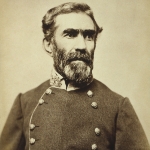
Daniel Weisiger Adams was an American lawyer and soldier. He was a brigadier general in the Confederate States Army during the American Civil War.
Background
Daniel Weisiger Adams was born in 1820 in Lynchburg, Virginia, United States. He was the son of George and Anna Weisiger Adams. While he was still a child, his father moved to Mississippi. Here, the elder Adams was district attorney from 1830 to 1836, and district judge from 1836 to 1839. Brigadier General Wirt Adams was his brother.
Education
Adams was educated at the University of Virginia from 1838 to 1842.
Daniel Weisiger Adams became a lawyer, practicing in Louisiana, where he gained some reputation.
In 1843 as a result of a quarrel over accusations of his father he killed editor James Hagan of Vicksburg under circumstances which suggested self-defense. He was tried for murder and acquitted.
In 1861 the governor of Louisiana appointed him one of three members of the military board to organize the state for war. Two regiments were formed, one of cavalry and one of infantry. Of the latter, Adams was appointed lieutenant-colonel, and on October 30, 1861, he was commissioned a colonel. The regiment was then at Pensacola, Florida, where preparations were being made to take Fort Pickens on Santa Rosa Island.
The enterprise was abandoned, however, and in the spring of 1862 Adams and his men took part in the operations of the West. At Shiloh, they were in Wither's division of the 2nd Corps under Gen. Bragg. Early in the first day's fighting, April 6, the brigade commander was killed, and Adams succeeded him, leading his troops in the attack which, in spite of heroic resistance, finally drove back and broke Prentiss's division on the Union left. In this engagement, Adams lost an eye. On May 23 he was commissioned brigadier-general.
Recovering from his wound sufficiently to take part in the Kentucky campaign, he commanded the Louisiana brigade of the Army of Tennessee, in the wing under General Hardee at Perryville, on October 8, 1862.
Again, at Stone's River (Murfreesboro), December 31 of the same year, Adams saw fierce fighting, his brigade was a part of the force which was sent to the support of General Polk, and one of the two which attacked a Union force of fifteen guns supported by infantry. The Confederates were repulsed, having lost about a third of their men, and he was again wounded.
He was able, however, to be at the battle of Chickamauga, on September 19, 1863, where his brigade was the first in contact with the Union army. On the second day, in the attack of Breckinridge's division, he fought his way to the rear of the Union intrenchments, but when reinforcements came up was driven back. Once more he was wounded.
Soon after recovering from his wounds, Adams was placed in command of a cavalry brigade operating in northern Alabama and Mississippi, and on September 24, 1864, of the district of central Alabama. The conditions were those inevitable in the rear of any army when defeat is impending. Adams had to collect supplies, gather in deserters and malingerers, and suppress bushwhackers.
On March 11, 1865, he was given command of the entire state north of the Gulf department.
He took part in the defense of Selma against General Wilson, on April 2, 1865, and having evacuated Montgomery, fought a battle at Columbus, on April 16.
He was paroled at Meridian, Mississippi on May 9, 1865, and resumed the practice of his profession at New Orleans, where he died.
Achievements
Daniel Weisiger Adams became a prominent local politician and his practice became one of the largest in the city.
As a military, he distinguished himself by leading a successful attack on Brigadier General Benjamin Prentiss' Division, where he lost his right eye. On May 23, 1862, he was commissioned Brigadier General and that year led the Louisiana Brigade at the October 8 Battle of Perryville, Kentucky, and the December 1862 Battle of Stone's River, Tennessee.
Politics
Although Adams opposed the early moves toward secession, he was appointed by Governor Thomas O. Moore to raise troops and help prepare Louisiana for war.
Connections
Adams was married twice, first to Anna M. Bullus, and then to Mary Virginia Calloway. He had seven children.