

Education
Doctor of Philosophy, University Oxford, 2001.
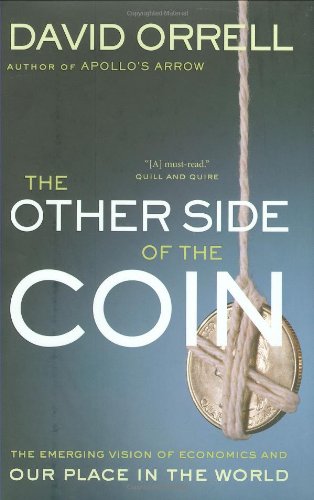
( According to author David Orrell, economics is in the m...)
According to author David Orrell, economics is in the middle of a revolution. The current theory based on a tradition of reductionist, mechanical thought that dates back to the time of Pythagoras has resulted in social injustice, huge disparities between the rich and the poor, and the degradation of the world’s ecology and environment. An alternative economic theory is now being fashioned, inspired by new sciences such as complexity and network theory, science-related movements like environmentalism, and social movements like feminism. The first heroes of this revolution include astronauts, student protestors, environmentalists, rock musicians, feminists, maverick mathematicians, and dissident scientists. All have had a hand in forging what is ultimately a new science of money. Part economic theory, part science, part popular history, and part manifesto, The Other Side of the Coin promises to change the way readers think about money forever.
http://www.amazon.com/gp/product/1552639819/?tag=2022091-20

(From the inability of wealth to make us happier, to our c...)
From the inability of wealth to make us happier, to our catastrophic blindness to the credit crunch, Economyths reveals ten ways in which economics has failed us all.Forecasters predicted a prosperous year in 2008 for financial markets - in one influential survey the average prediction was for an eleven percent gain. But by the end of the year, the Standard and Poor's 500 index - a key economic barometer - was down 38 percent, and major economies were plunging into recession. Even the Queen asked - "Why did no one see it coming?" An even bigger casualty was the credibility of economics, which for decades has claimed that the economy is a rational, stable, efficient machine, governed by well-understood laws. Mathematician David Orrell traces the history of this idea from its roots in ancient Greece to the financial centres of London and New York, shows how it is mistaken, and proposes new alternatives. Economyths explains how the economy is the result of complex and unpredictable processes; how risk models go astray; why the economy is not rational or fair; why until 2009 no woman had ever won the Nobel Prize for economics; why financial crashes are less Black Swans than part of the landscape; and finally, how new ideas in mathematics, psychology, and environmentalism are helping to reinvent economics. Economyths was a finalist for the 2011 National Business Book Award (Canada).
http://www.amazon.com/gp/product/0470677937/?tag=2022091-20
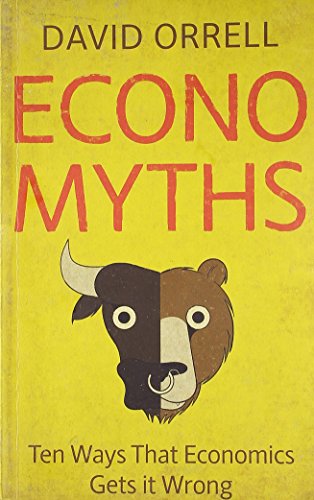
(From the inability of wealth to make us happier, to our c...)
From the inability of wealth to make us happier, to our catastrophic blindness to the credit crunch, "Economyths" reveals ten ways in which economics has failed us all. Forecasters predicted a prosperous year in 2008 for financial markets - in one influential survey the average prediction was for an eleven per cent gain. But by the end of the year, the Standard and Poor's 500 index - a key economic barometer - was down 38 per cent, and major economies were plunging into recession. Even the Queen asked - Why did no one see it coming? An even bigger casualty was the credibility of economics, which for decades has claimed that the economy is a rational, stable, efficient machine, governed by well-understood laws. Mathematician David Orrell traces the history of this idea from its roots in ancient Greece to the financial centres of London and New York, shows how it is mistaken, and proposes new alternatives. "Economyths" explains how the economy is the result of complex and unpredictable processes; how risk models go astray; why the economy is not rational or fair; why no woman (until 2009) had ever won the Nobel Prize for economics; why financial crashes are less Black Swans than part of the landscape; and, finally, how new ideas in mathematics, psychology, and environmentalism are helping to reinvent economics.
http://www.amazon.com/gp/product/1848311486/?tag=2022091-20
http://www.amazon.com/gp/product/B010BAEZJA/?tag=2022091-20
http://www.amazon.com/gp/product/B00GSW7192/?tag=2022091-20
Doctor of Philosophy, University Oxford, 2001.
(From the inability of wealth to make us happier, to our c...)
(From the inability of wealth to make us happier, to our c...)
( According to author David Orrell, economics is in the m...)
