

Background
Gonzalez-Foerster was born in Strasbourg, France, on June 30, 1965.

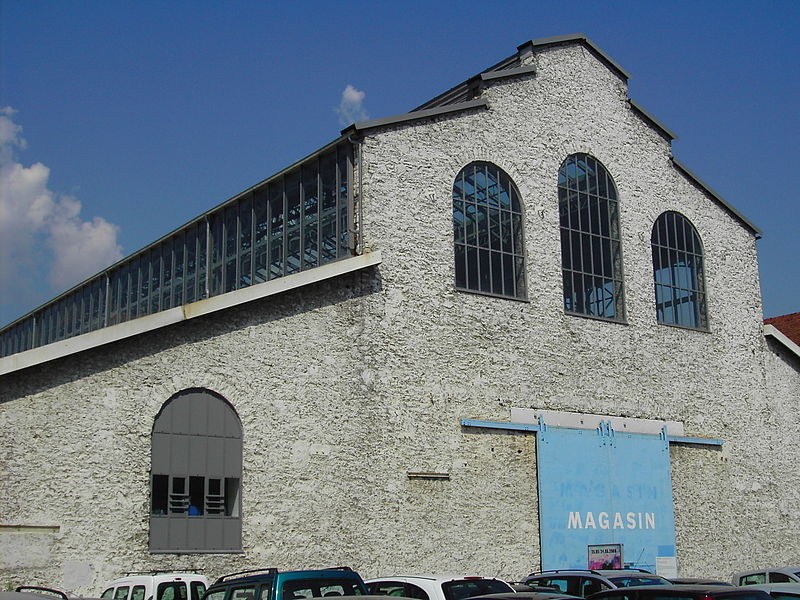
155 cours Berriat, 38028, Grenoble, France
González-Foerster became a student of the École du Magasin of the National Centre of Contemporary Art in Grenoble in 1987, graduating in 1988.

25 Rue Lesdiguières, 38000 Grenoble, France
González-Foerster started her artistic education at the École supérieure d'Art de Grenoble, where she studied from 1982 to 1987.

Dominique Gonzalez-Foerster during her exhibition.

Dominique Gonzalez-Foerster in front of her work.

Portrait of Dominique Gonzalez-Foerster.

Dominique Gonzalez-Foerster.

Dominique Gonzalez-Foerster portrayed by Oliver Mark, Paris 2002

Dominique Gonzalez-Foerster with her work.

Dominique Gonzalez-Foerster. Photo by Fred Ernst.

Gonzalez-Foerster photographed at the gates of the Crystal Palace.

Gonzalez-Foerster.
155 cours Berriat, 38028, Grenoble, France
González-Foerster became a student of the École du Magasin of the National Centre of Contemporary Art in Grenoble in 1987, graduating in 1988.
25 Rue Lesdiguières, 38000 Grenoble, France
González-Foerster started her artistic education at the École supérieure d'Art de Grenoble, where she studied from 1982 to 1987.
Dominique Gonzalez-Foerster during her exhibition.
Dominique Gonzalez-Foerster in front of her work.
Portrait of Dominique Gonzalez-Foerster.
Dominique Gonzalez-Foerster.
Dominique Gonzalez-Foerster.
Dominique Gonzalez-Foerster portrayed by Oliver Mark, Paris 2002
Dominique Gonzalez-Foerster with her work.
Dominique Gonzalez-Foerster. Photo by Fred Ernst.
Gonzalez-Foerster photographed at the gates of the Crystal Palace.
Gonzalez-Foerster.


Gonzalez-Foerster was born in Strasbourg, France, on June 30, 1965.
Dominique González-Foerster grew up in Grenoble, France. She started her artistic education at the École supérieure d'Art de Grenoble, where she studied from 1982 to 1987.
González-Foerster became a student of the École du Magasin of the National Centre of Contemporary Art in Grenoble in 1987, graduating in 1988. She also studied at the Institute des Hautes Études en Arts Plastiques, in Paris, completing her studies there in 1989.
When Gonzalez-Foerster was 17, she worked as a museum guard in Grenoble. Her artistic career began in the 1990s, when she began working primarily with films. Her early works were primarily short, minimalistic films. Now she collaborates on everything from the writing of a science fiction novel with fellow artist Philippe Parreno to working with rock singer Alain Bashung, with whom she designed sets in 2003. She has also worked in designing displays for the fashion boutiques of fashion house Balenciaga in Paris, Los Angeles, and New York. She has even been a designer of a house for a collector in Tokyo.
Dominique Gonzalez-Foerster usually seeks her inspiration in literature, film, modernist architecture, and art history. Her works are often characterized by a quiet, intimate interrogation of contemporary urban life. She frequently uses fragments from her international travels in her oeuvre and reassembles them into something brand-new.
Gardens and landscapes are also pivotal to González-Foerster’s art. For example, her film Gloria (2008) focuses on the Praa Paris in Rio de Janeiro and the incongruity of French landscaping to the tropical climate. From October 14, 2008, to April 13, 2009, the show was entitled "The Unilever Series: Dominique Gonzalez-Foerster: TH.2058" was held at the Turbine Hall of Tate Modern in London. It was her first public commission in the United Kingdom and filled half of the 3,400 square meter hall.
Her installation at the Hispanic Society of America in New York was installed under the title "chronotopes & dioramas" in 2009. In her work Desert Park (2010), commissioned by Inhotim in Belo Horizonte, Brazil, Dominique González-Foerster brought together decontextualized elements of fabricated concrete bus furniture on a plot of sand to create a site redolent of Brasília.
Dominique Gonzalez-Foerster hopes that her installations will encourage people to interact with them. The artist has had plenty of solo exhibitions, including those at the Centre Georges Pompidou, Paris (2002); Kunsthalle Zürich (2004); Museo de Arte Contemporáneo de Castilla y Léon, Spain (2008); Dia Art Foundation, New York (2009); Guggenheim Museum, New York (2011); and Palacio de Cristal, Museo Nacional Centro de Arte Reina Sofía, Madrid (2014).
Gonzalez-Foerster's artworks have also been included in the collective exhibitions Documenta, Kassel, Germany (2002); the São Paulo Biennial (2006); Skulptur Projekte Münster, Germany (2007); the Venice Biennale (2009); Performa, New York, and The New Monumentality, Henry Moore Institute, Leeds, United Kingdom (both 2009); and Human Valley-The Other Side of Contemporary History, Kunsthalle Zürich (2012). For the season 2015/2016 in the Vienna State Opera, Dominique Gonzalez-Foerster designed a large-scale picture (176 sqm) as part of the exhibition series "Safety Curtain".
The artist currently lives and works in Paris and Rio de Janeiro.

Dominique Gonzalez-Foerster was one of the most important and influential artists of her generation. She was one of the first to focus on the exhibition itself as an artistic medium. Her sole interest in space, alongside a preoccupation with cinema, literature, media, and technology has resulted in a uniquely cross-disciplinary practice.
Her work has been exhibited at major galleries and museums of the world, including the Musée d’Art Moderne de la Ville de Paris, the Centre Pompidou, the Tate Modern, the Dia Art Foundation, among others.
Dominique Gonzalez-Foerster received the Mies van der Rohe Award, Germany, in 1996-1997 and the Marcel Duchamp Award in 2002.
Untitled
Chambre en ville
Exotourisme
Untitled
Tapis de lecture
Untitled (Michel Butor)
Repulse Bay
Dream
After
Mixing text with terrain
Seance de Shadow II
Poubelles (Lot de cinq)
Poubelles (Lot de cinq)
LIP (Bleu)
La loge (Numero bleu)
Plage Parallele
Untitled
Untitled
euqinimod & costumes
Ludwig II (M.2062)
Fitzcarraldo
Cuentos Experimentales del siglo XXI
Quotations:
"My approach to art is quite radical. It has more to do with theatre and staging than making objects such as paintings or sculptures."
"I always look for experimental processes. I like the fact that at the beginning I don't know how to do things and then, slowly, I start learning. Often exhibitions don't give me this learning possibility anymore."
"I want to coax people to engage with my art, in the same way that a writer might entice people to read a book."


