

Background
Foley, Duncan Karl was born on June 15, 1942 in Columbus, Ohio, United States. Son of Gerard M. and Ruth C. (Johnson) Foley.
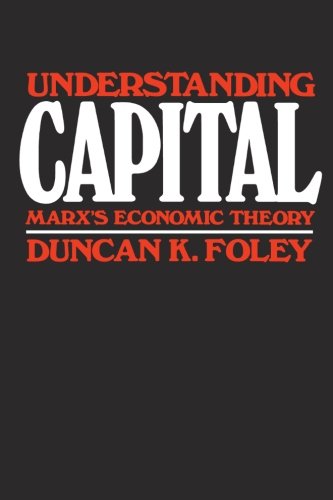
( Understanding Capital is a brilliantly lucid introducti...)
Understanding Capital is a brilliantly lucid introduction to Marxist economic theory. Duncan Foley builds an understanding of the theory systematically, from first principles through the definition of central concepts to the development of important applications. All of the topics in the three volumes of Capital are included, providing the reader with a complete view of Marxist economics. Foley begins with a helpful discussion of philosophical problems readers often encounter in tackling Marx, including questions of epistemology, explanation, prediction, determinism, and dialectics. In an original extension of theory, he develops the often neglected concept of the circuit of capital to analyze Marx's theory of the reproduction of capital. He also takes up central problems in the capitalist economy: equalization of the rates of profit (the "transformation problem"); productive and unproductive labor and the division of surplus value; and the falling rate of profit. He concludes with a discussion of the theory of capitalist crisis and of the relation of Marx's critique of capitalism to his conception of socialism. Through a careful treatment of the theory of money in relation to the labor theory of value, Foley clarifies the relation of prices to value and of Marx's categories of analysis to conventional business and national income accounts, enabling readers to use Marx's theory as a tool for the analysis of practical problems. The text is closely keyed throughout to the relevant chapters in Capital and includes suggestions for further reading on the topics discussed.
http://www.amazon.com/gp/product/0674920880/?tag=2022091-20
Foley, Duncan Karl was born on June 15, 1942 in Columbus, Ohio, United States. Son of Gerard M. and Ruth C. (Johnson) Foley.
Bachelor of Arts Central High School, Philadelphia, Pennsylvania, 1960. Bachelor of Arts (Mathematics) Swarthmore College, 1964. Doctor of Philosophy Yale University, 1966.
Assistant Professor, Association Professor of Economics, Massachusetts Institute of Technology, Cambridge, Massachusetts, United States of America, 1966-1973. Association Professor of Economics, Stanford University, 1973-1979. Professor of Economics, Barnard College, Columbia University, New York, United States of America,
1979-.
Editorial Board, Journal of Economic Theory,
1976-1981.
Journal of Economic Literature, 1984-1987.
( Understanding Capital is a brilliantly lucid introducti...)
My early work involved the extension of the general equilibrium model of resource allocation to economies with public goods, and the investigation of game theoretic solutions in that context. The main research problem that has engaged me has been the problem of the instability of accumulation in capitalist economies, or, in more traditional language, the business cycle, and the role of money in those phenomena. After attempting a synthesis of Keynesian and neoclassical approaches to these problems with Miguel Sidrauski, further investigations of deeper problems in these models led me to conclude that an understanding of these issues would require a fundamental reworking of the bases of economic theory, and in particular the abandonment of the traditional neoclassical paradigm of price determination through universal market clearing.
My search for an alternative has led me to study the classical political economists and Marx, with particular attention to their theories of value, money and accumulation. My current project is to formulate these theories in operational and testable terms through the use of modern mathematical techniques, and to discover the relations between these theories and those of neoclassical economics and Keynes.
Member American Economics Association, Union Radical Political Economy.
Married Helene Peet, June 11, 1966. 1 child, Nicholas C. B.
