

Background
Sinnott, Edmund Ware was born on February 5, 1888 in Cambridge, Massachusetts, United States. Son of Charles Peter and Jessie Elvira (Smith) Sinnott.


(Non-fiction)
Non-fiction
http://www.amazon.com/gp/product/B0007F94UU/?tag=2022091-20

(CELL AND PSYCHE THE BIOLOGY OF PURPOSE By EDMUND W. SINNO...)
CELL AND PSYCHE THE BIOLOGY OF PURPOSE By EDMUND W. SINNOTT. PREFACE TO THE TORCHBOOK EDITION: SINCE the publication of this little book, as the McNair Lectures at the University of North Carolina, the author has written two others, as well as a number of papers, on the same gen eral theme. Though these elaborate the argument a little further, the essence of it is in Cell and Psyche. This is admittedly a specula tion, but one based solidly on biological fact. It has been regarded as rather visionary and metaphysical by some people, but others have been attracted to it by the suggestion it offers for a better understanding of the ancient problem of how mind and body are related to each other. This problem is of such paramount impor tance, not only for a knowledge of what man really is but for the construction of a satisfying life philosophy, that any light thrown on it should be welcome. The suggestion that man's physical life grows out of the basic goal-seeking and purposiveness found in all organic behavior and that this, in turn, is an aspect of the more general self - regulating and normative character evident in the development and activities of living organisms, is at least worth serious consideration. If we are to avoid a dualistic idea of man's nature and to construct a true monism that does not require the sacrifice of the significance of either mind or body, some such conception as this seems a rea sonable means of doing so. It is to be hoped that the wider distri bution now made possible for the present book may result in a more general consideration of this particular relationship between biol ogy and philosophy* E. W. S. CONTENTS: Introduction . i I. Organization, the Distinctive Character of All Life 15 II. Biological Organization and Psychological Activity 43 IIL Some Implications for Philosophy 75 Suggested Readings . 112 Index . 117. INTRODUCTION: IN THE CLAMOR and confusion of our times one fact grows ever clearer beliefs are important. One of the major problems with which men now are faced per haps, indeed, the most important one is the wide dis agreement which still exists in their fundamental philos ophies. What course a man will follow, or a nation, is set in no small measure by his basic creed, by what he really thinks about the true nature of a human being his personality, his freedom, his destiny, his relations to others and to the rest of the universe; by the judgments lie makes as to what qualities and courses of action are admirable and should command his allegiance. These are not academic questions merely. They arc ancient mys teries which long have troubled human hearts and seem today almost as far as ever from solution. The answer a ny* n gives to them is the most significant thing that one can know about him. We may be tempted to under estimate the importance of these inner directives and turn instead to outer influences, to economic and social factors, as more decisive for our actions. But when we look at what the philosophy of Marx has done to set one half the world against the other, at the basic divergence between the thinking of East and West, and at so many other differences in political and religious beliefs which now divide mankind, we can hardly doubt the profound practical import of men's philosophies. It is still true today that as a man thinketh in his heart, so is he. In the minds of men are the most fateful battles fought. Against those ideologies we condemn, force in the end will fail. If our opponents cannot be convinced, or their ideas reconci
http://www.amazon.com/gp/product/1443728977/?tag=2022091-20

http://www.amazon.com/gp/product/B000S81SXC/?tag=2022091-20
(paperback)
paperback
http://www.amazon.com/gp/product/B0007DLEBO/?tag=2022091-20

http://www.amazon.com/gp/product/B01K9C236W/?tag=2022091-20

(an elementary text in presenting results of scientific pr...)
an elementary text in presenting results of scientific progress
http://www.amazon.com/gp/product/B000H5ANY6/?tag=2022091-20

(This is a pre-1923 historical reproduction that was curat...)
This is a pre-1923 historical reproduction that was curated for quality. Quality assurance was conducted on each of these books in an attempt to remove books with imperfections introduced by the digitization process. Though we have made best efforts - the books may have occasional errors that do not impede the reading experience. We believe this work is culturally important and have elected to bring the book back into print as part of our continuing commitment to the preservation of printed works worldwide.
http://www.amazon.com/gp/product/1116320991/?tag=2022091-20

http://www.amazon.com/gp/product/B000KU78SW/?tag=2022091-20

http://www.amazon.com/gp/product/B0006BO07M/?tag=2022091-20

(A classix text in the field)
A classix text in the field
http://www.amazon.com/gp/product/B000RVSBD0/?tag=2022091-20

http://www.amazon.com/gp/product/B001PCL49S/?tag=2022091-20

(Two Roads to Truth; A Basis for Unity Under the Great Tra...)
Two Roads to Truth; A Basis for Unity Under the Great Tradition An argument for a working partnership between religion and science.
http://www.amazon.com/gp/product/0670737070/?tag=2022091-20
Sinnott, Edmund Ware was born on February 5, 1888 in Cambridge, Massachusetts, United States. Son of Charles Peter and Jessie Elvira (Smith) Sinnott.
Bachelor of Arts, Harvard, 1908, Master of Arts, 1910, Doctor of Philosophy, 1913. Doctor of Science, Northeastern University, 1948. Lehigh, 1950.
He is best known for his work in plant morphology. Sinnott received his Bachelor of Arts in 1908, his Master of Arts Upon graduation, he became an instructor at Harvard, and worked with I. West. Bailey, the anatomist. From 1915-1928, he was at the Connecticut Agricultural College at Storrs, becoming Professor of Botany and Genetics.
From 1928-1939, he was Professor of Botany at Barnard College and chair of the Botany Department at Columbia University (1939-1940).
In 1940, he moved to Yale University to become Sterling Professor of Botany, chair of the Botany Department (1940-1956), director of the Marsh Botanical Garden (1940-1950), dean of the Graduate School (1950-1956) and director of Sheffield Scientific School (1945-1956). He was the co-author of the textbook Principles of Genetics (1925) which received positive reviews.
Throughout his life, Sinnott was a prolific author He wrote ninety scientific articles and many textbooks.
Sinnott contributed to the field of Colonial and early American Architecture with his book Meetinghouse & Church in Early New England (1963), with photographs by Jerauld Manter.
In his teaching, Sinnott stressed the idea of scientific discovery and the importance of making careful measurements and correctly interpreting data. He endeavored to explain the organism as an integrated whole from the sum of its parts, processes and history. He retired in 1956 and died in New Haven in 1968.
He held that view that life is goal directed and purposive.
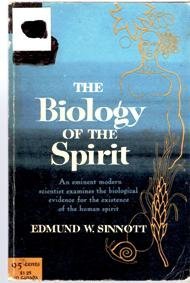
In his book Biology of Spirit (1955) he used the term Telism which he defined as "the philosophy of goals-a belief that what is important is not the push and drive of a living system but the drawing power of a goal, conscious or unconscious, that in some is established in it". Others such as George Gaylord Simpson claimed Sinnott was promoting a theological version of orthogenesis.
He rejected both dualism and materialistic monism for his own philosophy which was described by a reviewer as idealistic monism. He argued for the existence of an impersonal God which he described as a purposive organizing agent.
He was criticized by Leo Koch for making metaphysical statements in his science books, he stated for example "The Principle of Organization is far more than a scientific concept.
lieutenant states a belief that there is operating in the universe a something that leads to spirit. Something that is spirit." In his book he argued that mind and matter are two aspects of the same phenomenon and that purpose exists in all organisms as it is built into the genotype and the protoplasm.
(Two Roads to Truth; A Basis for Unity Under the Great Tra...)
(This is a pre-1923 historical reproduction that was curat...)
(an elementary text in presenting results of scientific pr...)
(CELL AND PSYCHE THE BIOLOGY OF PURPOSE By EDMUND W. SINNO...)
(A classix text in the field)
(Non-fiction)
(paperback)
Sinnott was a proponent of organicism and a critic of reductionism. His philosophy was compared by critics to a form of vitalism.
Member National Academy Sciences, American Philosophical Society, American Academy Arts and Sciences. Fellow of the American Association for the Advancement of Science (vice president 1935, president 1948), Botanical Society of America (president 1937), American Society Naturalists (president 1945), New England Botanical. Club (president 1931-1934).
Phi Beta Kappa, Sigma Xi.
McNair Lecturer University of North Carolina, 1949. Club: Graduates (New Haven).
Married Mabel H. Shaw. Children: Edmund Ware, Mildred Shaw, Clara Richardson.

