

Background
Katz, Elihu was born on May 31, 1926 in New York City. Son of Maurice Lionel and Rose (Lefkowitz) Katz.

http://www.amazon.com/gp/product/0563174161/?tag=2022091-20

(ARE THERE ANY? Many of us have our own canonic texts -- t...)
ARE THERE ANY? Many of us have our own canonic texts -- the kind that wona t go away. We tell them that their time has passed, that ita s embarrassing theya re still around, but they turn up repeatedly on our reading lists and in our bibliographies. They inspire us, haunt us, argue with us ---- but they wona t leave.
http://www.amazon.com/gp/product/B00FGVGANE/?tag=2022091-20

http://www.amazon.com/gp/product/B0089A7A7E/?tag=2022091-20

http://www.amazon.com/gp/product/B008VQU7SU/?tag=2022091-20

( Broadcasting has long been considered one of the keys ...)
Broadcasting has long been considered one of the keys to modernization in the developing world. Able to leap the triple barrier of distance, illiteracy, and apathy, it was seen as a crucial clement in the development of new nations. Recently, however, these expectations have been disappointed by broadcasting's failures to reach the rural masses and the urban unemployed. Broadcasting has also come under attack as serious questions have been raised about its uncritical importation of western culture. Now, in Broadcasting in the Third World, Elihu Katz and George Wedell offer the first complete coverage of the problems and promises of broadcasting in the third world. Their findings, often controversial and always illuminating, will be of considerable value to sociologists, political scientists, communications specialists, and students of development. Broadcasting in the Third World is based on field research in eleven developing countries (Algeria, Brazil, Cyprus, Indonesia, Iran, Nigeria, Peru, Senegal, Singapore, Tanzania, and Thailand) and secondary source material from a further eighty countries. In looking at the role of broadcasting in national development, the authors focus on three areas of promise: national integration, socio-economic development, and cultural continuity and change. They describe the ways in which the technology and content of broadcasting have been transferred from the developed west to the third world, and the go on to show that western broadcasting must be adapted to suit the specific political, economic and social structures of each developing country. The authors conclude with a series of recommendations which challenge most of the assumptions upon which the principles and practices of broadcasting are based. Well-researched, extensively documented, it will challenge policy-makers and provide important data for researchers.
http://www.amazon.com/gp/product/0674083415/?tag=2022091-20

(In the new paperback edition of this classic text, Liebes...)
In the new paperback edition of this classic text, Liebes and Katz examine how television viewers around the world respond differently to popular television programmes, particularly Dallas. Analszing conversations among viewers in Israel, Japan and the U. S., they show that viewers possess a good deal more critical ability than they are commonly given credit for.
http://www.amazon.com/gp/product/0745612954/?tag=2022091-20

(Book by Katz, Elihu, Gurevitch, Michael)
Book by Katz, Elihu, Gurevitch, Michael
http://www.amazon.com/gp/product/0571098487/?tag=2022091-20

http://www.amazon.com/gp/product/B012YWJVV0/?tag=2022091-20

(First published in 1955, "Personal Influence" reports the...)
First published in 1955, "Personal Influence" reports the results of a pioneering study conducted in Decatur, Illinois, validating Paul Lazarsfeld's serendipitous discovery that messages from the media may be further mediated by informal "opinion leaders" who intercept, interpret, and diffuse what they see and hear to the personal networks in which they are embedded. This classic volume set the stage for all subsequent studies of the interaction of mass media and interpersonal influence in the making of everyday decisions in public affairs, fashion, movie-going, and consumer behavior. The contextualizing essay in Part One dwells on the surprising relevance of primary groups to the flow of mass communication. Peter Simonson of the University of Pittsburgh has written that "Personal Influence was perhaps the most influential book in mass communication research of the postwar era, and it remains a signal text with historic significance and ongoing reverberations...more than any other single work, it solidified what came to be known as the dominant paradigm in the field, which later researchers were compelled either to cast off or build upon." In his introduction to this fiftieth-anniversary edition, Elihu Katz discusses the theory and methodology that underlie the Decatur study and evaluates the legacy of his coauthor and mentor, Paul F. Lazarsfeld.
http://www.amazon.com/gp/product/1412805074/?tag=2022091-20

http://www.amazon.com/gp/product/B00Y2SG2TO/?tag=2022091-20
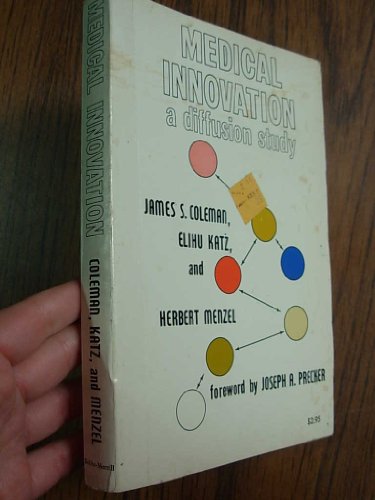
(Medical Innovation: A Diffusion Study Jan 01, 1966 James ...)
Medical Innovation: A Diffusion Study Jan 01, 1966 James S. Coleman; Elihu Katz and Herbert Menzel
http://www.amazon.com/gp/product/B0006BOQ6M/?tag=2022091-20

(Book by Segal, Jerome M., Levy, Shlomit, Sa Id, Nader Izz...)
Book by Segal, Jerome M., Levy, Shlomit, Sa Id, Nader Izzat, Katz, Elihu
http://www.amazon.com/gp/product/0791445380/?tag=2022091-20
sociologist communications educator
Katz, Elihu was born on May 31, 1926 in New York City. Son of Maurice Lionel and Rose (Lefkowitz) Katz.
Bachelor, Columbia University, 1948. Master of Arts, Columbia University, 1950. Doctor of Philosophy, Columbia University, 1956.
Certified in Japan studies, University Chicago, 1945. Doctor (honorary), University Ghent, Belgium, 1989. Doctor (honorary), University Montreal, Canada, 1990.
Doctor (honorary), University Paris 2, 2000. Doctor (honorary), University Haifa, Israel, 2000.
Research associate Bureau Applied Social Research Columbia University, New York City, 1951-1954. From assistant to associate professor University Chicago, 1954-1969. Professor Hebrew University, Jerusalem, 1963-1993.
Trustee professor University Pennsylvania, Philadelphia, since 1993. Science advisory committee National Science Foundation, Washington, 1960—1962. Founding director Israel television, Jerusalem, 1967—1969.
Consultant Office Social Research Columbia Broadcasting System, New York City, 1969, British Broadcasting Corporation, London, 1970—1971, 1975—1977. Distinguished visiting professor University Southern California, Los Angeles, 1978—1992, University Padua, Italy, 1985, Keio University, Tokyo, 1988, Pacific Union College, Porte Alegre, Brazil, 1999, University Vienna, 2002. Science director Israel Institute Applied Social Research, Jerusalem, 1988—1995.
Wilbur Schramm Memorial lecturer University Illinois, 1990. Wayne Danielson lecturer University Texas, 1995. Paul Lazarsfeld Memorial lecturer Columbia University, New York City, 1989.
John Siegenthaler lecturer Middle Tennessee State University, 1996. Samuel Becker lecturer University Iowa, Des Moines, 2001.
(First published in 1955, "Personal Influence" reports the...)
(Is there really a global village out there? It may be tru...)
(Constituting a new television genre, live broadcasts of "...)
(In the new paperback edition of this classic text, Liebes...)
( Broadcasting has long been considered one of the keys ...)
(ARE THERE ANY? Many of us have our own canonic texts -- t...)
(Medical Innovation: A Diffusion Study Jan 01, 1966 James ...)
(Book by Katz, Elihu, Gurevitch, Michael)
(Book by Katz, Elihu, Gurevitch, Michael)
(Fine cloth copy in an equally fine dw. Particularly and s...)
(Book by Segal, Jerome M., Levy, Shlomit, Sa Id, Nader Izz...)
Active Israel Council Culture and Arts, 1970—1973, Israel Film Council, 1972—1976. Chairman United States Educational Foundation Israel, 1976, board directors, 1971—1975, chairman, 1976. Fellow: International Commission Association, American Sociological Association.
Member: International Institute Communications (trustee 1977-1981), World Association Public Opinion Research, American Association Public Opnion Research, Israel Sociological Society (chairman 1977-1981), International Sociological Association, American Academy Arts and Sciences, Penn Club (New York ).
Married Ruth Torgovnik, September 16, 1951. Children: Matthew Joseph, Nathaniel Zvi.
