

Background
Scott, Elizabeth S. was born in 1945 in Washington, District of Columbia, United States.
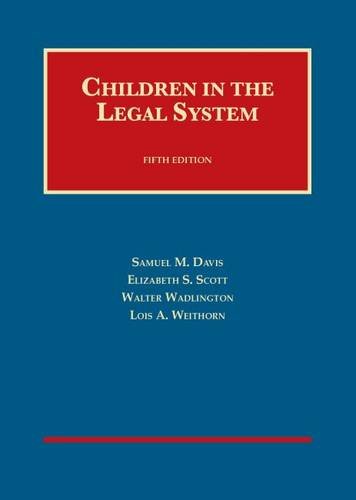
(This Edition has been thoroughly updated with the latest ...)
This Edition has been thoroughly updated with the latest cases, statutory references, and scholarly commentary. It also includes coverage of recent Supreme Court decisions such as: • Miller v. Alabama/Jackson v. Hobbs (2012), in which the Court held that mandatory imposition of a sentence of life without parole in the case of one who was a juvenile at the time of the offense violates the Eighth Amendment’s prohibition against cruel and unusual punishment • Graham v. Florida (2010), Miller’s predecessor, in which the Court held that imposition of a sentence of LWOP on a juvenile for a nonhomicide offense violated the Eighth Amendment • Florida v. Harris (2013), in which the Court, although in an adult, non-school search context, held that an alert by a trained, drug-sniffing dog constitutes a presumption of probable cause to search • J.D.B. v. North Carolina (2011), in which the Court held that a juvenile’s age is a factor that can be taken into account in determining whether one is “in custody” for Miranda and interrogation purposes • Stafford Unified School District No. 1 v. Redding (2009), in which the Court held that a strip search of a 13-year-old middle school student violated the Fourth Amendment’s prohibition against unreasonable search and seizure • Adoptive Couple v. Baby Girl (2013), in which the Court held that the preferences given to members of an Indian child’s family, members of the child’s tribe, or other Indian families, under the federal Indian Child Welfare Act, do not apply where there is no alternative party seeking to adopt the child. The 5th edition has retained the basic overall organizational structure of the previous edition, with one exception. Chapters 5 through 7, which focus on the legal response to child maltreatment, have been reorganized as follows: Chapter 5 addresses the substantive standards defining child abuse or neglect; Chapter 6 deals with processes characterizing the responses of the dependency and criminal justice systems to suspected child abuse or neglect; and Chapter 7 addresses various dispositions in child maltreatment cases. Within each chapter, substantial new material has been incorporated into the treatment of each topic. For example, Chapter 5 includes special attention to issues such as: specificity versus vagueness in construction of child maltreatment statutes; the line between corporal punishment and physical abuse; the relationships among poverty, race, homelessness, and neglect; the challenges of defining and identifying emotional or psychological maltreatment; and the interplay between domestic violence and child maltreatment. At the same time, Chapter 5 retains and updates this casebook’s distinctive in-depth examination of the appropriate legal responses to a range of medical neglect problems. Chapter 6 follows the processing of cases through the dependency and criminal justice systems respectively, examining topics relating to reporting statutes, summary removal, state liability for failure to protect, and constitutional and evidentiary issues encountered in criminal prosecution of alleged child maltreatment. Chapter 7 examines historical shifts in federal and state policy regarding child welfare system dispositional alternatives, considers the implications of the recent findings of developmental neuroscience for child protection policy reform, and contains materials that allow for critical analysis of a range of issues relating to the foster care system and legal mechanisms for the termination of parental rights. One of the distinguishing characteristics of this book, which the authors have retained in this edition, is its breadth of coverage and degree of flexibility in teaching. It deals with every aspect of how the law relates to minors, from free expression in school and other school-related issues to child custody, to private law (e.g.. torts and contracts), to the juvenile justice system (i.e., delinquency and the operation
http://www.amazon.com/gp/product/1609302362/?tag=2022091-20
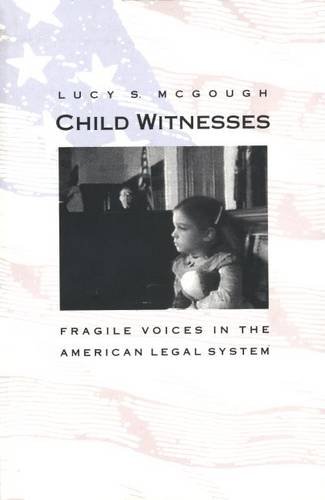
(Children are frequently called to testify in court in cri...)
Children are frequently called to testify in court in criminal prosecutions, divorce and child custody hearings, dependency abuse proceedings, and other disputes. But is their testimony reliable? This book carefully assesses research on the cognitive capabilities of children as well as the emotional, social, and moral influences that might affect children's potential reliability, and it recommends reforms in American legal processes that will protect child witnesses from trauma and ensure accurate testimony. Lucy S. McGough, a specialist in family law, examines the known developmental facts on perception, memory, and reporting that affect children's ability to serve as trial witnesses. She also analyzes many actual trials, including the McMartin Pre-School prosecution in California, the Morgan-Foretich custody and visitation controversy, and the five U.S. Supreme Court child sexual abuse cases, assessing how a child witness may be more prone to memory-fade, suggestibility, or fantasy than an adult witness. McGough also examines the legal processes and rules of evidence that affect how eyewitness accounts by children are received: trial processes for evaluating the credibility of witnesses; the hearsay rule and its exceptions; the Constitution's confrontation clause; and the use and abuse of expert witnesses. And she presents a proposal for the early videotaping of a child's eyewitness account in order to minimize the most serious potential reliability risks posed by child witnesses. The product of ten years of research and investigation, this book should help remedy the failure of American law to take into account all that we now know about the fragility of children's memories.
http://www.amazon.com/gp/product/0300068573/?tag=2022091-20
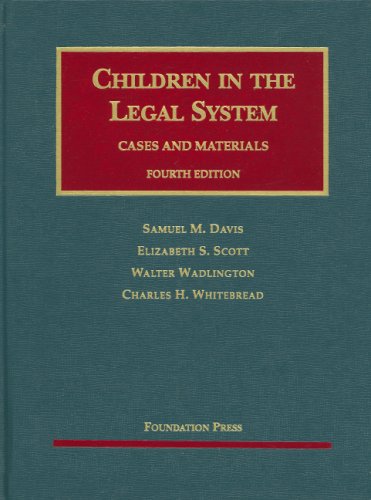
(The new 4th edition has been thoroughly updated with the ...)
The new 4th edition has been thoroughly updated with the latest and best cases and statutory references. It includes references to the most recent scholarly articles, books and other publications. It also includes coverage of some recent Supreme Court decisions such as:Morse v. Frederick (the BONG HITS 4 JESUS student free expression case)Roper v. Simmons (the juvenile death penalty case)Davis v. Washington and Hammon v. Indiana (clarifying the meaning of "testimonial" in the Court's earlier decision in Crawford v. Washington addressing Confrontation Clause issues with respect to statements made to police).This book is dinstiguished by its breadth of coverage and degree of flexibility in teaching. It deals with every aspect of how the law relates to minors, from free expression in school and other school-related issues to child custody, to private law (e.g., torts and contracts), to the juvenile justice system (i.e., delinquency and the operation of c
http://www.amazon.com/gp/product/1599414333/?tag=2022091-20

(CHILDREN IN THE LEGAL SYSTEM focuses on what has been acc...)
CHILDREN IN THE LEGAL SYSTEM focuses on what has been accomplished through legislation and judicial action since the Juvenile Justice Standards were published. General coverage of the juvenile justice system reflects the significant changes and new trends in this field. Highlights include: Cases that deal with subjects ranging from nocturnal juvenile curfews and school newspaper regulation to child abuse and medical decision making Discussion of permanent foster care Expanded coverage of custody and visitation Challenging conceptual treatment of the decision making capacity and authority of minor children An examination of adolescence as a legal category
http://www.amazon.com/gp/product/1566624592/?tag=2022091-20

(CHILDREN IN THE LEGAL SYSTEM focuses on what has been acc...)
CHILDREN IN THE LEGAL SYSTEM focuses on what has been accomplished through legislation and judicial action since the Juvenile Justice Standards were published. General coverage of the juvenile justice system reflects the significant changes and new trends in this field.
http://www.amazon.com/gp/product/1587785218/?tag=2022091-20
http://www.amazon.com/gp/product/0327002581/?tag=2022091-20
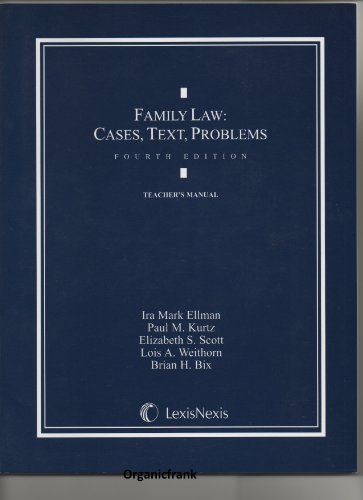
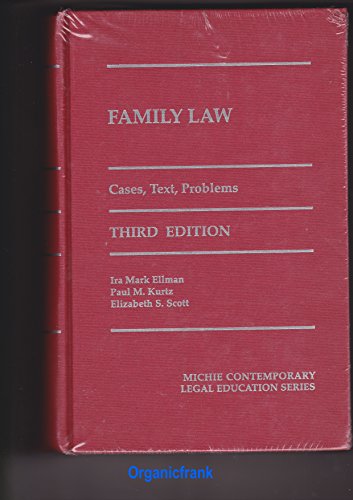
(PLEASE NOTE: Teacher's Manual. See my pictures posted abo...)
PLEASE NOTE: Teacher's Manual. See my pictures posted above, Organicfrank. ISBN: 0820561835. ***Family Law: Cases, Text, Problems*** 4th Edition, by Ira Mark Ellman, Paul M. Kurtz, Elizabeth S. Scott, Lois A. Weithorn, and Brian H. Bix. 2004 LexisNexis. 299 Numbered pages.
http://www.amazon.com/gp/product/0820561835/?tag=2022091-20
(Children are frequently called to testify in court in cri...)
Children are frequently called to testify in court in criminal prosecutions, divorce and child custody hearings, dependency abuse proceedings, and other disputes. But is their testimony reliable? This book carefully assesses research on the cognitive capabilities of children as well as the emotional, social, and moral influences that might affect children's potential reliability, and it recommends reforms in American legal processes that will protect child witnesses from trauma and ensure accurate testimony. Lucy S. McGough, a specialist in family law, examines the known developmental facts on perception, memory, and reporting that affect children's ability to serve as trial witnesses. She also analyzes many actual trials, including the McMartin Pre-School prosecution in California, the Morgan-Foretich custody and visitation controversy, and the five U.S. Supreme Court child sexual abuse cases, assessing how a child witness may be more prone to memory-fade, suggestibility, or fantasy than an adult witness. McGough also examines the legal processes and rules of evidence that affect how eyewitness accounts by children are received: trial processes for evaluating the credibility of witnesses; the hearsay rule and its exceptions; the Constitution's confrontation clause; and the use and abuse of expert witnesses. And she presents a proposal for the early videotaping of a child's eyewitness account in order to minimize the most serious potential reliability risks posed by child witnesses. The product of ten years of research and investigation, this book should help remedy the failure of American law to take into account all that we now know about the fragility of children's memories.
http://www.amazon.com/gp/product/0300057482/?tag=2022091-20
http://www.amazon.com/gp/product/B011DARNG4/?tag=2022091-20
(4)
4
http://www.amazon.com/gp/product/B00ZVOUOCE/?tag=2022091-20
Scott, Elizabeth S. was born in 1945 in Washington, District of Columbia, United States.
Bachelor, College William and Mary, 1967. Juris Doctor, University Virginia, 1977.
Attorney Michie, Hamlett, Donato & Lowry, Charlottesville, Virginia, 1977—1978. Legal director Forensic Psychiatry Clinic of Institute Law, Psychiatry, and Public Policy University Virginia, 1979—1987, University professor, since 1992, Robert C. Taylor research professor, 1997—2001, Joseph C. Carter, Junior research professor, since 2003, now Class of 1962 professor law, also founder & co-director Center for Children, Families and the Law. Visiting professor Columbia University School Law, 1987—1988, 2001—2002.
(Children are frequently called to testify in court in cri...)
(Children are frequently called to testify in court in cri...)
(CHILDREN IN THE LEGAL SYSTEM focuses on what has been acc...)
(CHILDREN IN THE LEGAL SYSTEM focuses on what has been acc...)
(This Edition has been thoroughly updated with the latest ...)
(The new 4th edition has been thoroughly updated with the ...)
(PLEASE NOTE: Teacher's Manual. See my pictures posted abo...)
(4)
Member research ethics committee University Virginia Medical School. Board directors Children, Youth and Family Services, Charlottesville. Member of John D. and Catherine T. MacArthur Foundation Research Network on Adolescent Development and Juvenile Justice.
