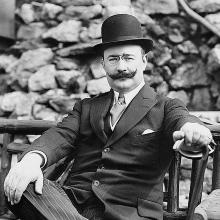
Background
He was born in Brooklyn, New York, but brought up and trained musically in Spain.

He was born in Brooklyn, New York, but brought up and trained musically in Spain.
He returned to the United States of America in his early 20s. He sang in many languages, including French, Italian and English, as well as Spanish. Owing to pronounced near-sightedness, he did not appear on the operatic stage but became a renowned concert and recital artist instead.
De Gogorza recorded prodigiously for the Victor Talking Machine Company.
His records display the intelligence and sensitivity of his singing, as well as a polished vocal technique. Victor released many recordings not only under his own name but under various aliases such as Carlos Francisco and Herbert Goddard.
He used these pseudonyms for records issued on Victor"s lower priced black label instead of the premium priced Red Seal label for which he usually recorded. In addition to recording, he also served as an early A&R man for Victor.
He helped persuade other well-known opera singers to record for the company, including Enrico Caruso who signed with the label in 1904.
Curiously, De Gogorza and Caruso made only one published recording together, a Spanish song entitled "A la luz de la luna" (In the moonlight) in 1918. In 1928, De Gogorza recorded the song again, with tenor Tito Schipa. During this time he also was a professor of voice and music for the Curtis Institute of Music in Philadelphia.
Evans would become a well-known baritone on Broadway and radio, as well as co-starring in London"s South Pacific opposite Mary Martin.
De Gogorza also taught in retirement. Among his pupils were the American composer Samuel Barber and the noted Philadelphia music critic, Max de Schauensee, who left many affectionate reminiscences of him.
He died in 1949 in New York City, from lung cancer at the age of 74.