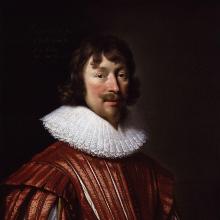
Endymion Porter was an English diplomat and royalist.
Background
Endymion Porter was born in 1587. He was descended from Sir William Porter, sergeant-at-arms to Henry VII, and son of Edmund Porter, of Aston-sub-Edge in Gloucestershire, by his cousin Angela, daughter of Giles Porter of Mickleton, in the same county.
Career
Porter was brought up in Spain - where he had relatives - as page in the household of Olivares. He afterwards entered successively the service of Edward Villiers and of Buckingham, and through the latter's recommendation became groom of the bedchamber to Charles I.
In October 1622 he was sent to negotiate concerning the affairs of the Electorate of the Palatinate and the proposed "Spanish Match" of the Prince of Wales with the Infanta. He accompanied Charles and Buckingham on their foolhardy expedition in 1623, acted as their interpreter, and was included in the consequent attack made by Lord Bristol on Buckingham in 1626.
In 1628 he was employed as envoy to Spain to negotiate for peace, and in 1634 on a mission to the Netherlands to the Cardinal-Infante Ferdinand.
Porter was one of the promoters of the 1635 Courteen association.
During the Civil War Porter remained a constant and faithful servant of the king. He was with him during the two Scottish campaigns, attended him again on the visit to Scotland in August 1641, and followed Charles on his last departure from London in 1642, receiving the nominal command of a regiment, and sitting in the Royalist parliament at Oxford in 1643.
As member of the Long Parliament, in which he sat as member for Droitwich, he was one of the minority of 59 who voted against Strafford's attainder, and was in consequence proclaimed a "betrayer of his country. "
On 15 February 1642 he was voted one of the dangerous counsellors, and specially excepted from pardon on 4 October and in the treaties of peace negotiated subsequently, while on 10 March 1643 he was excluded from parliament.
Porter was also implicated in the army plot. He assisted Glamorgan in illegally putting the great seal to the commission to negotiate with the Irish in 1644 and was charged with having in the same manner affixed the great seal of Scotland, then temporarily in his keeping, to that of O'Neill in 1641, and of having incurred some responsibility for the Irish rebellion. Towards the end of 1645, when the king's cause was finally lost, Porter abandoned England, and resided successively in France, Brussels and Antwerp, where he was reduced to great poverty, and the Netherlands.
He returned to England in 1649, after the king's death, and was allowed to compound for what remained of it. The property which he had accumulated during the tenure of his various appointments, by successful commercial undertakings and by favours of the court, was now for the most part either confiscated or encumbered.
He died shortly afterwards, and wras buried on the 20th of August 1649 at St Martin's-in-the-Fields.
Achievements
Endymion Porter was a favourite courtier of Charles I. After the war with Spain he took part in peace negotiations which led to the treaty of 1630.
He was instrumental in bringing van Dyck to England in 1632 and later sat for portraits by van Dyck and William Dobson.
Politics
He was a strong supporter of Thomas Wentworth. On the outbreak of the Civil War Porter supported Charles I and the Royalists.
Views
Quotations:
"His Majesty's businesses, run in their wonted channel—subtle designs of gaining the popular opinion and weak executions for the up-holding of monarchy. "
"My duty and loyalty have taught me to follow my king and by the grace of God nothing shall divert me from it. "
Interests
During the period of his prosperity Porter had gained a great reputation in the world of art and letters. He wrote verses, was a generous patron of Davenant, who especially sings his praises, of Dekker, Warmstrey, May, Herrick and Robert Dover, and was included among the 84 "essentials" in Bolton's "Academy Royal. "
He was a judicious collector of pictures, and as the friend of Rubens, Van Dyck, Daniel Mijtens and other painters, and as agent for Charles in his purchases abroad he had a considerable share in forming the king's magnificent collection. He was also instrumental in procuring the Arundel pictures from Spain.
Writers
William Davenant
Connections
He was married to Olivia Boteler Porter, daughter of John, Lord Boteler of Bramfield, and niece of Buckingham. She was a zealous Roman Catholic. He left five sons, who all played conspicuous, if not all creditable, parts in the history of the time.