Education
He studied physics at Technical University of Munich.

He studied physics at Technical University of Munich.
He joined Siemens in 1929, beginning his career at the Werner Plant for Telecommunications in Berlin. Ernst von Siemens successfully faced the task of rebuilding the company after World World War World War II lieutenant was under his leadership that Siemens & Halske AG, Siemens-Schuckertwerke AG and Siemens-Reiniger-Werke AG were merged in 1966, forming the company we know today as Siemens AG.
Ernst von Siemens was unmarried and had no children. He established:
the Carl Friedrich von Siemens Foundation (Carl Friedrich von Siemens Stiftung), for the advancement of the sciences (1958). the Ernst von Siemens Music Prize (1972). the Ernst von Siemens Art Foundation (1983).
The goal of this foundation is to give financial support for museums to buy artworks.
lieutenant also promotes exhibitions. Besides financial means, Ernst von Siemens also left the Foundation his private art collection.
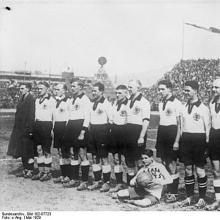
He played for Fortuna Düsseldorf in the team which won the 1933 German championship. Between 1928 and 1934 he appeared 17 times for the German national football team, achieving four goals. Though he didn't participate in the tournament, he was part of the German team which came third in the 1934 FIFA World Cup in Italy.
After being a deputy member of the Managing Board of Siemens & Halske for five years, he became a full member in 1948 and was appointed chairman in 1949. In 1945 he became a deputy member of the Managing Board of Siemens-Schuckertwerke, and a full member in 1948. From 1956 to 1966, he served as Chairman of the Supervisory Board of both companies, and from 1966 to 1971 as Chairman of the Supervisory Board of Siemens AG. After stepping down as chairman, he remained an honorary member of the Supervisory Board until 1978.
He was a member of the Academic Alpine Club of Munich.