(
The multi-million-copy bestseller that coined the phras...)
The multi-million-copy bestseller that coined the phrase for tragic American blunders abroad.
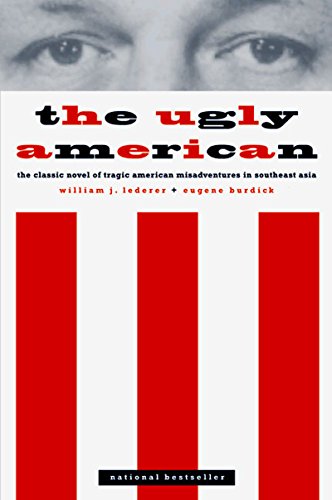
In the episode that lends the book its title, the "ugly American" is Homer Atkins, a plain and plain-spoken man, who has been sent by the U.S. government to advise the Southeast Asian country of Sarkhan on engineering projects. When Atkins finds badly misplaced priorities and bluntly challenges the entrenched interests, he lays bare a foreign policy gone dangerously wrong.
First published in 1958, The Ugly American became a runaway national bestseller for its slashing exposé of American arrogance, incompetence, and corruption in Southeast Asia. In linked stories and vignettes, the book uses gripping storytelling to draw a devastating picture of how the United States was losing the struggle with Communism in Asia.
(
Something has gone wrong. A group of American bombers a...)
Something has gone wrong. A group of American bombers armed with nuclear weapons is streaking past the fail-safe point, beyond recall, and no one knows why. Their destination -- Moscow.
In a bomb shelter beneath the White House, the calm young president turns to his Russian translator and says, "I think we are ready to talk to Premier Kruschchev." Not far away, in the War Room at the Pentagon, the secretary of defense and his aides watch with growing anxiety as the luminous blips crawl across a huge screen map. High over the Bering Strait in a large Vindicator bomber, a colonel stares in disbelief at the attack code number on his fail-safe box and wonders if it could possibly be a mistake.
First published in 1962, when America was still reeling from the Cuban missle crisis, Fail-Safe reflects the apocalyptic attitude that pervaded society during the height of the Cold War, when disaster could have struck at any moment. As more countries develop nuclear capabilities and the potential for new enemies lurks on the horizon, Fail-Safe and its powerful issues continue to respond.
Eugene Leonard Burdick was an American political theorist and writer. He is famous for his important political thrillers and non-fiction novels that gained national attention.
Background
Eugene Leonard Burdick was born on December 12, 1918 in Sheldon, Iowa, the son of John ("Jack") D. Burdick, a house painter, and Marie Ellerbroek. When Burdick was four, his father died. When he was seven, his mother married Fritz Gaillard, a Dutch immigrant, who later became a cellist with the Los Angeles Philharmonic. The family settled permanently in Los Angeles.
Education
Burdick, an accomplished athlete, attended Santa Monica Junior College and Santa Barbara Junior College before transferring to Stanford as a sophomore. A scholarship student, he distinguished himself academically, receiving a degree in psychology in 1941.
Burdick went to England as a Rhodes scholar in 1948 and completed his Oxford University D. Phil. in political science in 1950.
In 1945 Burdick wrote his first short story. Two years later, upon his return to civilian life, he attended graduate school at Stanford, incidentally studying writing under Wallace Stegner. This led to a Breadloaf Writer's Fellowship for 1948 and then to a major short story prize.
Career
In 1942 Eugene Burdick was commissioned an ensign in the navy. He was decorated for bravery in the battle of Guadalcanal, where he was captain of an amphibious personnel carrier. Assigned to navy schools in Miami and Washington, he became a destroyer gunnery officer.
Then, as a lieutenant commander in the Naval Reserve, he taught for two years at the Naval War College at Newport, Rhode Island.
In 1952 he became an assistant professor of political science at the University of California at Berkeley. Burdick's first book, The Ninth Wave (1956), was a political, semiautobiographical novel adumbrating all of his interests and later themes. It was a best-seller and a Book-of-the-Month-Club selection. But The Ugly American (1958), written with William J. Lederer, made him famous.
He visited Vietnam with Lederer, a Vietnamese-speaking, navy-loving writer, before collaborating on the novel. Its events occur in the fictitious Sarkhan and deal with the administration of American foreign aid in Southeast Asia. A best seller, the book was made into a successful movie, and its title became a term of opprobrium, although the Ugly American in the book was actually the hero.
In 1959 Burdick coedited with Arthur J. Brodbeck American Voting Behavior, an important anthology. He also suffered his first heart attack in that year. The New York Times praised his next book, The Blue of Capricorn (1961). "Readers will share his fascination for the emptiness, silence, vastness and passion of the South Pacific, " the reviewer wrote. Perhaps his best-written work, it mixed short fiction with travel essays.
In 1965 two novels appeared: Nina's Book and Sarkhan, written with Lederer. In his last years Burdick had visited India on a corporate writing assignment and Australia on a University of Chicago writing commission. The visits usually centered on his cottage near Tahiti. Next Burdick wrote The 480 (1964), a tale suggesting that computers and polling might eventuate in the nomination of a presidential candidate who could not lose.
He died in San Diego, California.
Achievements
Burdick's creative imagination combined with rigorous insight and a powerful morality produced such remarkable literary works, as "The 480", "Fail-Safe", and "The Ugly American". His works had a strong influence on the society, for example, his "The Ugly American" enlarged the national consciousness and marked a coming of age and a new national maturity. "Fail-Safe" (1962), written with Harvey Wheeler, was his most spectacular and controversial work, a political novel treating the terrifying unreliability of devices designed to prevent accidental thermonuclear war.
"Readers will share his fascination for the emptiness, silence, vastness and passion of the South Pacific, " the reviewer wrote.
Views
Burdick had an almost archetypal professorial career; his teaching and writing informed each other. He was a popular lecturer and a respected political theorist. Yet he found time to write his novels, working every night and taking an occasional school quarter off. Apparently he overextended himself.
Quotations:
Often he said (according to his family) that he had "so much to do in such a short time. "
Personality
Quotes from others about the person
Criticism ranged from Sidney Hook's "sensational hysteria-mongering science fiction" to Norman Cousins' "an essay on the end of man, swiftly paced, ingeniously constructed, a glimpse of reality in our time, a precious commodity. "
Reviewers took their usual ambivalent view of Burdick's work--"a gimmick kind of novel, " but "a strong sense of foreboding lingers in the mind. "
Connections
Burdick married Carol Warren on July 3, 1942. They had three children.
Father:
John ("Jack") D. Burdick
Mother:
Marie Ellerbroek
Wife:
Carol Warren
Friend:
Marlon Brando
actor
He often returned to the South Pacific, sometimes with his friend the actor Marlon Brando, who had starred in the movie version of The Ugly American.