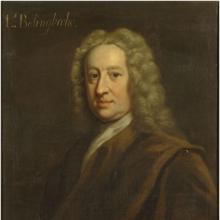
Bolingbroke, First Viscount, English statesman and writer, was born Henry St. John, of an old Wiltshire family.
Background
Bolingbroke was a man of great talents and little character. He was a notorious rake in private life and in office a skillful diplomat and administrator. He was also a brilliant orator and a facile writer. A friend of Alexander Pope and Jonathan Swift, he helped Pope prepare his Essay on Man.
Career
He was educated at Eton and then traveled abroad for about two years, entering Parliament in 1701 for his family's borough. His ability and gifts of oratory soon made him prominent on the High Tory side, and in 1704 he was appointed secretary for war in the Godolphin administration. In this capacity he worked in close association with the Duke of Marlborough, the commander-in-chief. Marlborough was pleased with Bolingbroke's services but the latter left the government with Robert Harley, later Earl of Oxford, in 1708 when the administration became predominantly Whig. When the Tories returned to power under Harley in 1710 Bolingbroke was given charge of foreign affairs. He played a leading part in bringing about the Treaty of Utrecht in 1713 which ended the War of the Spanish Succession and gave peace to Europe for many years. He was created a viscount the preceding year as a reward for these negotiations.
In the months before the death of Queen Anne in 1714 Bolingbroke quarreled with Oxford over the steps to be taken to ensure the position of the Tory Party after the queen's death. Oxford was removed from power, and Bolingbroke enjoyed the position of chief minister for a few days, but on the accession of George I he was dismissed. When his impeachment was threatened for having attempted to restore the Stuarts to the throne, he fled to France and, after some hesitation, joined the cause of James Stuart, the "Old Pretender" to the English throne, whom he served for a time as secretary of state. He was dismissed by James after the unsuccessful 1715 rebellion. He then sought to be pardoned by George I and return to England, but he was not able to effect this until 1723. Moreover, his place in the House of Lords was not restored, and he could play no part in Parliament. He became the center of opposition to the head of the government, Sir Robert Walpole, however, and used his pen against him in a brilliant series of articles in the Craftsman, a weekly publication which attacked the Whig government during the years 1726-1735. Failing to have Walpole dismissed by the King, in 1735 Bolingbroke retired again to France, which was the country of his second wife, whom he had married in 1722. He returned to England in 1743, however, after the death of his father and settled at the family seat at Battersea, where he died.