Supplementary Reading for Primary Schools (Classic Reprint)
(Excerpt from Supplementary Reading for Primary Schools
...)
Excerpt from Supplementary Reading for Primary Schools
The cat shall not see you. You may run and play. I have two pretty pets.
Fido is my dog. He had a nap. He had a nap with the cat. Cat had a nap too. Are they hav ing a nap now? No, they are not having a nap. Fido loves Tab. Tab loves Fido. Tab is white, and.
About the Publisher
Forgotten Books publishes hundreds of thousands of rare and classic books. Find more at www.forgottenbooks.com
This book is a reproduction of an important historical work. Forgotten Books uses state-of-the-art technology to digitally reconstruct the work, preserving the original format whilst repairing imperfections present in the aged copy. In rare cases, an imperfection in the original, such as a blemish or missing page, may be replicated in our edition. We do, however, repair the vast majority of imperfections successfully; any imperfections that remain are intentionally left to preserve the state of such historical works.
Francis W. Parker School Studies in Education, Vol. 8 (Classic Reprint)
(Excerpt from Francis W. Parker School Studies in Educatio...)
Excerpt from Francis W. Parker School Studies in Education, Vol. 8
Recent scientific investigation and research in educational fields has enabled teachers to measure the intelligence of children more accurately, to evaluate school subject matter better, and to test some kinds of school achievement. For such help we must be profoundly grateful; but there is some danger, it seems to me, of swinging too far in this direction, of allowing the mere gather ing of data to engross too much of the precious time of children. Moreover, in too many schools both teachers and children seem so concerned in getting control of tools that they have little time to use them constructively or for creative purposes. More than ever we need to keep our vision clear to the value of those elements in life and education which cannot be measured and which give to us all, big and little, the highest aspiration and inspiration, which create in us standards of taste and attitudes toward life which go far in protecting us from ugliness and sordidness in our environ ment.
We believe that a study of such material as we cite tends to make us realize that creative expression is fundamental to the child's fullest development, to his happiness and his spiritual growth. All normal children have the right to live in a rich environment, to exercise to the full all their powers of expression, and to have every avenue to their souls open and in use. Not everyone can contribute to the permanent beauty of the world, but it is the privilege of every school to create conditions which should arouse each child to express freely in some chosen form his own best ideas, inspirations, and emotions.
About the Publisher
Forgotten Books publishes hundreds of thousands of rare and classic books. Find more at www.forgottenbooks.com
This book is a reproduction of an important historical work. Forgotten Books uses state-of-the-art technology to digitally reconstruct the work, preserving the original format whilst repairing imperfections present in the aged copy. In rare cases, an imperfection in the original, such as a blemish or missing page, may be replicated in our edition. We do, however, repair the vast majority of imperfections successfully; any imperfections that remain are intentionally left to preserve the state of such historical works.
(Excerpt: ... said Donald. "But the leaves turn yellow in ...)
Excerpt: ... said Donald. "But the leaves turn yellow in the fall," said Frank, "and the trees do not die." "The leaves of my spruce don't turn yellow in the fall," said Donald. "They stay green all winter." "What makes the leaves green?" asked Uncle Robert. No one answered. "What is the color of the potato sprouts in the cellar?" "Yellow," said Susie. "When you take up a board that has lain on the grass, what is the color of the grass?" "Yellow," said Donald. "Why?" asked Uncle Robert. "Because they don't get any light," said Frank. "You know why we put our plants in the south window in winter?" said Mrs. Leonard. "Oh, yes," said Susie, "because the sun shines in at that window." "Warmth and water and air help trees and plants to grow," said Uncle Robert, "but without sunlight their leaves would be yellow and their stems and branches weak. The greatest forests on earth are where it is very hot and moist. The sun is a wonderful artist, and every leaf it paints makes the tree stronger." "But what makes the leaves turn yellow and red just before they fall off?" asked Frank. "Does the sun paint them then?" "That is a question that no one has been able to answer," replied his uncle. "But how can the sap flow up the tree?" said Donald. "I should think it would run down." "It would unless there was something to draw it up," said Uncle Robert. "I suppose the sun does that, too," said Frank. "Where does it go after it reaches the leaves?" asked Uncle Robert. "Why, back again," said Susie. "No, it doesn't go back-not a drop," laughed Uncle Robert. "Does it dry up?" asked Donald. "What do you mean by drying up?" "It evap-o-rates," said Donald, who liked to use large words. "Does it all go into the air?" asked Frank. "I want you to answer these questions yourselves, children. What do you see on the corn leaves in the early morning?" "Drops of water; but that is dew, isn't it?" asked Frank. Uncle Robert had a way of stopping or changing the subject when he had asked...
Talks on Pedagogics an Outline of the Theory of Concentration (Classic Reprint)
(These Talks were given at the Teachers Retreat, Chautauqu...)
These Talks were given at the Teachers Retreat, Chautauqua A ssembly, New York, July, 1891. Their popular form has been changed to text for close study. Many repetitions have been omitted, but leaving, as the reader will find, a sufficient number to maintain the reputation of an average teacher. The experience of three years has naturally brought other changes, suggesting modifications and additions. The discussion of the doctrine of Concentration presented in this book is the outcome of work done in the Cook County Normal School. In 1883 I resigned my position as one of the Supervisors of the Boston schools in order to come into closer range and contact with childrens minds. The work done in Quincy was a slight beginning of something far better. Of the special direction of progress, the ideal was vague not in the clear. One thing, however, appeared right that the natural sciences and history should be put into the primary school, made an essential part of the course for eight years; and that reading and language lessons might spring from the thought aroused from the study of the central subjects. A nother proposition presented itself with great force: that pupils under proper They were also given at the New York Teachers Training College, the University of Minnesota, and the Cook County Normal Summer School.
(Typographical errors above are due to OCR software and don't occur in the book.)
About the Publisher
Forgotten Books is a publisher of historical writings, such as: Philosophy, Classics, Science, Religion, History, Folklore and Mythology.
Forgotten Books' Classic Reprint Series utilizes the latest technology to regenerate facsimiles of historically important writings. Careful attention has been made to accurately preserve the original format of each page whilst digitally enhancing the aged text.
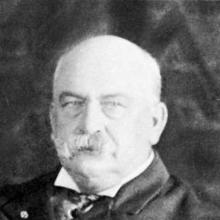
Francis Wayland Parcker was born on October 9, 1837 in Bedford, Hillsborough County, New Hampshire, United States. He was the son of Robert Parker, a cabinet maker, and Milly (Rand) Parker, a teacher before her marriage. His father died when he was six years of age, and he was bound out by his uncle to a farmer by the name of Moore, who provided him a home.
Education
Uncle allowed Francis Wayland Parker attend district school eight weeks each winter. Packer wrote that the best part of his early education was secured from his contacts with nature on the farm and from his reading of the few books available at the Moore house: the Bible, The Pilgrim's Progress, Wayland's Life of Judson, and some almanacs. At thirteen years of age he went to Mount Vernon, New Hampshire, where he attended a good school. Here he earned his living by working at odd jobs until he was sixteen, when he began teaching.
Career
Francis Wayland Parker taught in New Hampshire until 1859 and was then called to a school in Illinois. Returning to New Hampshire at the beginning of the Civil War, he enlisted in Company E, 4th New Hampshire Volunteers, being commissioned lieutenant, September 20, 1861. He rose to the rank of lieutenant-colonel, and was wounded, August 16, 1864, at the battle of Deep Bottom. After his marriage he returned to his regiment at Port Royal and served to the end of the war. Later, he taught school in several New Hampshire towns and in Dayton, Ohio, where he was put in charge of the normal school. He experimented with new and radical methods of teaching, following the lines suggested by the work of Dr. Edward A. Sheldon of Oswego, whose book entitled Object Lessons seemed to him to show how to overcome the formalism then common in American schools. In 1872 he went to Europe and studied in Germany, coming into contact with the new methods of teaching geography developed by Ritter and Guyot. He was also inspired by the developments in natural science, by the new methods of the Herbartians, and by what he observed in the kindergartens.
Returning to the United States in 1875, he secured an appointment as superintendent of schools at Quincy, Massachussets The community and the superintendent were enthusiastic about the introduction of science into the curriculum, the cultivation of freedom and informality in classroom methods, and the complete elimination of the rigid discipline traditional in New England schools. In 1880 he was called to Boston as one of the supervisors of the school system, and in 1883 he was appointed principal of the Cook County Normal School, Chicago, Illinois, which afterwards became a part of the city school system. Here Parker introduced the new ideas and methods which had made him famous in Quincy and Boston. He imported teachers sympathetic with his views and displaced the conservatives whom he found on the faculty. This action brought down a storm of protest, and for years a continuous battle raged between the reformer and his opponents. In the meantime, the Cook County Normal School became a widely recognized center for vigorous, liberal movements in elementary education.
In 1899 Francis Wayland Packer was offered the opportunity to establish an independent normal school by Mrs. Emmons Blaine, who gave him a generous endowment for the new Chicago Institute. In 1901 the Institute was transferred to the University of Chicago and Parker became the first director of the School of Education of the University. This transfer was effected in part because of the cordial sympathy between Parker and Prof. John Dewey, and also because of President Harper's conviction that education as a technical field should be cultivated in the University. Parker did not serve long in his new position, however, since he died on March 2, 1902.
Achievements
Francis Wayland Parker was famous as a founder of progressive elementary education in the United States and organizer of the first parent-teacher group at Chicago. He was a developer of the Quincy Method for schools.
(Excerpt: ... said Donald. "But the leaves turn yellow in ...)
Views
Quotations:
"Work is the greatest means of education. To train children to work, to work systematically, to love work, and to put their brains into work, may be called the end and aim of schools. In education, no work should be done for the sake of the thing done, but for the sake of the growing mind. "
Connections
Francis Wayland Packer married Phenie E. Hall of Bennington, New Hampshire. His wife and an only child died while he was at Dayton. In 1883 he married Mrs. Frances Stuart, first assistant in the Boston School of Oratory. She sympathized fully with the reforms which Parker advocated and greatly reinforced him in his work.