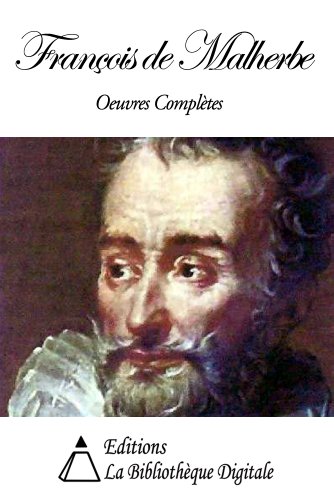
François de Malherbe was a French poet, critic, and translator whose insistence on formal discipline, restraint, and clear diction helped shape French poetry’s movement toward Classicism. A court poet under Henry IV and Louis XIII, he also influenced younger writers through his criticism and teaching.
Background
Malherbe was born in Caen in 1555, the eldest son of François de Malherbe, a royal councillor in Caen’s magistracy, and Louise de Valois. His family had long-standing status but limited wealth; his maternal grandfather was Henri de Valois, lord of Ifs.
Education
Malherbe studied first in Caen, then in Paris, and later at Heidelberg and Basel. His education included legal studies, though he did not pursue a career in the magistracy. His schooling and early adulthood unfolded during the French Wars of Religion, a period of religious and political conflict that also formed the setting for his earliest literary work.
In 1577 Malherbe entered the service of Henri d’Angoulême, governor of Provence, as his secretary. He remained in that position until Henri’s assassination in 1586. During these years he wrote *Les Larmes de Saint-Pierre*, an imitation of Luigi Tansillo’s Italian poem; first published in 1587, it is notable for the ornate style that Malherbe later repudiated. He also married in Provence in 1581.
After Henri’s death, Malherbe lived first in Caen and returned to Provence in 1595. His reputation grew, but his early poems addressed to powerful figures did not at first secure him a place at court. An ode welcoming Marie de Médicis in 1600 brought him influential notice. In 1605 Cardinal du Perron presented him to Henry IV, and Malherbe settled in Paris. His *Prière pour le roi allant en Limousin*, written for Henry IV’s campaign, helped establish his position as a court poet. He served at court through the king’s reign and remained active under Louis XIII and during Marie de Médicis’s regency, from 1610 to 1617.
Malherbe wrote odes, stanzas, sonnets, songs, occasional poems, consolations in a Stoic vein, and translations of the Psalms. His occasional verse addressed battles and political events, praised peace, and lamented the destruction caused by the Wars of Religion. He sought clarity through careful organization, correct syntax, and intelligible vocabulary and imagery. His criticism was especially exacting about rhyme, word choice, syntax, structure, logic, coherence, antithesis, and Petrarchan emotionalism. He spread his principles largely through discussion with friends and disciples, including François Maynard and Honorat de Bueil, seigneur de Racan. His influence prepared an important step toward French Classicism, although other poets of the late sixteenth century had independently begun to move away from some of the excesses he criticized, and Malherbe did not always meet his own strict standards. His early poem *Les Larmes de Saint-Pierre* was among the works he later disavowed.
Malherbe’s standing was greatest during Marie de Médicis’s regency. His final years were marked by the death of his son in a duel and a decline in poetic production. He died in Paris on October 16, 1628.
Achievements
Through his poetry, criticism, and teaching, Malherbe helped establish stricter standards of form, restraint, rhyme, syntax, and diction in French verse, preparing the way for Classicism. His influence on French poetry continued beyond his lifetime and remained evident through the Romantic period and later.
The football club Stade Malherbe Caen was named in his honor.
(A long poem imitating Luigi Tansillo’s Italian *Lagrime d...)
1587
Views
Malherbe’s poetic principles favored formal control, restraint, syntactic correctness, precise rhyme, and clear diction. He argued through his criticism and example for tightly organized verse in which a definite thought was developed coherently, resisting looseness, obscurity, and excessive ornament. His work helped prepare French poetry for Classicism, though the wider movement away from some late-Renaissance excesses was not his alone.
Quotations:
“And the fruits will outdo what the flowers have promised.”
“While you are meditating revenge, the devil is meditating a recruit.”
“Our days and nights have sorrows woven with delights.”
Personality
Quotes from others about the person
In *Art poétique* (1674), Nicolas Boileau celebrated Malherbe’s role in poetic reform with the phrase “Enfin Malherbe vint” (“At last came Malherbe”).
Connections
Malherbe married in Provence in 1581. His son was killed in a duel, a loss that marked his final years. Honorat de Bueil, seigneur de Racan, was among the younger poets who became his disciples.
Father:
François de Malherbe
A royal councillor in the magistracy of Caen.
Mother:
Louise de Valois
Daughter of Henri de Valois, lord of Ifs.
disciple:
Honorat de Bueil, seigneur de Racan
A poet among Malherbe’s younger literary followers.