

Education
Australian National University.

http://www.amazon.com/gp/product/B01GMI2Z9C/?tag=2022091-20

http://www.amazon.com/gp/product/B010BD75OO/?tag=2022091-20

http://www.amazon.com/gp/product/B01GMH77IM/?tag=2022091-20

http://www.amazon.com/gp/product/B010BD72AG/?tag=2022091-20

http://www.amazon.com/gp/product/B00Y2S09LG/?tag=2022091-20

http://www.amazon.com/gp/product/B01FEOQ5F0/?tag=2022091-20

http://www.amazon.com/gp/product/B010BD6L5I/?tag=2022091-20

http://www.amazon.com/gp/product/B010EW44QE/?tag=2022091-20

(This book offers a novel approach to the analysis of demo...)
This book offers a novel approach to the analysis of democracy, and an application of that approach to a variety of democratic institutions, including elections, representation, political parties and the separation of powers. Standard economic approaches to politics concentrate on the design of institutions and the role of individuals motivated by self-interest. The authors incorporate a broader view of political motivation, assuming individuals are moral as well as rational, and provide a wide-ranging discussion of the design of democratic institutions.
http://www.amazon.com/gp/product/0521639778/?tag=2022091-20

( Commenting on his collaboration with Geoffrey Brennan o...)
Commenting on his collaboration with Geoffrey Brennan on The Power to Tax, James M. Buchanan says that the book is demonstrable proof of the value of genuine research collaboration across national-cultural boundaries.” Buchanan goes on to say that The Power to Tax is informed by a single ideathe implications of a revenue-maximizing government.” Originally published in 1980, The Power to Tax was a much-needed answer to the tax revolts sweeping across the United States. It was a much-needed answer as well in the academic circles of tax theory, where orthodox public finance models were clearly inadequate to the needs at hand. The public-choice approach to taxation which Buchanan had earlier elaborated stood in direct opposition to public-finance orthodoxy. What Buchanan and Brennan constructed in The Power to Tax was a middle ground between the two. As Brennan writes in the foreword, The underlying motivating question was simple: Why not borrow the motivational assumptions standard in public-choice theory and put them together with assumptions about policy-maker discretion taken from public-finance orthodoxy?” The result was a controversial bookand a much misunderstood one as well. Looking back twenty years later, Brennan feels confirmed in the rightness of the theories he and Buchanan espoused, particularly in their unity with the public-choice tradition: The insistence on motivational symmetry is a characteristic feature of the public choice approach, and it is in this dimension that The Power to Tax and the orthodox public- finance approach diverge.” James M. Buchanan is an eminent economist who won the Alfred Nobel Memorial Prize in Economic Sciences in 1986 and is considered one of the greatest scholars of liberty in the twentieth century. The entire series will include: Volume 1: The Logical Foundations of Constitutional Liberty Volume 2: Public Principles of Public Debt Volume 3: The Calculus of Consent Volume 4: Public Finance in Democratic Process Volume 5: The Demand and Supply of Public Goods Volume 6: Cost and Choice Volume 7: The Limits of Liberty Volume 8: Democracy in Deficit Volume 9: The Power to Tax Volume 10: The Reason of Rules Volume 11: Politics by Principle, Not Interest Volume 12: Economic Inquiry and Its Logic Volume 13: Politics as Public Choice Volume 14: Debt and Taxes Volume 15: Externalities and Public Expenditure Theory Volume 16: Choice, Contract, and Constitutions Volume 17: Moral Science and Moral Order Volume 18: Federalism, Liberty, and the Law Volume 19: Ideas, Persons, and Events Volume 20: Indexes
http://www.amazon.com/gp/product/0865972303/?tag=2022091-20

http://www.amazon.com/gp/product/B010BD6PYA/?tag=2022091-20

http://www.amazon.com/gp/product/B010BD6SQ0/?tag=2022091-20

http://www.amazon.com/gp/product/B010BD7IKA/?tag=2022091-20
(This groundbreaking book by two distinguished scholars fr...)
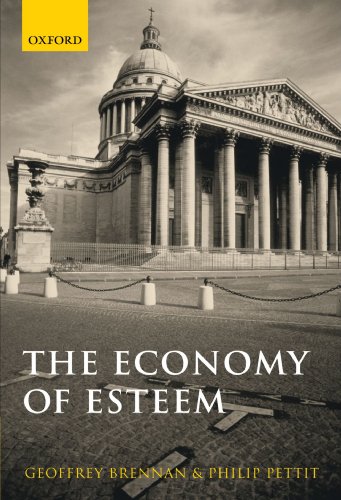
This groundbreaking book by two distinguished scholars from different disciplines begins by outlining the psychology of esteem and the way the working of that psychology can give rise to an economy. It then shows how a variety of social patterns that are otherwise anomalous come to make a lot of sense within an economics of esteem. And it looks, finally, at the ways in which the economy of esteem may be reshaped so as to make for an improvement -- by reference to received criteria -- in overall social outcomes. While making connections with older patterns of social theorising, it offers a novel orientation for contemporary thought about how society works and how it may be made to work. It puts the economy of esteem firmly on the agenda of economic and social science and of moral and political theory.
http://www.amazon.com/gp/product/0199289816/?tag=2022091-20

http://www.amazon.com/gp/product/B010BD7LRK/?tag=2022091-20
Australian National University.
He is a professor of philosophy at the University of North Carolina at Chapel Hill and a professor of political science at Duke University. When not teaching in the United States Brennan is a faculty member in the Research School of Social Sciences (Research School of Social Sciences) at the Australian National University. Brennan has published widely on rational actor theory, philosophy, and economics, and sits on the editorial board of the academic journal Representation.
He has held academic positions in several related departments at Australia National University and Virginia Technology
Brennan is a golfer, and a semi-professional singer (for some years a national recitalist with the American Broadcasting Company).
Trained as an economist, Brennan has collaborated extensively with Nobel Prize winner James M. Buchanan and became the first non-American president of the Public Choice Society in 2002. With Loren Lomasky he is winner of the American Philosophical Association"s Gregory Kavka Prize in Political Philosophy for the paper "Is There a Duty to Vote?".
(This book offers a novel approach to the analysis of demo...)
(This groundbreaking book by two distinguished scholars fr...)
( Commenting on his collaboration with Geoffrey Brennan o...)
