Georg Samuel Dörffel was a German Lutheran theologian and astronomer who investigated the orbits of planets and comets.
Background
Georg Samuel Dörffel was born on October 21, 1643, in Plauen, Vogtland, Germany. He was the son of Friedrich Dörffel, pastor in Plauen, and Maria Tröger, the daughter of the Plauen councilor Johann Tröger. Out of a total of four children only Georg survived.
Education
After attending the Latin school in his hometown Dörffel went in 1659 to the Evangelical Lutheran Gymnasium in Halle.
He began his studies in Leipzig in 1661. The Baccalaureate of the liberal arts (1662) followed - according to his scientific interests - a semester with Erhard Weigel in Jena, where he studied mathematics and astronomy. Dörffel also met Gottfried Wilhelm Leibniz, who studied mathematics in Jena at the same time.
In 1662/63 he earned a master's degree in philosophy. Thereafter Dörffel studied theology under Johann Adam Scherzer in Leipzig and became the Bachelor of Theology in 1667.
Dörffel became his father’s substitute in Plauen in 1667 and his successor in 1672. In 1684 he became ecclesiastical superintendent in Weida.
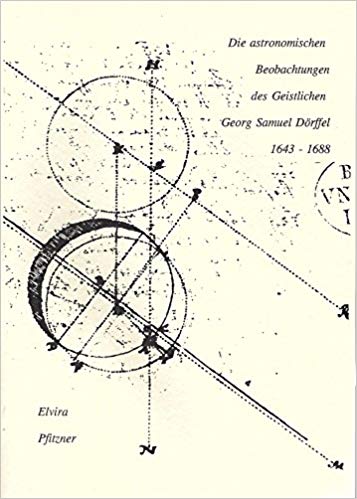
Dörffel found no observable parallax for the comet of 1672 and measured its angular distance from fixed stars. From measurements made with a quadrant on March 27, he calculated its latitude and longitude and length and breadth. He depicted its apparent path as circular and noted that it moved in the same direction as the planets. Dörffel published his report while the comet was still visible but growing fainter. He realized that it was soon to be lost in the light of the moon. His next recorded astronomical activity concerns the comet of 1677.
In 1680 Dorffel shifted his attention from the apparent path to the actual path of comets. He noted Apian’s statement that comets’ tails are directed away from the sun and appreciated Tycho Brahe’s observations of the nova of 1572 and the comet of 1577 as forcing abandonment of the concept of the incorruptibility of the heavens.
Using the radius of the earth's circular orbit around the sun and his observations of the comet’s elongation from the sun, he projected the comet’s path on the ecliptic. Probably the first (August 25) observer of Halley’s comet in 1682, he described it briefly in print and at greater length in correspondence with Gottfried Kirch.
In 1685 he published his discovery, mentioned in 1682, of a new method to determine the distance of a body from the earth, with observations from only one site, utilizing the earth’s diurnal rotation and expressing the distance in semidiameters of the earth.
Dörffel’s writings, which were in German and anonymous or signed only with initials, were soon superseded by Newton’s Principia. They received little attention until the mid-eighteenth century when they began to be of historical interest and appealed to German national pride.
Georg Samuel Dörffel is best known for his representation of the orbit of a comet as a parabola with the sun at the focus; the recognition of his achievements took place only 100 years later. Although not the first to suggest a parabolic path for a comet, Dörffel was the first to describe the path of the comet of 1680, and possibly other comets.
In 1791 J. H. Schroter named a lunar mountain range after him. A lunar crater and an asteroid were also named in his honor.
Dörffel considered God responsible for comets. In the last half of the seventeenth century, skepticism existed about astrological predictions. Dörffel, although he accepted the ancient belief that comets were evil omens, said of the comet of 1672 that it signified something new that was not good, but that he would not predict specific events which might follow.
Although he had the comet move around the sun while that body moved around the stationary earth, he was not a confirmed anti-Copernican.
Personality
Dörffel had an excellent astronomical library and good eyesight but observed mostly with an old-fashioned astronomical radius. His comet observations with it were accurate to one or two minutes, even though his home was not favorable for observing because of neighboring buildings.
His interests extended to the computation of lunar eclipses, to occultations, to meteors, including computation of their paths, and to mock moons.
Connections
Dörffel was married three times and had nine children.