Background
Custer was born in New Rumley, Ohio, United States on December 5, 1839.

Custer was born in New Rumley, Ohio, United States on December 5, 1839.
George Armstrong Custer graduating from McNeely Normal School (later Hopedale Normal College) in Ohio in 1856, he taught school before matriculating at the U.S. Military Academy, from which he graduated last in his class in June 1861.
George Armstrong Custer was at once sent to the theatre of war in Virginia, joining his regiment on the battlefield of Bull Run. His daring and energy, and in particular a spirited reconnaissance on the Chickahominy river, brought him to the notice of General McClellan, who made him an aide-de-camp on his own staff, with the rank of captain.
A few hours afterwards Custer attacked a Confederate picket post and drove back the enemy.
Custer promptly won a resounding victory over the Southern Cheyenne by destroying Chief Black Kettle and his entire village on the Washita River. During the next eight years Custer's regiment guarded surveyors working for the proposed Northern Pacific Railroad, explored the Yellowstone River and the Black Hills, and had many skirmishes with the Indians.
At the end of September 1864, he was appointed to command a division, and on the 9th of October fought, along with General Merritt, the brilliant cavalry action called the battle of Woodstock.
His part in the decisive battle of Cedar Creek was most conspicuous.
He served with Sheridan in the last great cavalry raid, won the action of Waynesboro, and in the final campaign added to his laurels by his conduct at Dinwiddie and Five Forks, and in other operations.
At the close of the war he received the brevets of brigadier and major-general in the regular army, and was promoted major-general of volunteers.
In 1873 he was sent to Dakota Territory to serve against the Sioux. In 1876 an expedition, of which Custer and his regiment formed part, was made against the Sioux and their allies.
Unfortunately, the presence of what was judged to be a small isolated force of Indians was reported to the general.
But instead of meeting only a small force of Indians, the 7th were promptly attacked by the full forces of the enemy. Splitting his command into three parts, Custer personally led 264 men into battle.
His force was surrounded on the hill that now bears his name, overlooking the valley of the Little Bighorn River.
He and all the men under his personal command were massacred there, while Maj. Marcus Reno and Capt. Frederick Benteen took refuge on the bluffs overlooking the river and escaped. The Custer massacre electrified the nation, although it had little effect on the outcome of the Sioux wars.
This controversy continues, for Custer was a man so paradoxical that he could fight corruption in the Indian Bureau to the disservice of his own carrier, yet also order a charge to kill Native Americans.
As no man survived the battle, the details of it, as well as Custer's conduct and character, continue to stir controversy.
Custer's detractors bemoaned the death of the troops under his command due to his rash order to charge so superior a Native American force.
He was first lieutenant in the 7th cavalry when he fell with his brother at the Little Big Horn.
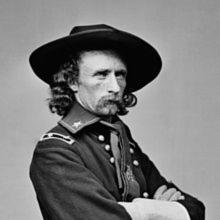
Physical Characteristics: George Armstrong Custer was described at this time as tall, slender, energetic, and dashing, with blue eyes and long golden hair and mustache.
George Armstrong Custer was married to his childhood sweetheart, Elizabeth Bacon.
soldier