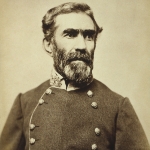
George Doherty Johnston was an American soldier. He was a member of the Alabama Senate from 1900 to 1906.
Background
George Doherty Johnston was born on May 30, 1832, in Hillsboro, North Carolina, United States. He was born in Hillsborough, presumably at Heartsease, on East Queen Street. His father was George Mulhollan Johnston, a planter and surveyor. His mother was Eliza Mary Bond.
In August 1834 the family, accompanied by Miss Mary Williams Burke, a colorful great-aunt who was self-educated and took it upon herself to teach the local children, moved to Greensboro, where after only two weeks George's father died unexpectedly. The Court of Perry County awarded Miss Burke the guardianship of young George, whom she raised and taught while also looking after her beloved niece, George's mother. The family then settled in Marion.
Education
George Johnston received private tutoring and eventually attended Howard College and attended law school at Cumberland University.
In 1854, Johnston practiced law in Marion, Alabama, where he was also elected mayor in 1856. In 1857-1858, he represented Perry County in the Alabama legislature. When the war began, he enlisted in the Confederate Army as a second lieutenant in the 4th Alabama Regiment.
Promoted to lieutenant colonel after the battle of Shiloh in the spring of 1862, he participated in every engagement of the Army of Tennessee from Shiloh to Bentonville, North Carolina. Five days after his promotion to brigadier general on July 26, 1864, he was wounded at the Battle of Ezra Church, and he spent the rest of the war on crutches. Even so, he participated in Hood's Tennessee campaign and served in the last battles in North Carolina.
He surrendered at Durham Station, North Carolina, in April 1865. After the war, he practiced law in Marion until he became commandant of cadets at the University of Alabama from 1871 to 1873. From 1885 to 1890, he was superintendent of the South Carolina Military Academy.
George Johnston returned to Tuscaloosa, Alabama, and in 1892-1893, he was a member of the United States Civil Service Commission. Upon his return to Tuscaloosa, Alabama he was elected a State Senator from 1900 to 1906.
Achievements
George Doherty Johnston fought in the First Battle of Bull Run as a Lieutenant in the 4th Alabama Infantry Regiment. He fought in the Franklin-Nashville Campaign on crutches before eventually taking command of Quarles’ Brigade after the Battle of Franklin. He went on to fight with the Army of Tennessee in every major battle until the Army’s Surrender at Bennett Place in Durham, North Carolina.
George Doherty Johnston has been listed as a noteworthy soldier by Marquis Who's Who.
Connections
George Doherty Johnston married Euphrodia Poellnitz in 1853, and after her death, Maria Barnett, in 1865. His second wife also died and he married Stella Searcy Harris in 1876. He had seven children: Maria Barnett Johnston, Ida Johnston, George Burke Johnston, Charles Poellnitz Johnston, Henry Milton Johnston, Euphradia P. Johnston, George Doherty Johnston, Jr.
Johnston led the regiment in some minor engagements and in the autumn of 1862 accompanied General Braxton Bragg's army on the Kentucky campaign, although it did not participate in any of the fightings.