

Background
Simitses, George John was born on July 31, 1932 in Athens, Greece. Came to the United States, 1951, naturalized, 1963. Son of John G. and Vasilike (Goutoufas) Simitses.

(Dynamic instability or dynamic buckling as applied to str...)
Dynamic instability or dynamic buckling as applied to structures is a term that has been used to describe many classes of problems and many physical phenomena. It is not surprising, then, that the term finds several uses and interpretations among structural mechanicians. Problems of parametric resonance, follower-force, whirling of rotating shafts, fluid-solid interaction, general response of structures to dynamic loads, and several others are all classified under dynamic instability. Many analytical and experimental studies of such problems can be found in several books as either specialized topics or the main theme. Two such classes, parametric resonance and stability of nonconservative systems under static loads (follower-force problems), form the main theme of two books by V. V. Bolotin, which have been translated from Russian. Moreover, treatment of aero elastic instabilities can be found in several textbooks. Finally, analytical and experimental studies of structural elements and systems subjected to intense loads (of very short duration) are the focus of the recent monograph by Lindberg and Florence. The first chapter attempts to classify the various "dynamic instability" phenomena by taking into consideration the nature of the cause, the character of the response, and the history of the problem. Moreover, the various concepts and methodologies as developed and used by the various investigators for estimating critical conditions for suddenly loaded elastic systems are fully described. Chapter 2 demonstrates the concepts and criteria for dynamic stability through simple mechanical models with one and two degrees of freedom.
http://www.amazon.com/gp/product/354097010X/?tag=2022091-20

(Knowledge of structural stability theory is of paramount ...)
Knowledge of structural stability theory is of paramount importance to the practicing structural engineer. In many instances, buckling is the primary consideration in the design of various structural configurations. The emphasis of the book is on the fundamental concepts and on the methodology developed through the years to solve structural stability problems. This book is intended to serve as a text in college courses such as aerospace engineering, civil engineering, engineering science and mechanics, and mechanical engineering.
http://www.amazon.com/gp/product/089874914X/?tag=2022091-20

http://www.amazon.com/gp/product/B007ERZ6WO/?tag=2022091-20

http://www.amazon.com/gp/product/B00KL6A3F0/?tag=2022091-20
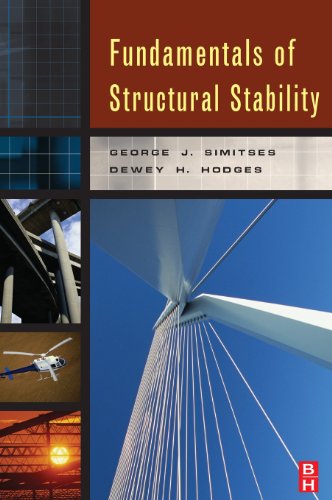
(The ability of a structural assembly to carry loads and f...)
The ability of a structural assembly to carry loads and forces determines how stable it will be over time. Viewing structural assemblages as comprising columns, beams, arches, rings, and plates, this book will introduce the student to both a classical and advanced understanding of the mechanical behavior of such structural systems under load and how modeling the resulting strains can predict the overall future performance-the stability-of that structure. While covering traditional beam theory, the book is more focused on elastica theory in keeping with modern approaches. This text will be an expanded and updated version a similar, previously published book, but with pedagogical improvements and updated analytical methods. This engineering textbook will provide a focused treatment on the study of how structures behave and perform when under stress loading, including plastic deformation and buckling. All advanced engineering students studying engineering mechanics, structural analysis and design, fatigue and failure, and other related subjects need to have this knowledge, and this book will provide it in a thorough and coherent fashion. Written by two of the world’s leading engineering professors in this subject area, the pedagogy has been classroom-tested over many years and should find a receptive readership among both students and instructors. * An understandable introduction to the theory of structural stability, useful for a wide variety of engineering disciplines, including mechanical, civil and aerospace engineering * Covers both static and dynamic loads, for both conservative and nonconservative systems * Emphasizes elastic behavior under loads, including vertical buckling, torsional buckling and nonlinear affects of structural system buckling and stability * Case examples to illustrate real-world applications of Stability Theory
http://www.amazon.com/gp/product/0750678755/?tag=2022091-20

http://www.amazon.com/gp/product/B013J9HLXW/?tag=2022091-20

(Dynamic instability or dynamic buckling as applied to str...)
Dynamic instability or dynamic buckling as applied to structures is a term that has been used to describe many classes of problems and many physical phenomena. It is not surprising, then, that the term finds several uses and interpretations among structural mechanicians. Problems of parametric resonance, follower-force, whirling of rotating shafts, fluid-solid interaction, general response of structures to dynamic loads, and several others are all classified under dynamic instability. Many analytical and experimental studies of such problems can be found in several books as either specialized topics or the main theme. Two such classes, parametric resonance and stability of nonconservative systems under static loads (follower-force problems), form the main theme of two books by V. V. Bolotin, which have been translated from Russian. Moreover, treatment of aero elastic instabilities can be found in several textbooks. Finally, analytical and experimental studies of structural elements and systems subjected to intense loads (of very short duration) are the focus of the recent monograph by Lindberg and Florence. The first chapter attempts to classify the various "dynamic instability" phenomena by taking into consideration the nature of the cause, the character of the response, and the history of the problem. Moreover, the various concepts and methodologies as developed and used by the various investigators for estimating critical conditions for suddenly loaded elastic systems are fully described. Chapter 2 demonstrates the concepts and criteria for dynamic stability through simple mechanical models with one and two degrees of freedom.
http://www.amazon.com/gp/product/038797010X/?tag=2022091-20
consultant engineering educator
Simitses, George John was born on July 31, 1932 in Athens, Greece. Came to the United States, 1951, naturalized, 1963. Son of John G. and Vasilike (Goutoufas) Simitses.
Technology Institute, 1955, Master of Science in Aerospace Engineering, 1956. Doctor of Philosophy in Aeronautics an Astrosci. Stanford University, 1965.
From instructor to professor engineering Georgia Technology Institute, Atlanta, 1956-1989, professor, head department aerospace engineering, interim dean engineering U. Cincinnati, 1989.
Consultant Lockheed-Georgia Company, Marietta, Georgia, 1965-1970, King & Gavaris Engineers, New York City, 1977-1979, Georgia Power Company, Atlanta, 1971-1972.
From instructor to professor engineering Georgia Institute of Technology, Atlanta, 1956-1989. Professor, head department aerospace engineering, interim dean engineering University Cincinnati, 1989-2000, retired, 2000. Consultant Lockheed-Georgia Company, Marietta, Georgia, 1965-1970, King & Gavaris Engineers, New York City, 1977-1979, Georgia Power Company, Atlanta, 1971-1972.
(Dynamic instability or dynamic buckling as applied to str...)
(Dynamic instability or dynamic buckling as applied to str...)
(Knowledge of structural stability theory is of paramount ...)
(The ability of a structural assembly to carry loads and f...)
Community representative American Hellenic Institute, Washington, 1976-1991. Delegate Georgia State Democratic Convention, Macon, 1969. Fellow American Institute of Aeronautics and Astronautics (various committees since 1974), American Society of Mechanical Engineers (committees since 1976), American Academy mechanics.
Correspondent member Academy Athens. Member Hellenic Society Theoretical and Applied mechanics (founding honorary member), The American Hellenic Educational Progressive Association (vice president chapter 1978-1979, committees 1975-1990), Sigma Xi (Sustained Research award 1980, Best Paper award 1985).
Married Nena Athena Economy, September 11, 1960. Children: John G., William G., Alexandra G. Bachelor of Science in Aerospace Engineering.
