

Background
Dowdall, George William was born on May 18, 1943 in New York City. Son of George W. and Monica K. (McGovern) Dowdall.

( Adventures in Criminal Justice Research: Data Analysis ...)
Adventures in Criminal Justice Research: Data Analysis for Windows ® Using SPSS ™ Versions 11.0/11.5, or Higher, Third Edition is the only book that guides students through a series of investigative adventures in criminal justice research using current General Social Survey data and the Harvard School of Public Health College Alcohol Study. Authors George W. Dowdall, Kim Logio, Earl Babbie, and Fred Halley offer students practical experience using version 11.0 of the Statistical Package for the Social Sciences (SPSS), the most popular professional program available for criminal justice data analysis.
http://www.amazon.com/gp/product/0761988084/?tag=2022091-20
http://www.amazon.com/gp/product/B00Y2S1A7I/?tag=2022091-20
http://www.amazon.com/gp/product/B00ZLWIPEA/?tag=2022091-20

( The only book of its kind, this text guides students th...)
The only book of its kind, this text guides students through the process of conducting criminological data analysis. Used primarily in lab settings, the Fourth Edition of Adventures in Criminal Justice Research, derived from the popular Adventures in Social Research (Babbie et al, Pine Forge Press/SAGE), systematically takes students through a series of investigative adventures. More than 150 screenshots in the text offer clear visual step-by-step instructions to solidify student understanding. New to This Edition • Incorporates even more criminal justice exercises, policy-related exercises, and hot criminal justice–related issues throughout the book • Includes analysis of criminal justice and other social issues using data from GSS sets, the 2000 Census, the Harvard School of Public Health College Alcohol Survey, and other data sets available to the public through the Internet • Offers increased coverage of Web-based surveys and survey software Accompanied by High-Quality Ancillaries! • A new Student study site at www.sagepub.com/logiostudy features numerous data sets along with online appendices - Appendix A: Sample Journal Article and "How to Read a Research Article", Appendix B: College Alcohol Study Questionnaire, and Appendix C: Chapter Review Quizzes with Answers . Intended Audience This practical textbook is a valuable supplement for courses in Research Methods and/or Statistics in departments of criminal justice or criminology. The only book of its kind, this text guides students through the process of conducting criminological data analysis. Used primarily in lab settings, the of , derived from the popular (Babbie et al, Pine Forge Press/SAGE), systematically takes students through a series of investigative adventures.
http://www.amazon.com/gp/product/1412963516/?tag=2022091-20
(Review of the original edition “In comparison the other ...)
Review of the original edition “In comparison the other recent books on the topic, Dowdall’s book is more broad-based, yet also more comprehensive, and utilizes a wider range of scientific and professional resources, and provides more evidence-based suggestions for change to a wider audience. If there is a book that can reach all intended audiences (college administrators, governmental policy makers, practitioners, scientists, parents, and students), Dowdall’s book seems to do it. Readers of varied backgrounds should all come away with useful information and suggestions for changes."?The Journal of Higher Education Drinking is recognized as one of the most important problems confronting students on campus today, with major impacts on health and safety. This book answers crucial questions about why students drink, examines its complex links to campus crime and sexual assault, and offers new insights on how to address the issue. It differs from other studies of college drinking by dispelling the myth that the problem is universal. Dowdall’s research reveals that the incidence of alcohol abuse varies enormously between colleges, and in doing so identifies interventions and policies that have been effective, and those that have failed. His study is also unique in looking “upstream” at the broader cultural, organizational and social forces that shape this behavior, where most studies focus only on “downstream” behaviors, well after students have selected their college and have started drinking. This book both defines and illuminates the issue, and outlines effective interventions.
http://www.amazon.com/gp/product/1579228135/?tag=2022091-20
( Drinking has become recognized as one of the most impor...)
Drinking has become recognized as one of the most important problems facing today's college student. Even though college drinking has increased only modestly over the past few decades, concern about its health, behavioral, and safety consequences has risen rapidly. This book examines college drinking as a social problem within higher education, based on interviews with many leading figures engaged in addressing the problem. It assesses the evidence about how many students drink or drink excessively, and what kinds of behavioral and health problems they have as a consequence. The book answers the crucial questions of why students drink and what mixture of personal and environmental factors shape college drinking. The complex links to campus crime and sexual assault are discussed fully. Key practical questions about effective prevention programs and countermeasures are answered in detail. Students and parents can take action to lower the risk of binge drinking by consulting an appendix, which explains how to use college guide data on 400 leading institutions or data about alcohol violations and crime available for several thousand colleges. Anyone concerned with higher education today will find a full discussion of the scope of the problem and what can be done about it.
http://www.amazon.com/gp/product/0275999815/?tag=2022091-20
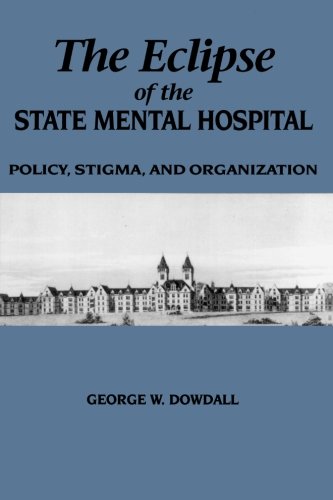
(State hospitals still account for the majority of the sta...)
State hospitals still account for the majority of the state dollars spent on mental health care across the nation. Why do state hospitals persist and expand despite public scandal and professional disapproval? What role does the state mental hospital play in the current system of care for the seriously mentally ill? What role should it play, and at what cost? Dowdall explores recent efforts, successful and unsuccessful, to meet the increasingly elaborate standards imposed from without on the contemporary state mental hospital, and the impact of these efforts on the quality of care provided to its patients.
http://www.amazon.com/gp/product/0791428966/?tag=2022091-20
Dowdall, George William was born on May 18, 1943 in New York City. Son of George W. and Monica K. (McGovern) Dowdall.
AB, Holy Cross College, Worcester, Massachusetts, 1965. AM, Brown University, Providence, 1969. Doctor of Philosophy, Brown University, Providence, 1972.
Post doctoral, University of California at Los Angeles School Public Health, 1978—1979.
Assistant professor Indiana University, Bloomington, 1970—1973. Associate professor State University of New York, Buffalo, 1973—1982. Director program evaluation Buffalo Psychiatric Center, 1980—1982.
Professor, chairman St. Joseph's University, Philadelphia, since 1982. Visiting professor Brown University School Medicine, Providence, 1993—1996. Visiting lecturer Harvard University School Public Health, 1993—1996.
(Review of the original edition “In comparison the other ...)
( The only book of its kind, this text guides students th...)
(State hospitals still account for the majority of the sta...)
( Drinking has become recognized as one of the most impor...)
( Adventures in Criminal Justice Research: Data Analysis ...)
Board director Security on Campus, since 2005. Member Pennsylvania Advisory Council on Drug and Alcohol Abuse, Philadelphia Blue Ribbon Commission on Children's Behavioral Health, 2006—2008, Philadelphia Resource Allocation Advisory Committee, since 2006. Board directors Stop Child Abuse Now Inc., since 2008, Society Hill Civic Association, since 2010.
Member of American Public Health Association, Eastern Sociological Society, Society for Study of Social Problems, American Sociological Association (congressional fellow 2006).
Married Jean A. Amatneek, December 20, 1970. 1 child, Nina Shapiro.
