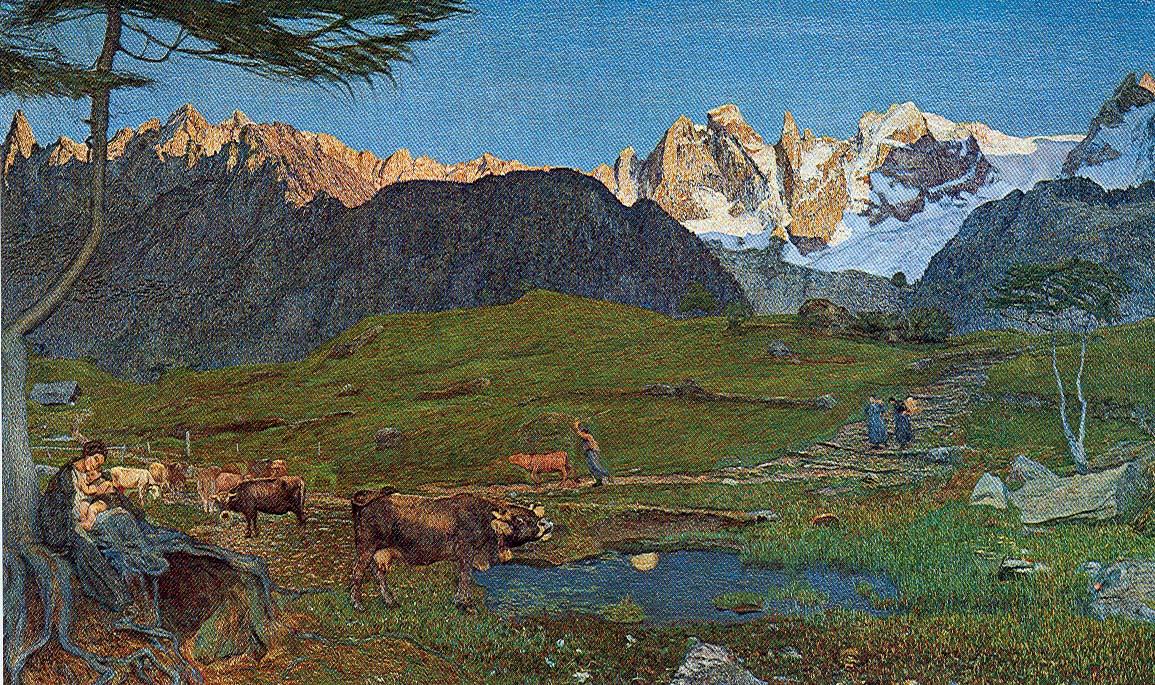
Giovanni Segantini was an Italian painter, who represented Post-Impressionism and Symbolism movements. He was mostly known for his Alpine landscapes and allegorical pictures.
Background
Giovanni Segantini was born on January 15, 1858 in Arco, Trentino, which was then part of the County of Tyrol in the Austro-Hungarian Empire (present-day Arco, Trentino, Italy). He was a son of Agostino Segatini, a tradesman, and Margherita de Giradi. Also, the painter had an older brother, Lodovico Segatini, who died in a fire the same year, when Giovanni was born.
After the death of his mother in the spring of 1865, Giovanni's father left him under the care of Irene, who was his second child from a previous marriage. The following year, Agostino Segatini died, leaving little Giovanni in poverty. In 1874, Segantini started to live with his half-brother Napoleon in Trentino.
Education
During the time, when Giovanni lived with his half-brother Napoleon, he attended his photography studio, where he learned the basics of this relatively new art form. In 1875, Segantini attended classes at the Brera Academy, where he befriended the members of a transformative movement, known as Scapigliatura (the "Disheveleds").
In 1879, Segantini's first major work, entitled "The Chancel of Sant Antonio", was purchased by Milan's Società per le Belle Arti. Vittore Grubicy de Dragon, a gallery owner, noticed the work and became Giovanni's dealer and life-long financial supporter. At that time, Vittore introduced Segantini to the works of Anton Mauve and Jean-François Millet.
The same year, in 1879, the painter got acquainted with the sister of his friend, Luigia Pierina Bugatti. He fell in love with her and the couple began their life-long relationship. Giovanni tried to marry Luigia, but since he was stateless, he could not be granted the proper legal papers. They decided to live together as an unmarried couple, despite the fact, that their union led to frequent conflicts with the Catholic church, that dominated the region, where they lived at that time and the couple had to relocate every few years to avoid local condemnation.
In 1880, the couple left for Pusiano and later for the village of Carella, where they lived together with their friend Longoni. It was at that time, that Segantini started to paint en plein air. Some time later, Giovanni contributed articles for Italian art magazines.
In 1883, Segantini's work "Ave Maria" won him a gold medal at the World's Fair in Amsterdam. Having earned some money, the painter employed a young maid, Barbara "Baba" Uffer, in order to help Bice to take care of their children. Barbara served not only as a maid to the family, but also as a model for Giovanni's paintings.
In 1886, the family left for Savognin, Graubünden. Within one year, Vittore Grubicy de Dragon stayed in Segantini's new house. It was at that time, that Giovanni followed his dealer's advice to separate his colors in order to increase their brilliance. He put this advice into practice, when he worked on the second version of his "Ave Maria". As a result, this new style was highly acclaimed by the public.
In 1890, the painter was given an entire exhibition room at the Salon des XX in Brussels. Despite the fact, that Segantini became famous in Europe, he still couldn't get a passport due to his stateless status. It was for that reason, that the painter couldn't attend international shows.
Later, together with his family, Giovanni settled down in Engadin, where high mountain passes became his major subject. At that time, Segantini became interested in philosophy. He was fascinated by the works of Friedrich Nietzsche.
In the late 1890's, the painter's fame continued to grow. In 1894, a retrospective of his works was held at Castello Sforzesco in Milan. The following year, in 1895, he participated in Venice Biennale, where Giovanni received the Prize of the Italian State for his work, entitled "Return to the Homeland". In 1896, the painter was given an entire exhibition room in the Munich Secession.
In 1897, Segantini received the commission to build a huge panorama of the Engadin valley for a group of local hotels. In order to implement the work, the painter worked exclusively outdoors on large canvases, covered by substantial wooden shelters. Having some financial difficulties, Segantini had to scale down the work, and as a result, he redesigned the concept into a large triptych, known as "Life, Nature and Death".
Segantini's fame continued to grow till the end of his life and museums all over the world haunted his works. Two weeks before his death, the painter moved to the mountains near Schafberg in order to finish the third part of his large tryptich, but his health deteriorated as he became ill with acute peritonitis and was no longer able to paint again.
Giovanni Segantini gained prominence as the great reviver of Alpine painting and an important representative of Symbolism at the end of the 19th century. "Life, Nature and Death" is his most famous work.
During his lifetime, the painter received several awards, including a gold medal at the World's Fair in Amsterdam in 1883, the Prize of the Italian State for the work "Return to the Homeland" in 1885 and others.
After his death, the Swiss government successfully awarded him citizenship. In 1908, the Segantini Museum was established in St. Moritz.
Today, the painter's works are kept in the collections of numerous museums and galleries, including the Musée des Beaux-Arts in Rouen, Österreichische Galerie Belvedere in Vienna and others.
Il Coro Della Chiesa Di Sant'antonio Abate a Milano
Bildnis Des Toten Segantini
Il Naviglio a Ponte San Marco
Alpweiden
Life
Ploughing
Kühe An Der Tränke
The Punishment of Lust
Cow in Stable
Untitled
An Der Stange
Selbstbildnis
Still Life with S. Cecilia
Bildnis eines toten
Das Bad Des Kindes
Pine Tree
High Noon in the Alps
Glaubenstrost
Selbstbildnis
Die Beiden Mütter
Landschaft Mit Frau Im Baum
Lebensengel
sketch
Barbara Uffer Im Profil
Studie Zum Bild La Natura
Eroe Morto
Studie Zum Bild La Vita
Studie Zum Bild La Morte
Personality
During his lifetime, Giovanni remained stateless, as he and his half-sister Irene had some difficulties in application for Italian citizenship. Although, Switzerland offered him citizenship, he refused it, in spite of many hardships, saying Italy was his true homeland.
Also, Segantini changed his family name by adding another "n" after the "a".
Connections
Giovanni lived with his life-partner Luigia Pierina Bugatti, with whom he had four children — Gottardo, Alberto, Mario and Bianca.
Father:
Agostino Segatini
Mother:
Margherita de Giradi
child:
Gottardo Segantini
child:
Alberto Segantini
child:
Mario Segantini
child:
Bianca Segantini
life partner:
Luigia Pierina Bugatti
Brother:
Lodovico Segatini
Friend:
Carlo Bugatti
Friend:
Emilio Longoni
model:
Barbara "Baba" Uffer
References
Giovanni Segantini
A long-awaited retrospective, this work showcases sixty paintings, selected from the artist’s prolific career. Among them are many truly beautiful images. Suffused with light and saturated with color, they feature villages, farmers and shepherds, watching over wandering livestock, and idyllic pastoral scenes from the Swiss Alps. Each painting is described in detail, with information about the circumstances of its creation.
Segantini
Published on the occasion of a comprehensive exhibition at the Fondation Beyeler in Basel, this book unites the artist's earliest works from Northern Italy with his depictions of Savoyan peasant life and the later paintings of the Engadin mountains, that mark the apex of his career.