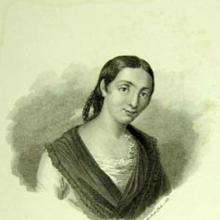
Giustina Renier Michiel was a Venetian noblewoman, linguist, translator, and salon-holder. Known for her intellect, charm, and commitment to Venetian heritage, she hosted one of the city’s most vibrant salons and translated major Shakespearean works into Italian.
Background
Giustina was born on October 15, 1755, in Venice to Andrea Renier—later Doge and son of Paolo Renier, the penultimate Doge of Venice—and Cecilia Manin, sister of Ludovico Manin, the last Doge. Her noble lineage placed her at the heart of the Venetian Republic’s final chapter. At the age of twenty, she married Marco Antonio Michiel, a diplomat from another patrician family. Shortly afterward, they moved to Rome, where her husband served as ambassador of the Serenissima to Pope Pius VI. This period broadened her intellectual horizons and introduced her to the world of diplomacy and cosmopolitan culture.
Education
At the age of three, Giustina was sent to a convent of Capuchin nuns in Treviso, where she received early instruction in music, drawing, mathematics, and natural history. She also learned French and English. At nine, she returned to Venice and continued her studies at a prestigious boarding school managed by a Frenchwoman. There, she gained a reputation for her curiosity, love of books, and independent thinking—traits that would define her intellectual life.
Career
Renier-Michiel played a vital role in preserving and stimulating Venetian cultural life during a time of political decline and foreign occupation. She became a central figure in literary and intellectual circles through her celebrated salon, held in her Venetian palazzo. Known for its elegance and vibrant discussions, her salon was frequented by prominent figures such as Ippolito Pindemonte, Marina Querini Benzon, Ugo Foscolo, Madame de Staël, Giustiniana Wynne (Countess Rosenberg), and Lord Byron.
Renier-Michiel was admired not only for her intelligence and beauty but also for her social skill in connecting writers, artists, diplomats, and thinkers. Her gatherings often extended into the early hours, with guests arriving after theater performances to reflect on what they had seen or to engage in society games. According to writer Vittorio Malamani, her salon was both intellectually stimulating and socially delightful, providing a rare cultural space in post-republican Venice.
When Napoleon invaded and dissolved the Venetian Republic, she temporarily closed her salon and turned inward, dedicating herself to scholarly work. Over the next decade, she studied botany and focused on translating Shakespeare’s plays. Her Italian translations of Othello and Macbeth were published in 1798, followed by Coriolanus in 1800. These works contributed significantly to the reception of English literature in Italy.
In 1817, she published her most notable work, Origine delle feste veneziane (The Origins of Venetian Festivals), a six-volume exploration of Venetian traditions, customs, and legends. Originally presented as a bilingual Italian-French essay in 1810, the expanded version was published between 1817 and 1827. She described it as a “historical novel,” blending storytelling with documentary precision in an effort to preserve the city’s disappearing cultural identity.
Renier-Michiel also engaged in public literary debate. In 1807, she responded to François-René de Chateaubriand’s negative portrayal of Venice with a rebuttal in the Giornale dei letterati di Pisa. Her other writings include an appreciative analysis of Ultime lettere di Jacopo Ortis by Ugo Foscolo, further demonstrating her literary insight and admiration for contemporary Italian authors. She maintained correspondence with cultural figures such as Antonio Canova and Chateaubriand, reinforcing her position at the intersection of art, politics, and literature.
In her later years, even as she grew deaf and required an ear trumpet, she continued to receive guests and lead her salon with the same grace and wit that had made her an icon of Venetian society. Her presence was so influential that even her rival, the celebrated Isabella Teotochi Albrizzi, acknowledged her charm and brilliance in published descriptions.