

Background
Matloff, Gregory Lee was born on March 2, 1945 in New York City. Son of Simon and Eudice (Strom) Matloff.

http://www.amazon.com/gp/product/B009CL0VVQ/?tag=2022091-20

(This is a book of astronomy activities for kids ages 10-1...)
This is a book of astronomy activities for kids ages 10-14, offering both kids who have telescopes and science teachers simple projects that can be done with telescopes.
http://www.amazon.com/gp/product/B00FFBPH84/?tag=2022091-20

http://www.amazon.com/gp/product/B0024OBKRC/?tag=2022091-20

(There is currently tremendous interest in the search for ...)
There is currently tremendous interest in the search for extrasolar life and extraterrestrial intelligence, and this is expressed by financial backing from NASA for extrasolar exploration by space probes.This book will be an authoritative and comprehensive survey of the present-day state of the art in the field of extrasolar and interstellar space exploration, focusing on the most promising techniques.
http://www.amazon.com/gp/product/185233200X/?tag=2022091-20

http://www.amazon.com/gp/product/B010WEQING/?tag=2022091-20

http://www.amazon.com/gp/product/B010BDUGWM/?tag=2022091-20

(1)
1
http://www.amazon.com/gp/product/B010718990/?tag=2022091-20

(A complete guide for the amateur astronomer living in an ...)
A complete guide for the amateur astronomer living in an urban or suburban center. The Urban Astronomer If you think a trip to the country is necessary to observe celestial objects, take a second look. Viewing the sky from an urban location can be just as fun and educational -- if you know how to go about it. The Urban Astronomer shows amateur and more advanced astronomers the best ways and times to observe celestial objects from a city or suburban environment. Complete with detailed illustrations, The Urban Astronomer: Shows readers how to overcome the special problems of viewing the sky from cities and suburbs, such as light pollution Describes in detail those objects most easily viewed from a city location Includes many sky activities that can be enjoyed by novice and experienced urban astronomers Provides helpful tips and checklists for preparing your own stargazing outing Covers objects for naked-eye observation as well as those that need binoculars or telescopes and describes the best equipment for the urban stargazer
http://www.amazon.com/gp/product/0471531421/?tag=2022091-20

(Discover the power of your telescope as you explore the v...)
Discover the power of your telescope as you explore the vast reaches of the universe Want to explore Mars? Observe Jupiter's cloud bands? Visit a galaxy that's almost 2 million light years away? With More Telescope Power, you can do all of that and more! Under the guidance of experienced astronomer Gregory Matloff, you'll uncover the full potential of your telescope as you take a fascinating tour of the universe. Along the way you'll learn plenty of new observation techniques, including: using various eyepieces and filters; tracking satellites; observing comets and meteors; using sunspots to determine solar rotation; and much, much more. Filled with dozens of all-new stargazing projects and observing activities, this detailed guide also contains plenty of helpful illustrations such as finder charts, lunar and solar eclipse tables, diagrams, and photos. Whether you're a science teacher searching for simple telescope projects, an amateur astronomer just learning to use your new telescope, or a science student with a yen for the stars, you'll find everything you're looking for in More Telescope Power.
http://www.amazon.com/gp/product/0471409855/?tag=2022091-20
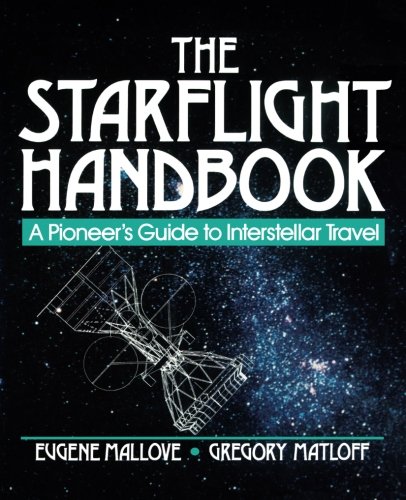
(The Starflight Handbook A Pioneer's Guide to Interstellar...)
The Starflight Handbook A Pioneer's Guide to Interstellar Travel "The Starflight Handbook is an indispensable compendium of the many and varied methods for traversing the vast interstellar gulf--don't leave the Solar System without it!" --Robert Forward "Very sensible, very complete and useful. Its good use of references and technical 'sidebars' adds to the book and allows the nontechnical text to be used by ordinary readers in an easy fashion. I certainly would recommend this book to anyone doing any thinking at all about interstellar flight or the notion of possibilities of contacts between hypothetical civilizations in different stat systems." --Louis Friedman Executive Director, The Planetary Society The Starflight Handbook is the first and only compendium on planet Earth of the radical new technologies now on the drawing boards of some of our smartest and most imaginative space scientists and engineers. Scientists and engineers as well as general readers will be captivated by its: In-depth discussions of everything from nuclear pulse propulsion engines to in-flight navigation, in flowing, non-technical language Sidebars and appendices cover technical and mathematical concepts in detail Seventy-five elegant and enlightening illustrations depicting starships and their hardware
http://www.amazon.com/gp/product/0471619124/?tag=2022091-20

( The Space Age is nearly 50 years old but exploration of...)
The Space Age is nearly 50 years old but exploration of the outer planets and beyond has only just begun. Deep-Space Probes Second Edition draws on the latest research to explain why we should explore beyond the edge of the Solar System and how we can build highly sophisticated robot spacecraft to make the journey. Many technical problems remain to be solved, among them propulsion systems to permit far higher velocities, and technologies to build vehicles a fraction of the size of today’s spacecraft. Beyond the range of effective radio control, robot vehicles for exploring deep space will need to be intelligent, ‘thinking’ craft – able to make vital decisions entirely on their own. Gregory Matloff also looks at the possibility for human travel into interstellar space, and some of the immense problems that such journeys would entail. This second edition includes an entirely new chapter on holographic message plaques for future interstellar probes – a NASA-funded project.
http://www.amazon.com/gp/product/3642063926/?tag=2022091-20

( The Space Age is nearly 50 years old but exploration of...)
The Space Age is nearly 50 years old but exploration of the outer planets and beyond has only just begun. Deep-Space Probes Second Edition draws on the latest research to explain why we should explore beyond the edge of the Solar System and how we can build highly sophisticated robot spacecraft to make the journey. Many technical problems remain to be solved, among them propulsion systems to permit far higher velocities, and technologies to build vehicles a fraction of the size of today’s spacecraft. Beyond the range of effective radio control, robot vehicles for exploring deep space will need to be intelligent, ‘thinking’ craft – able to make vital decisions entirely on their own. Gregory Matloff also looks at the possibility for human travel into interstellar space, and some of the immense problems that such journeys would entail. This second edition includes an entirely new chapter on holographic message plaques for future interstellar probes – a NASA-funded project.
http://www.amazon.com/gp/product/3540247726/?tag=2022091-20

(Learn to unleash the awesome power of your telescope and ...)
Learn to unleash the awesome power of your telescope and take a fascinating tour of the Universe Astronomer Gregory Matloff introduces you to all the fun and excitement of astronomy by helping you to discover the full potential of any telescope. Packed with dozens of fun and easy stargazing projects and activities. Telescope Power doesn't just tell you about all the beauty and mystery of the stars but lets you see it all for yourself! You begin your tour of the Universe by setting your sights on nearby neighbors in our Solar System. You'll hunt for blue lunar flashes, spot lunar landing sites, and use color filters to observe the changing seasons on Mars and the spectacular rings of Saturn. From there, it's off to more distant stars. You'll learn how to read a star atlas and identify the various constellations: locate binary stars Mizar and Alcor; use a finder chart to observe the beautiful Globular Cluster M-13 and the Ring Nebula Lyra: visit the Great Spiral Galaxy in Andromeda twin sister to our own Milky Way Galaxy; and a lot more. You'll also learn about the different types of telescopes and how they work; how to set up your telescope; the "care and feeding" of telescopes; the best accessories to try, including different eyepieces, filters, clock drives, and star wheels; and how to share your experiences with other young astronomers.
http://www.amazon.com/gp/product/0471580392/?tag=2022091-20
(SPACE EXPLORATION, STAR SHIPS, HARDWARE, MATH CONCEPTS, N...)
SPACE EXPLORATION, STAR SHIPS, HARDWARE, MATH CONCEPTS, NUCLEAR PULSE PROPULSION ENGINES
http://www.amazon.com/gp/product/B002JHR0D2/?tag=2022091-20

( What was our planet like before the advent of our moder...)
What was our planet like before the advent of our modern civilization? What effects has our civilization had on the planet and its ecological systems? Paradise Regained discusses these questions and then creates a scenario for the re-greening of Earth. The authors introduce new and innovative ideas on how humankind might use the resources of the solar system for terrestrial benefit. Earth would then become a place for a technologically advanced human civilization to live in synchronization, if not in harmony, with the environment which gave us birth. Since the formation of our solar system, the resources and ecological state of Earth have undergone many changes. The environmental challenges facing humanity today, as the authors posit them, will not be resolved simply by conservation and Earth-based alternative technologies. Paradise Regained considers the environmental dilemma and highlights the risk of humankind's future extinction from environmental degradation. Human population growth, climate change, and the strained sustainability of the few remaining habitats for wild life are all discussed. The authors, however, are not discouraged and offer a potential solution through the development of space. Not only will extraterrestrial resources help avert environmental disaster, but will also provide the basis for continued technological and societal progress. The resources of the solar system will help meet our projected industrial needs and feed our industry once terrestrial sources are depleted. Space-based power generation systems will work synergistically with Earth-based conservation. Paradise Regained concludes with the discussion on how closed ecological systems in space will help us to build a prosperous and sustainable future for all humanity.
http://www.amazon.com/gp/product/0387799850/?tag=2022091-20
Environmental space and computer scientist
Matloff, Gregory Lee was born on March 2, 1945 in New York City. Son of Simon and Eudice (Strom) Matloff.
Research engineer United Aircraft Research Company, East Hartford, Connecticut, 1969-1970. Research associate Wesleyan University, Middletown, Connecticut,1970-1971. Assistant editor American Institute Physics, New York City, 1971-1972.
Research assistant New York University, 1972-1975, postdoctoral research scientist, 1975-1977.
Consultant staffscientist Systems and Applied Science Corporation, Riverdale, Maryland., 1978-1981. Consultant environmental scientist, Brooklyn, 1980.
Member of faculty Pratt Institute, 1980-1982, administrator, 1983-1985. Member of faculty New York City Technology College, 1979, Baruch College City University of New York, 1986-1989, Saint Hilda"s and Saint Hugh"s School, 1988-1990, City University of New York, 1993, New York University, 1993.
Engineer Kollsman Institute Corporation, Emhurst, New York, 1965-1967, Grumman Aerospace Company, Bethpage, 1967-1969. Research engineer United Aircraft Research Company, East Hartford, Connecticut, 1969-1970. Research associate Wesleyan University, Middletown, 1970-1971.
Assistant editor American Institute Physics, New York City, 1971-1972. From research assistant to research scientist New York University, 1972-1977. Consultant staff scientist Systems and Applied Science Corporation, Riverdale, Maryland, 1978-1981.
Consultant environmental scientist Brooklyn, 1980—1990. Consultant National Aeronautics and Space Administration, 1999—2007. Faculty Pratt Institute, 1980-1982, administrator, 1983-1985.
Faculty New York City Technology College, since 1979, Baruch College City University of New York, 1986-1989, St. Hilda's and St. Hugh's School, 1988-1990, New York University, 1993—2000.
(Discover the power of your telescope as you explore the v...)
(The Starflight Handbook A Pioneer's Guide to Interstellar...)
( What was our planet like before the advent of our moder...)
(Learn to unleash the awesome power of your telescope and ...)
(There is currently tremendous interest in the search for ...)
(This is a book of astronomy activities for kids ages 10-1...)
( The Space Age is nearly 50 years old but exploration of...)
( The Space Age is nearly 50 years old but exploration of...)
(SPACE EXPLORATION, STAR SHIPS, HARDWARE, MATH CONCEPTS, N...)
(A complete guide for the amateur astronomer living in an ...)
(1)
Director astronomy program New York City Department Parks and Recreation, 1987-1991. Fellow British Interplanetary Society. Member American Association for the Advancement of Science, American Meteorological Society, American Optical Society, International Academy Astronautics, New York Academy of Sciences, Planetary Society, K.M., Sigma Xi.
Married Constance Bangs, 1986.man Institute.
