

Education
Haig Bosmajian received a Doctor of Philosophy in 1960 from Stanford University.

(...a vital resource....)
...a vital resource....
http://www.amazon.com/gp/product/0918212545/?tag=2022091-20

http://www.amazon.com/gp/product/B01N2ZIUIN/?tag=2022091-20

http://www.amazon.com/gp/product/B01K3O3FG8/?tag=2022091-20

http://www.amazon.com/gp/product/B000O914D4/?tag=2022091-20

http://www.amazon.com/gp/product/B01MY3UO19/?tag=2022091-20

http://www.amazon.com/gp/product/B00GUEHL9I/?tag=2022091-20

http://www.amazon.com/gp/product/039504216X/?tag=2022091-20
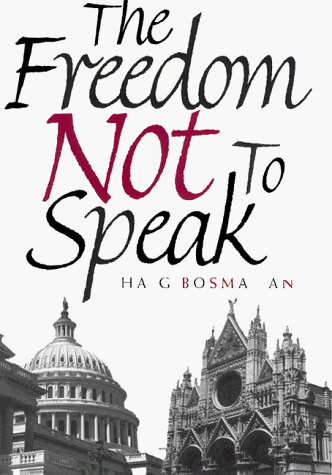
( Hotly contested and vigorously defended since it was fi...)
Hotly contested and vigorously defended since it was first written into the Bill of Rights, freedom of speech is a basic right that all Americans hold dear. But what of the freedom not to speak? Should, for instance, a special prosecutor be able to compel a mother to testify about, and incriminate, her own daughter? The freedom not to speak is an implicit "right" that holds great relevance for all of us-the freedom not to speak when commanded by church and state, not to sign an oath, not to salute a flag, not to assert a belief in God, or not to reveal one's political beliefs and associations. Bosmajian traces the history of the freedom not to speak from the Middle Ages and Inquisition to the twentieth century and the House Committee on Un-American Activities. His history addresses the Civil War and Reconstruction loyalty oaths by Union Confederate soldiers, and the expulsion of Jehovah's Witnesses from schools for refusing to salute the flag, and includes an analysis of coerced speech in a variety of literary works. Bosmajian also contemplates the future of this right to silence and argues for the importance of a specifically labeled and firmly established freedom not to speak.
http://www.amazon.com/gp/product/0814712975/?tag=2022091-20

(For over 2000 years, book burners have laid their torches...)
For over 2000 years, book burners have laid their torches to millions of books condemned as heretical, blasphemous, immoral, obscene, subversive or seditious. Books have been reduced to ashes in church yards, college yards, school furnaces, public squares and city streets. The goals of the book burners have been to extirpate history, to intimidate and stamp out opposition, to create solidarity, and to cleanse society of controversial ideas. Too often, book burning foreshadows violence against those who originated or shared the ideas. This work provides a detailed account of book burning worldwide over the past 2000 years. (Book burning is meant literally, not as a figurative reference to book banning.) The book burners are identified, along with the works they deliberately set aflame. An important aspect of this study is its examination of the metaphoric language that "justified" the destruction; books being burned were “tares,” “pestilence,” “plagues,” “cancers,” and “poison.” Such language is a central part to the control the burners hope to exercise over those who might otherwise read the books and become part of the exchange of ideas. Also considered is the primeval pull of the book burning ritual, which in its simplicity leads to the destruction of ideas and the uniformity of thought most often associated with totalitarian regimes.
http://www.amazon.com/gp/product/0786422084/?tag=2022091-20

(Examines decadence in our language, especially that langu...)
Examines decadence in our language, especially that language which leads to dehumanization and degradation of human beings. Powerful illustrations may be found in the fact that, for instance, Hitler's "Final Solution" appeared "reasonable" once the Jews were successfully labelled by the Nazis as sub-humans, "parasites," "vermin," or "bacilli." So, too, the subjugation of the American Indian was "defensible" since they were defined as "barbarians" and "savages." The author of this engrossing text that was originally published in 1974 by Public Affairs Press successfully identifies and critically comments on the racist, sexist, and ethnic slurs still predominant in society today, with the hope that this decadence will be cured. Winner of the 1983 George Orwell Award from the Committee on Doublespeak of the N.C.T.E.
http://www.amazon.com/gp/product/0819131865/?tag=2022091-20
( To the public, judges handing down judicial decisions p...)
To the public, judges handing down judicial decisions present arguments arrived through rational discourse and literal language. Yet, as Judge Richard Posner has pointed out, "Rhetorical power counts for a lot in law. Science, not to mention everyday thought, is influenced by metaphors. Why shouldn’t law be?" Haig Bosmajian examines the crucial role of the tropemetaphors, personifications, metonymiesin argumentation and reveals the surprisingly important place that figurative, nonliteral language holds in judicial decision making. Focusing on the specific genre of the legal opinion, Professor Bosmajian discusses the question of why we have judicial opinions at all and the importance of style in them. He then looks at specific well-known figures of speech such as "the wall of separation" between church and state, justice personified as a female, or the Constitution as "colorblind," explaining why they are not straightforward statements of legal fact but examples of the ways tropes are used in legal language. A useful example can be found in Judge Learned Hand’s response to a 1943 case involving news gathering and monopoly. Hand found the need to protect the public’s right to the "dissemination of news from as many different sources, and with as many different facets and colors possible," an interest "closely akin to, if indeed it is not the same as, the interest protected by the First Amendment; it presupposes that right conclusions are more likely to be gathered out of a multitude of tongues, than through any kind of authoritative selection. To many this is, and always will be folly; but we have staken upon it our all."
http://www.amazon.com/gp/product/0809316129/?tag=2022091-20

(Book by Bosmajian, Haig A.)
Book by Bosmajian, Haig A.
http://www.amazon.com/gp/product/0819129623/?tag=2022091-20

http://www.amazon.com/gp/product/B01FEPQWQG/?tag=2022091-20
Haig Bosmajian received a Doctor of Philosophy in 1960 from Stanford University.
His work has explored rhetoric and the freedom of speech. Bosmajian was professor emeritus at the University of Washington, in the Speech/Communications Department, where he taught since 1965. Haig and Hamida Bosmajian wrote the textbook, The Rhetoric of the Civil Rights Movement (1969), which has been published as a student textbook to analyze strategies of rhetoric.
( This book examines the rhetorical strategies of dissent...)
(For over 2000 years, book burners have laid their torches...)
( Hotly contested and vigorously defended since it was fi...)
( To the public, judges handing down judicial decisions p...)
(Examines decadence in our language, especially that langu...)
(Book by Bosmajian, Haig A.)
(...a vital resource....)
