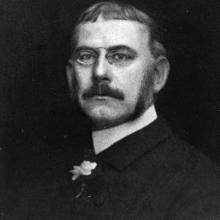
Harry Thurston Peck was an American editor, critic, educator, and author. Though he published more than a dozen books, he is best remembered for his periodical publications and his accomplishments as an editor, most notably of Harper's Dictionary of Classical Literature.
Background
Harry Thurston Peck was born on November 24, 1856, in Stamford, Fairfield County, Connecticut, United States. He was of English colonial stock. Harry was the son of Harry and Harriet Elizabeth (Thurston) Peck.
From his father, a well-known schoolmaster, he acquired his skill as a teacher and the beginnings, at least, of his passion for literature and learning. Excessive reading by candlelight, while he was still a mere boy, did irreparable damage to his eyes and, by preventing his participation in games and athletics, intensified his bookishness.
Education
Harry Thurston Peck attended private schools and Columbia College, graduating in 1881. As a student at Columbia College, he won local renown for intellectual brilliance and wrote prose and verse remarkable for their maturity and polish. After his graduation in 1881, Harry Thurston Peck studied classical philology in Paris, Berlin, and Rome. He went in 1883, for some obscure reason, to Cumberland University, Lebanon, Tennessee, to obtain the degree of Doctor of Philosophy, and in 1884 received the degree of Doctor of Humane Letters in a course at Columbia University.
Harry Thurston Peck was in the service of the Columbia University for twenty-six years: as a tutor in Latin from 1882 to 1886, and in Latin and Semitic languages from 1886 to 1888, as professor of the Latin language and literature from 1888 to 1904, and as Anthon Professor of the Latin language and literature from 1904 to 1910. He was one of the most prominent and useful officers of Columbia during the period of its transformation from a small college into a university of world-wide reputation.
Among his philological publications were a students' edition of "Suetonius' De Vita Caesarum Libri Duo" (1889), "Latin Pronunciation" (1890), a translation of "Trimalchio's Dinner" (1898) from the Satyricon of Petronius Arbiter, and a textbook, "A History of Classical Philology" (1911). He was the editor, also, of "Harper's Dictionary of Classical Literature and Antiquities" (1897), which is still the most compendious handbook of its class in English. None of these productions gives any adequate indication of Peck's real powers. For many years he looked forward to the time when he would have the leisure to write a history of Latin literature and edit a major edition of Juvenal, undertakings for which he was admirably and in some ways uniquely equipped, but fate cheated him of his masterpieces.
Harry Thurston Peck began his long connection with the publishing house of Dodd, Mead & Company by editing their "International Encyclopedia" (1892). He and Daniel Coit Gilman served jointly as editors of the "New International Encyclopedia" (1900-1903), but Frank Moore Colby was chosen as managing editor. Peck also edited several compilations and reference books; contributed articles to various magazines. He was also literary editor of the New York Commercial Advertiser, 1897-1901; and was on the staff of Munsey's Magazine, 1907-1911. His best vehicle, however, was the Bookman, a literary monthly launched by Dodd, Mead & Company in February 1895, of which Peck was editor-in-chief until 1902 and a contributing editor until 1907. For some issues, he wrote a good part of the contents himself, and his taste, knowledge, and lightness of touch set the tone of the whole magazine.
His separate publications included: "The Personal Equation" (1897), "What Is Good English? and Other Essays" (1899), "Greystone and Porphyry" (1899), a volume of verse, displaying excellent technique but little original poetic insight, "William Hickling Prescott" (1905), a contribution to the "English Men of Letters Series; Literature" (1908), an academic lecture and a characteristic example of his more florid manner; "Studies in Several Literatures" (1909), and "The New Baedeker" (1910), an amusing volume of travel sketches.
Harry Thurston Peck also wrote two charming volumes for children, "The Adventures of Mabel" (1896) and "Hilda and the Wishes" (1907). "His Twenty Years of the Republic" (1906), a vivid, pungent history of the United States during the administrations of Cleveland, Harrison, and McKinley, has only recently been displaced as the best summary account of the period. It was an extraordinary feat of literary virtuosity and has become a minor classic. It was characteristic of Peck that he should write his best work in a field so far removed from his professional concerns.
By 1905 or 1906 Harry Thurston Peck began to show signs of mental deterioration and aberration. In the summer of 1910, the foundations of his security crumbled under him, overwhelming him with disgrace, poverty, and illness. In June of that year Esther Quinn, a former stenographer, brought suit against him for breach of promise, and several sensational newspapers printed as a serial the letters that he had written to the woman. It was his innocence rather than culpability that ruined him. At worst the letters showed that he was an inexpert philanderer, but the obloquy and ridicule excited by their publication brought on a mental collapse. He was dismissed from his professorship and expelled from his clubs, his wife left him, his friends deserted him almost in a body, and magazines refused to print his articles.
In January 1913 Harry Thurston Peck declared himself bankrupt. A few months later he was in a hospital at Ithaca, New York, desperately ill in body and mind. His first wife, at this juncture, came to his rescue, took him to her home at Stamford, and nursed him back to a semblance of his former health and spirits. It was only a semblance, however. Her efforts to convert him to Christian Science irked him, and finally, with money that she supplied, he rented a cheap room in a lodging house, ate his meals, gourmet that he had been, in a Greek restaurant, and endeavored to earn his living by revising articles for a new edition of the encyclopedia that he had once edited.
Achievements
Harry Thurston Peck was widely known as an outstanding teacher and scholar of encyclopedic learning. He pursued two careers simultaneously, as professor of Latin and as an editor, author of poems, essays, biography, literary criticism, political history, even children's books.
As an editor, Harry Thurston Peck made Acta Columbiana the most famous undergraduate periodical in the United States. Peck's contributions to "Bookman," which he edited from 1895 to 1907, earned him the most recognition. Peck also has been listed as a notable editor, author by Marquis Who's Who.
In professional knowledge, though not in minute accuracy, Harry Thurston Peck was the equal of such Columbia Latinists as Anthon, Drisler, and Short, and he was their superior as a teacher. Like them, he insisted that his pupils master their grammar and translate their text into exact, effective English, but he never forgot the purpose behind the discipline. He was saturated with the very spirit of Latin literature, and he brought his whole mind with him to the classroom. In his hands, the great Roman classics became an introduction to the literature, ideas, and manners of the western world. To graduate students he offered courses, also, in Latin metrics, the history of the language, and the literature of the Silver Age. His feeling for the nuances of Latin style was precise and delicate, the product of innate aptitude reinforced by the close study.
Peck's "Bookman's Letter-Box" was famous, for he answered his readers' questions both authoritatively and wittily. His criticism for the most part was shrewd and good-tempered, impressionistic in method, but founded on a keen appreciation of literary technique and receptiveness to ideas. He was relatively free from provincialism and colonialism that still dominated American criticism. His actual influence on the culture of the period cannot be estimated; but whatever its extent, it was wholly beneficial.
Personality
In any society, Harry Thurston Peck would have been a man of distinction. A brilliant, versatile, and independent intellect. He learned encyclopedic in its range and detail. Peck had an astoundingly capacious memory and instant power of association and recall. Harry Thurston Peck had a ready command of a clear, sparkling prose style, and a faculty for gracious, witty conversation - all these gifts were his, and, though seldom guilty of overt showmanship, he took great delight in their exercise.
Despite his many activities and incessant reading, Harry Thurston Peck had time to travel extensively and to lead a gracious social life. He bestowed great pains on his more promising pupils, cultivating their personal friendship. Harry Thurston Peck wrote sprightly letters to his distant friends and was an inveterate theatre-goer. His taste in waistcoats and cravats ran to the colorful. his friends attributed Peck's choice of wearing apparel to his defective eyesight.
Interests
Traveling
Connections
On April 26, 1882, Harry married Cornelia M. Dawbarn, of Stamford. They had two daughters. In September 1908 his wife obtained a divorce from him in South Dakota, and on August 26, 1909, Peck married Elizabeth Hickman Du Bois, of Philadelphia, a teacher in a New York high school. His second wife left him.