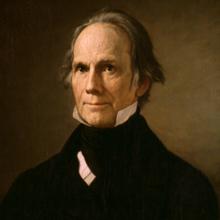
Henry Clay was an American political leader who served in Congress and as Secretary of State under President John Quincy Adams. He came to national prominence as leader of the "War Hawks" who drove the country into the War of 1812. For the next 40 years he worked for international peace and sought to reconcile warring factions in the nation.
Background
Henry Clay was born on April 12, 1777 in Hanover County, Virginia, the seventh of nine children of the Reverend John Clay and Elizabeth Hudson Clay. Henry's father died in 1781, the year British and loyalist soldiers raided the area and looted the Clay home. Ten years later his mother remarried and his stepfather moved the family to Richmond.
Education
Henry had little regular education, but he read in Wythe's library and learned to make the most of scanty information.
Career
Clay worked as a store clerk in Richmond and then, from 1793 to 1797, as secretary to George Wythe, Chancellor of the High Court of Chancery. In November 1797 he moved to Lexington, Kentucky, and made a reputation as a lawyer. In 1803 he was elected to the Kentucky Legislature. In 1806 and again in 1810 Clay was sent to the U. S. Senate to fill out short terms. In 1811 he was elected to the House of Representatives. He was immediately chosen Speaker and was elected six times to that office, making it a position of party leadership.
By 1811 Clay was fanning the war spirit and the aggressive expansionism of the young republic. He said that the "militia of Kentucky are alone competent" to conquer Montreal and Upper Canada, and he organized the war faction in the House of Representatives. He was one of five men selected to meet British representatives in Ghent in 1814; there the failure of American arms forced them to a treaty in which no single objective of the war was obtained.
In the House again from 1815 to 1825 (except for the term of 1821-1823, when he declined to be a candidate), Clay developed his "American System, " a program designed to unite the propertied, commercial, and manufacturing interests of the East with the agricultural and entrepreneurial interests in the West. It would establish protection for American industries against foreign competition, Federal financing of such internal improvements as highways and canals, and the rechartering of the United States Bank to provide centralized financial control. Clay succeeded for a time in part of his program: the Bank was rechartered and protective tariffs were enacted, reaching a climax in 1828 with the "Tariff of Abominations. " But the internal improvements were not carried out in his lifetime, and long before Clay's death the Bank and the protective tariff had fallen at the hands of the Democrats.
In 1816 Clay was one of the founders of the American Colonization Society, which promoted sending freed slaves to Africa. The racism which he shared with most Americans was an important motivation in the society. Missouri's application for statehood in 1819 raised the issue of slavery and shocked the nation "like a firebell in the night. " In the Missouri debate Clay did not devise the basic compromise – that is, that Missouri be a slave state but that slavery henceforth be prohibited in territory north of 36°30'. But he resolved the second crisis caused by the Missouri constitutional provision that free Negroes could not enter the state; Clay got assurance from the Missouri Legislature that it would pass no law abridging the privileges and immunities of United States citizens.
The role which Clay played in the debate was, in fact, as spokesman for the interests of the slave South. In the controversy over the activities of the abolitionists in the 1830s he defended the right of petition but secured the passage of resolutions in the Senate censuring the abolitionists and asserting that Congress had no power to interfere with the interstate slave trade.
Clay was a candidate for the presidency in 1824, but three others received more votes, so that his name did not go to the House for election. He defied Kentucky's instruction to cast the state's votes for Jackson, saying he could not support a "military chieftain"; instead, his support elected John Quincy Adams. When Clay subsequently became Secretary of State, the traditional steppingstone to the presidency, the cry of "corrupt bargain" was raised. The charge was unwarranted – he had merely supported the man whose views were closest to his own – but the charge lingered for the rest of his life.
Foreign affairs were not particularly important from 1825 to 1829, and most of Clay's diplomatic efforts did not succeed. The United States failed in efforts to purchase Texas from Mexico, nor was progress made toward acquiring Cuba. The State Department was unsuccessful in settling the Maine-Canadian boundary dispute, in securing trade with the British West Indies, and in getting payment from France for losses suffered by Americans during the Napoleonic Wars. Clay had taken a strong position in support of recent Latin American independence movements against Spain, and he tried unsuccessfully to promote active American participation in the Congress of Panama in 1826.
The Adams administration was defeated overwhelmingly in 1828; Clay's own state voted for Andrew Jackson. Adams offered to appoint Clay to the Supreme Court, but he declined and returned to Kentucky. In 1831 he was elected to the Senate and remained in that office until 1842. During these years of Jacksonian democracy Clay fought a losing battle for his American System. In 1833 he devised the compromise on the tariff which brought the nullification threat from John C. Calhoun's South Carolina; his measure provided that duties be lowered gradually until none were higher than 20 percent by 1842. He favored higher duties but said he made the concession to get past the crisis and on to saner times.
Clay correctly estimated that Martin Van Buren was unbeatable in 1837, but he expected the Whig nomination in 1840 and was bitterly disappointed when the aging military hero William Henry Harrison won nomination and election. Clay then anticipated that he would be the actual leader of the administration, but Harrison resisted him for the short time that he lived and Harrison's successor, John Tyler, proved to be opposed in principle to Clay's Whig program. Clay resigned from the Senate in disgust.
Clay was the Whig presidential candidate in 1844, but his equivocation on the expansionist issue of the annexation of Texas cost him the election. He made an abortive effort for the 1848 nomination, which went to the Mexican War general Zachary Taylor. Clay had condemned the initiation of the war but supported it once it got under way.
The fruits of that war brought on another sectional crisis, with threats to dissolve the Union. Clay returned to the Senate in poor health and led in working out the Compromise of 1850. This series of measures admitted California as a free state, organized the new territories without reference to slavery, assumed the public debt of Texas while restricting its area, abolished the slave trade in the District of Columbia, and enacted a fugitive slave law which denied due process and equal protection of the laws to African Americans living in the North. Thus was the rupture of the Union delayed for a decade. Clay died in Washington on June 29, 1852.
Achievements
Henry Clay was noted for his American System (which integrated a national bank, the tariff, and internal improvements to promote economic stability and prosperity) and was a major promoter of the Missouri Compromise (1820) and the Compromise of 1850, both efforts to shield the American union from sectional discord over slavery.
Personality
Clay was tall and slim with an air of nonchalance, and he had a sensitive, expressive face, a warm spirit, much personal charm, and an excellent speaker's voice. Clay's life-style was that of the frontier South and West; he drank and gambled through the night for high stakes. He fought two duels, one in 1809 and the other in 1826.
Quotes from others about the person
John Quincy Adams:
"In politics, as in private life, Clay is essentially a gamester. "
Connections
In 1799 Clay married Lucretia Hart, the daughter of a wealthy Lexington businessman. They had 11 children.